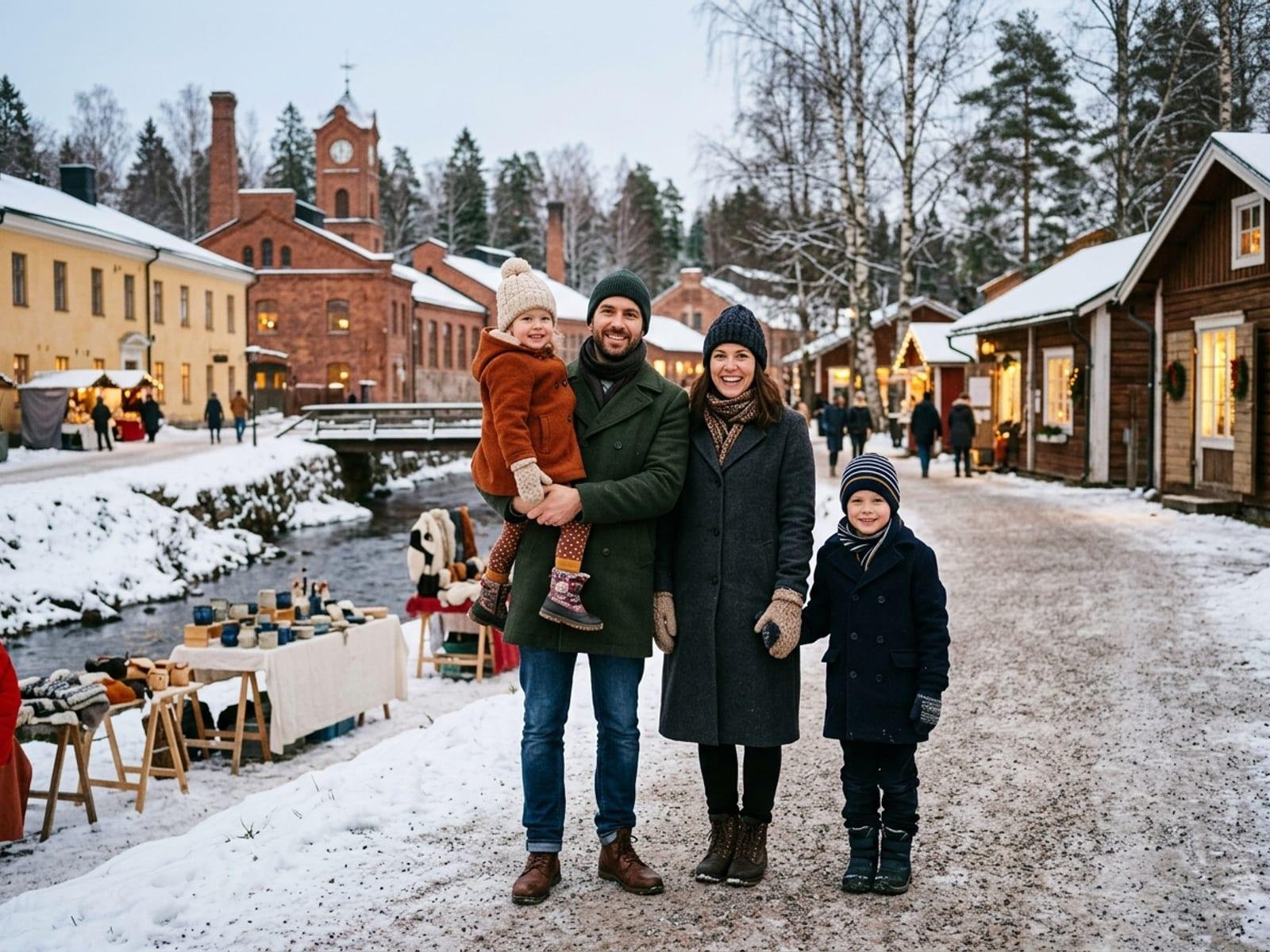
If you've ever used a pair of scissors with orange handles, you may already know the name. Fiskars is the village where the company behind those scissors began, about 100 kilometers west of Helsinki. In the old buildings of an ironworks founded in 1649, artisans and designers now run workshops and shops, more than 20 of them with their doors open to visitors. You walk the riverside paths, watch makers at work, and at the start of winter pick out handmade gifts at the Christmas market. It's a family trip to a village of people who make things by hand.
An ironworks founded with a queen's permission
Fiskars' story goes back to 1649. A Dutch merchant, Peter Thorwöste, received permission from Queen Christina of Sweden, which ruled Finland at the time, to set up a blast furnace and forge. He wasn't allowed to make cannons, so the works started out producing nails, wire, hoes and iron wheel rims.
Toward the end of the 18th century the works began handling copper from nearby Orijärvi, and the first blast furnace went cold in 1802. In 1822 Johan Jacob Julin bought the village and the ironworks, and under him Fiskars shifted from making iron to working it, producing tools, knives, scissors and table cutlery. In 1832 Finland's first cutlery factory opened here.
The famous orange-handled scissors arrived in 1967. Prototypes were made in several colors, and orange was reportedly chosen by an internal company vote. The company grew and eventually moved its headquarters to Espoo, but artisans, designers and artists settled in the village. The old factory buildings became workshops, galleries and shops, and the ironworks village turned into a village of crafts.
Look into the workshops and talk to the makers
The pleasure of Fiskars is wandering slowly between shops and workshops. According to the village's official website, more than 20 shops and workshops are open all year, with many more opening in summer. Walking the parks and nature areas is free, as is entry to most shops and workshops, and in the workshops you can watch makers at work. You'll find handmade goods, clothing, homeware, art, jewelry, local food and drink, books and more.
When you visit a workshop, pick your moment to speak to someone who's working. Don't interrupt while they're handling fire, blades or a kiln; wait until their hands are still, then ask if you can watch. Ask before touching any piece, too. Tell children at the start, "look first, and ask before you touch," and the makers will feel at ease welcoming you.
For the village's history, head to the Fiskars Museum. Its exhibitions show the daily lives of the people who lived at the ironworks, and from June 2026 an exhibition on life at Fiskars Ironworks is scheduled to run until the end of 2028.
Christmas in the village, from late November
As winter arrives, the village enters its "Christmas in the Village" season. In 2026 it runs from Saturday, November 21 to January 6, 2027. On the opening weekend, November 21 and 22, there's a Christmas market of local food and handicrafts (10 a.m. to 4 p.m.). Then on November 27–29 and December 3–5, a "Curated Market" with about 30 artists, designers and craftspeople is held in the Black Hall of the old Copper Smithy (11 a.m. to 6 p.m.).
There's nothing mass-produced at the market, which makes it ideal for choosing a present for someone in the family together with your child: a wooden bowl, a piece of pottery, something knitted. Dates change from year to year, so check the official website before you go.
A little earlier, from late October into early November (October 23 to November 1 in 2026), "Dark Weeks" celebrates the dark season with events themed around Kekri, an old Finnish autumn harvest festival. Kekri was once widely celebrated in Finland and Karelia, and one custom involved welcoming the spirits of the family's dead to a feast. The village is making a joint effort to bring back a festival that Christmas now tends to overshadow. In 2026, an event called "The Forest Between Us" also ran from September 12 to October 11. Something is on in almost every season, so if your travel dates are already set, look up what's happening then on the official website.
Coming at a different time of year has its rewards too. In summer you can swim at nearby Flacksjö beach, and the Fiskars Museum's exhibition "The Eternal Forest," about the forests around the village, runs from June to the end of 2026.
A day in the village with children
The village is small enough to walk around, and the parks and nature trails are always open. The roughly 2-kilometer Tree Trail takes you around the village past 25 kinds of trees; a cultural trail of about 2 kilometers follows the old factory sites upstream of the ironworks; and the roughly 4-kilometer Rissla forest trail leads to the old Rissla dam and a lean-to shelter. With small children, the Tree Trail is a good length. There's also a playground and a skate park.
Many of the buildings are old and not all are accessible, but the restaurants, cafes and some shops and exhibition spaces can be reached by wheelchair. There are accessible restrooms at the Market Square, the Craft Square and in every restaurant. Days are short in November and the paths can ice over, so bring non-slip shoes, gloves and hats.
To see what a photo of your family in knit hats in front of the old factory buildings and the river might look like, you can try pokesta's AI photos ($1 per photo, and your first one is free).
Getting there and where to stay
The gateway is Helsinki Airport (HEL). By car, Fiskars is about 74 minutes from Helsinki and about 86 minutes from Turku. By public transport, take a train or bus from Helsinki or Turku to Karis (Karjaa), then a taxi, a bike or a local bus to the village. Cycling from Karis station takes about 40 minutes. There are connections to make, so check the times for your return journey before you set off. Entry requirements for Finland depend on your nationality, so check your own government's official information.
You can visit as a day trip, but the village has a hotel with 24 rooms and a traditional inn with four, so staying a night on a Christmas market weekend lets you walk through the village after dark, when the windows glow. Combine it with Lux Helsinki at the turn of the year and the Runeberg torte in Porvoo in January, and you have a winter trip around southern Finland.
Even if you buy only one thing, having seen the workshop of the person who made it, you'll handle it a little more carefully at home. Fiskars is a place where children can learn that.
References