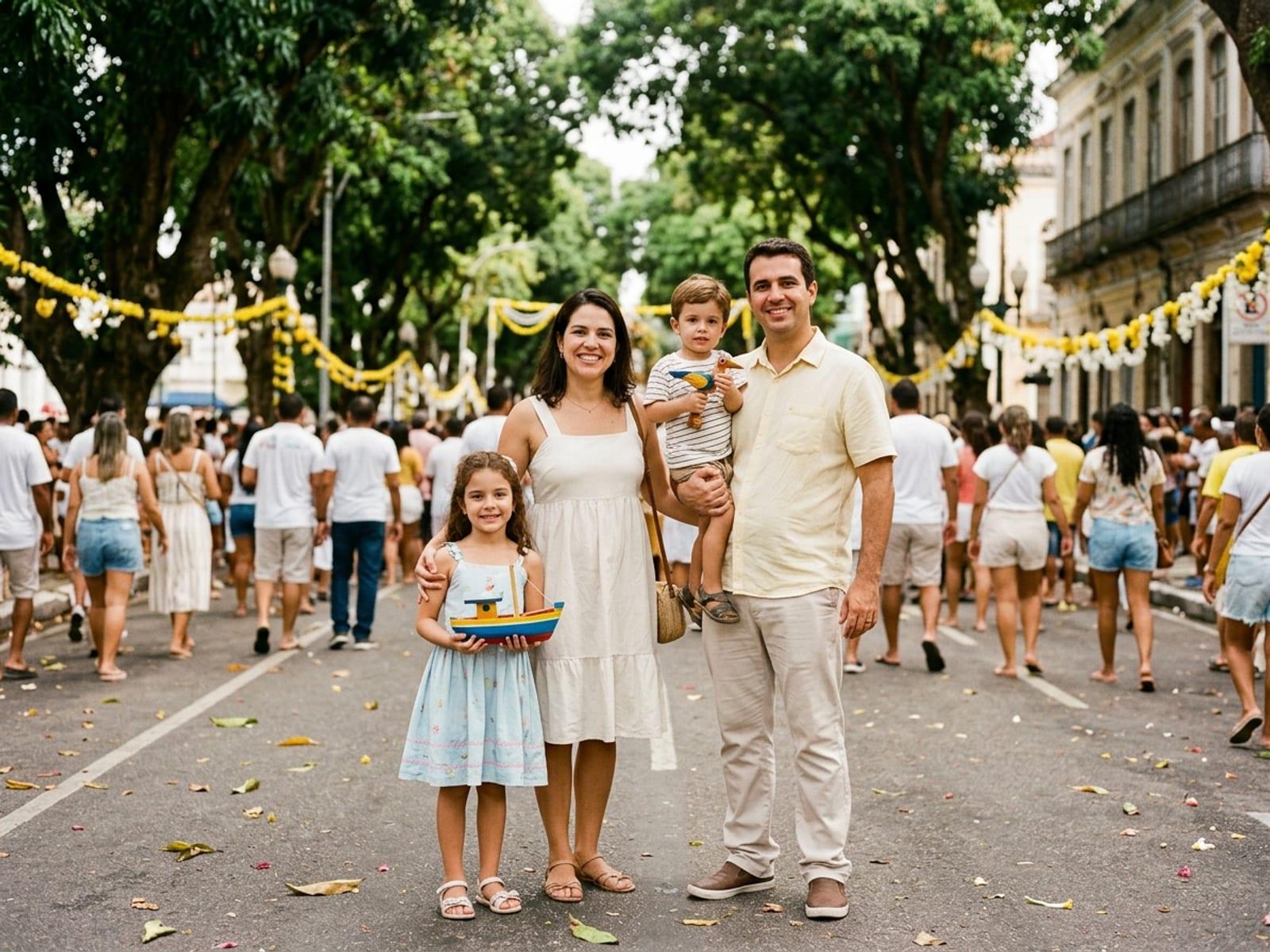
In Belém, the port city near the mouth of the Amazon, a float carrying a small wooden statue of the Virgin makes its way through the streets from the cathedral to the basilica every year on the second Sunday of October, a journey of about five hours. More than 2 million people turn out for this procession, the Círio de Nazaré (the Taper of Our Lady of Nazareth), which ranks among the largest religious events in the world. It is first of all a time of prayer for the faithful, so a family with children does best to stay clear of the crush around the rope tied to the statue's float, watch from a shady spot along the route, and wander the fair beside the basilica.
A small statue found around 1700
According to tradition, it began around 1700 when Plácido, a caboclo (a person of mixed Indigenous and European descent) living in Belém, found a small wooden statue of the Virgin on a riverbank. Each time he took it home it somehow returned to where he had found it, so a small chapel was built on the spot. That chapel eventually became today's large basilica, the Basilica Sanctuary of Our Lady of Nazareth.
Devotion to Our Lady of Nazareth was brought over by the Portuguese in colonial times, and she is also celebrated in September in the town of Nazaré in Portugal. Belém held its first procession in 1793. It has taken place every year for more than two centuries since, except in 2020 and 2021, when it was called off because of the Covid pandemic. In 2004 it was listed as intangible heritage by IPHAN, Brazil's National Institute of Historic and Artistic Heritage, and in 2013 it was inscribed on UNESCO's list of Intangible Cultural Heritage.
UNESCO describes preparatory events starting in August, with the festival carrying on for 15 days after the main procession. Small altars go up in homes and shops, and even in markets and government offices, and the whole city takes on the feeling of waiting to receive the Virgin. It is also a homecoming: family members who live far away come back at this time every year.
From Saturday night to Sunday afternoon
On Saturday night, the eve of the main day, there is the Trasladação, a procession that carries the statue from a school to the Cathedral of Belém (Catedral da Sé). In some years it draws even bigger crowds than the main event. Then on Sunday morning the berlinda, the flower-decked float bearing the statue, leaves the cathedral for Santuário Square in front of the basilica. In recent years the journey has taken four and a half to five hours.
Tied to the berlinda is a thick rope (corda) made of sisal, 400 meters long. People who have made a vow or are giving thanks for a prayer answered take hold of it and move along with the float. It is the most demanding part of the devotion, physically and emotionally. The crowd around the rope is so tight that people are pressed against each other, and it is not somewhere to go with children. If you are watching as a family, choose a spot along the route well away from the rope, ideally somewhere a little raised or in the shade of a tree.
The festival also includes the Romaria Fluvial, a river pilgrimage in which the statue crosses Guajará Bay by boat. It has been held since 1986: a boat leaves the port in the outlying district of Icoaraci, followed by a great flotilla. Children who love boats may enjoy this more than the procession on land.
The statue's mantle is made new every year, and the Virgin wears the one prepared for that year's Círio in the procession. If pushing into the crowds on the day feels like too much, visiting the basilica on a weekday before or after and simply seeing the statue in the quiet interior still gives you a real sense of the festival. The celebrations close with the Recírio, when the statue returns to its everyday place.
Miriti toys and the festival lunch
During the festival, the Nazaré fair is held near the basilica. Its best-known wares are miriti toys. The stalks of the Amazon's miriti (buriti) palm are light and soft like a sponge, earning them the nickname "natural Styrofoam." Carved and painted into little boats, birds, fish, snakes, houses and more, the toys are made by hundreds of families in Abaetetuba, a town near Belém, and much of the year's output goes on sale for the Círio. IPHAN has recognized this craft as intangible heritage too. The toys are so light that children can carry their own souvenir.
Sunday afternoon after the procession is a time for family and relatives to gather around a big meal. The classics are pato no tucupi, duck simmered in tucupi, a yellow broth extracted from bitter cassava root, with jambu, a herb that makes your mouth tingle and go slightly numb; and maniçoba, made from ground cassava leaves cooked for about a week to remove their toxins and combined with pork and other meats. Both dishes are found only in the Amazon, and more restaurants around town serve them at this time of year. October also falls in the açaí harvest, so it's a good moment to try Belém's açaí with fried fish at the Ver-o-Peso market.
What to wear and how to prepare
There is no dress code for the procession. Some families dress their children as angels and join the procession in thanks for a prayer answered. That is a devotional practice, so visiting families will be fine in cool, comfortable clothes: cotton shirts or dresses with a hat and sneakers.
Belém is close to the equator, and October days are hot and humid. The procession moves through the morning and into the early afternoon, when the sun is strongest, so always bring water, hats and sunscreen. The crowds are enormous and pickpocketing and bag theft are a concern, so carry as few valuables as you can. Give children a wristband with a parent's phone number and agree on a meeting point in case you get separated. If you'd like to see what a family photo in white in front of the basilica might look like, you can try it ahead of time with pokesta's AI photos ($1 per photo).
When to go and how to get there
The procession is held every year on the second Sunday of October: October 11 in 2026 and October 10 in 2027. Dates and times for the other events, such as the Trasladação the night before and the river pilgrimage, vary from year to year, so check announcements from the Basilica of Our Lady of Nazareth or the Archdiocese of Belém.
The international gateway is Belém International Airport (BEL), about 12 km from the city center. It has links to Lisbon, Miami, Cayenne and Paramaribo, among others, though routes change from year to year. There are many flights from Brazil's other major cities, and most visitors will arrive on a connection. Hotels and flights are busy around the procession, so book early. Entry rules vary by nationality, so check the latest information from your own government before you leave.
Both are Brazilian religious festivals, but the mood in Belém is completely different from Salvador's Lavagem do Bonfim in January. The procession in Belém runs on a quiet intensity made of countless personal prayers. For a family with children, watching from a little distance rather than from the middle of it is about right.
References