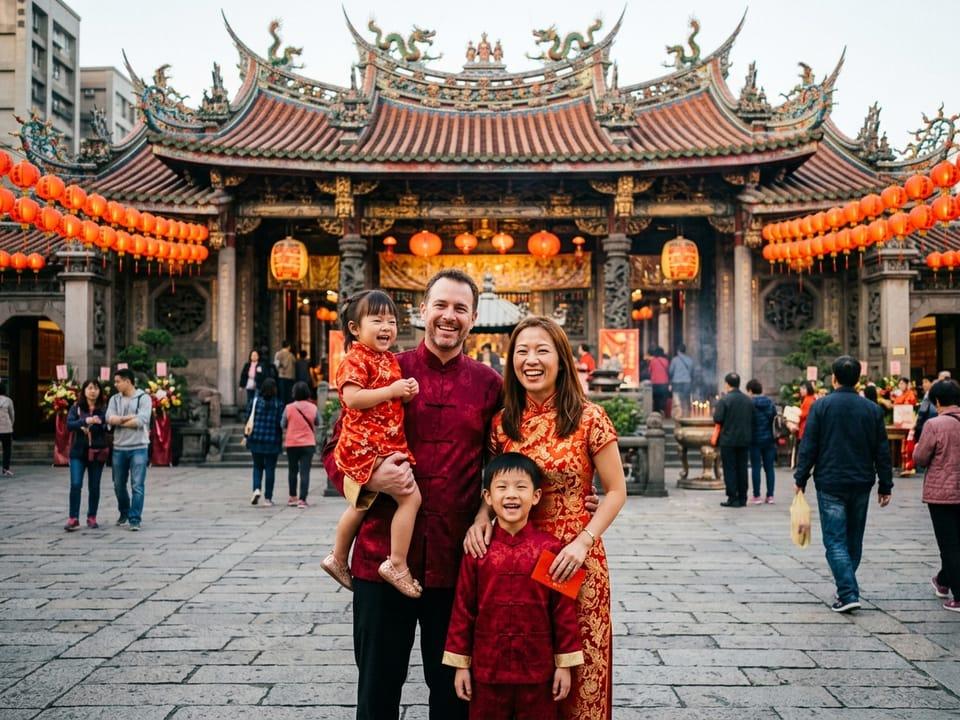
The best time for the Lunar New Year family photo is the afternoon of New Year's Eve (chuxi, 除夕): the household offerings are done, the reunion dinner (圍爐) isn't on the table yet, it's still light, and fifteen minutes is enough. In 2027, New Year's Eve falls on Friday 5 February and the sun sets in Taipei at 17:42; indoor daylight fades earlier, so aim to start around four. After dinner the children are tired, some adults have had a drink, and the only light is the ceiling fitting.
Over the holiday, there are few moments when everyone is home and it's light
The holiday in Taiwan roughly runs like this. On the morning of New Year's Eve, households make offerings to their gods and ancestors, and in the evening they gather for the reunion dinner. On the first day, people visit temples and go out on New Year calls. The second day is when married daughters return to their parents' homes. The third is traditionally a day to rest early and stay in; the fourth welcomes the gods back, and the fifth is when work restarts. For 2027, government offices are off from 4 to 10 February; because the first and second days (6 and 7 February) fall on a weekend, 9 and 10 February are given as make-up days.
Laid out like that, New Year's Eve is the one day one side of the family is reliably all in one place. From the second day, people head to the in-laws, go on trips or drive back early.
Plan the fifteen minutes the day before
Call "photo time!" on the day and it usually slides until the food is out. Settle three things the day before: who takes it (a hired photographer, the relative who's good with a camera, or a tripod and self-timer), where (the wall by the living room window, the front door with its spring couplets, a sanheyuan courtyard), and who stands where. Grandparents sit in the middle of the front row, children on their laps or in front, and the back row goes by height. Set the tripod up the night before and take a test shot to check everyone fits. If a photographer is coming, ask them to arrive around 3:30 to look at the light and positions, and start at about four.
Have everyone face the window or the doorway so the light falls on their faces; with the window behind them, faces go dark. Switch on every lamp to help, and make sure a red lantern behind the group isn't glowing straight into the lens.
New Year's Eve afternoon is when the kitchen is busiest, so for those fifteen minutes, ask the cooks to take their aprons off and turn the heat down. Shoot the whole family first, then grandparents with grandchildren, then each household, and finally a loose one with everyone chatting. Use burst mode for each group; with a dozen or more people, someone will be mid-blink.
Toddlers run on naps, and the north runs on weather
Small children are at their best just after a nap and a snack, so time the photo around their routine, not the adults' convenience. Don't wake a sleeping child for it; ten minutes of crying is worse than starting ten minutes late. Put the new red outfit on after the nap so it isn't creased or drooled on. Have someone the child knows stand behind the camera with a toy or call their name. Let a toddler go once the full-family shot is done; they needn't be in every grouping. Hold back sweets and red drinks until afterwards; stains show.
Weather depends on where you are. Central Weather Administration 1991–2020 averages give Taipei 12.9 rainy days in February, a mean February low of 14.4°C, and 2.8 days in January with a low of 10°C or below; Kaohsiung averages only 3.2 rainy days in February. Families in the north should pick an indoor spot in advance and keep the children's coats on until the last second.
Studio, home visit or DIY: over the holiday, it comes down to flexibility
A studio session usually means booking a separate day before the holiday and gathering the family an extra time. Studios give even light and a clean backdrop, and a pre-holiday photo can be printed in time for New Year's Eve. But a child's cold or a traffic jam means rescheduling, so read the studio's deposit and rescheduling terms first. A photographer who comes on New Year's Eve captures the day itself, though you'll need to ask early whether anyone is available. DIY fits around the children best and can slip by an hour without trouble; it just needs one person in charge. Hire a professional for a large print for the wall or a group big enough to need someone keeping order; for one photo with everybody in it, DIY is enough.
On the first and second days, keep it to one quick photo each
Temples are crowded on the first day. One photo under the red lanterns outside is plenty; keep clear of worshippers coming and going, and check for any rules before taking pictures in the main hall. The second day, at the mother's family home, is the moment for that side's family photo, and again, shoot before eating; traffic is often heavy, so let the children rest a little first. The third day, when most people stay home, suits relaxed photos of children opening red envelopes or playing with new toys. The same "shoot before dark" logic from our Mid-Autumn barbecue photo guide applies here. For sending the photos to relatives, see our piece on sharing photos with LINE albums.
Relatives who can't make it home can still share the frame
If someone is working abroad, on shift over the holiday or too unwell to travel, you don't have to wait a year. pokesta can turn each person's phone photos into a Lunar New Year family portrait with AI, everyone in red around the reunion table or under temple lanterns, for $1 per photo, and the first photo is free. It's a generated image, not a record of the evening, so take the real group photo as usual. Then make the free one from a recent photo of your child and send it to the person who couldn't be there.
References