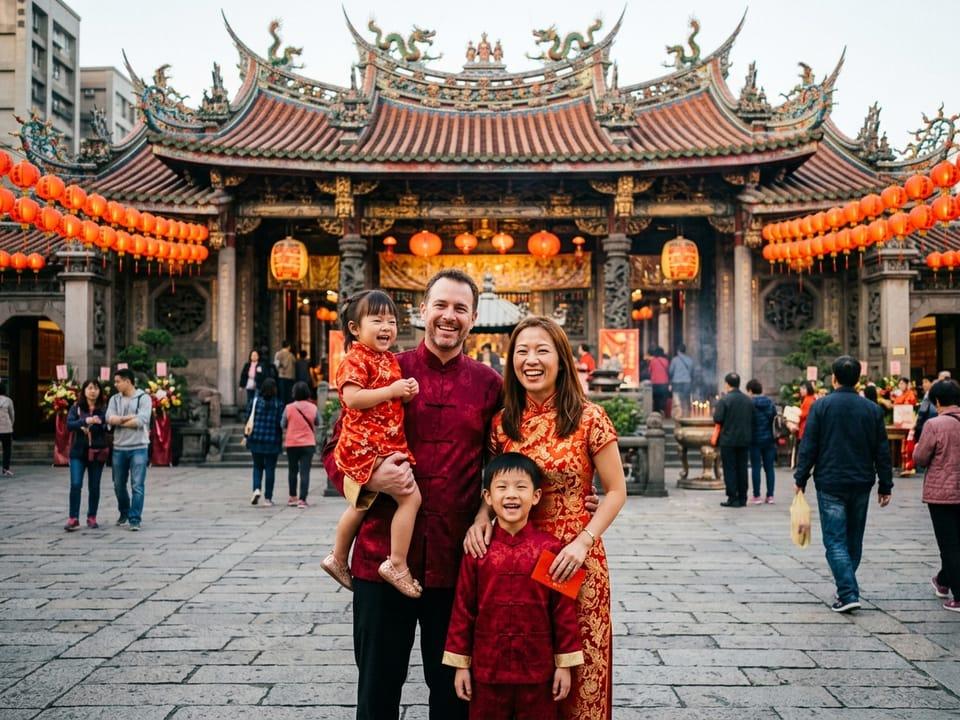
When three generations sit for a family portrait (quanjiafu, 全家福) in Taiwan, the first decision isn't the budget but who can travel and what you want in the background. If the grandparents find outings hard, bring a photographer home or shoot it yourself on a tripod. If there are more than ten of you, you need a studio with the floor space and the lights. If the point is the old family home, shoot it there. PRO360, a Taiwanese platform that matches clients with photographers, puts a family portrait at roughly NT$5,000–20,000 a session, usually quoted for three or four people plus about NT$800–1,000 for each extra person (as of October 2026), so the gap between the three options widens with every relative.
The real difference is who travels
A studio shoot (棚拍) means the family goes to the photographer's own space or a rented studio. A home visit (到府) means the photographer comes to you and works indoors or nearby outdoors. DIY means a tripod and a timer. Each is priced differently. One photographer on PRO360, based in Yuanli in Miaoli County, offers family portraits from NT$6,000: about an hour, every file from the day colour-graded, shot at your home or outdoors, with any studio hire paid by the client. The listing caps the group at 10 and adds NT$200 per person over that. 揪影子快門 (Enjoying Shutter), a Taipei photographer, says its family package is designed for small households of parents and children, charges NT$200 per extra person, prices studio shoots as the package plus the chosen studio's fee, and quotes travel by area. All of this was checked in October 2026; prices and terms vary by business, season and plan, so confirm with each one.
|
Studio |
Home visit |
Do it yourself |
| Who travels |
Everyone |
The photographer |
No one |
| How it's priced |
Package + studio hire + headcount |
Package + travel fee + headcount |
Tripod and remote |
| Grandparents and kids |
Outing and waiting, but air-conditioned |
Home comforts, rest between shots |
Most relaxed, needs someone in charge |
| Rescheduling |
Studio's deposit terms |
Photographer's terms |
Any time |
| Result |
Even light, clean backdrop |
Depends on your light and space |
Depends on your preparation |
| Best for |
Big groups, outfit changes |
Frail grandparents, newborns |
One or two group shots |
If the grandparents can't easily go out, bring the photographer in
For a grandparent with a cane or a wheelchair, a studio trip means parking, stairs, waiting while everyone else changes, then standing under lights. With a home visit, they sit in their usual chair, go back to their room after the first round and have a bathroom close by. The same logic applies to a newborn; our piece on newborn photos at home covers how those visits run.
If you still prefer a studio, ask three things before booking: is there a lift, how far is it from parking, and are there chairs for older relatives? Agree the order too: the full family with grandparents seated first, then let them rest.
Past ten people, space matters more than price
Large families hit studio capacity limits first. The partner studios listed by 揪影子快門 each set their own: 陽光棚 holds up to eight; the two Attic80 studios in Shezi and Yangmingshan list six, with NT$100 per extra person per hour for groups of six to ten; 鋼琴攝影棚 takes five in its plain studio and ten in its set studio, with NT$300 for each person beyond that. If you hire a studio yourself, PRO360's guide puts rental at about NT$1,000–3,000 an hour, usually with a two-hour minimum on weekdays and three to four hours on holidays, and NT$200–500 per person over the limit.
At home, the problem with fifteen people is distance. Two rows need the camera well back from the front row. Stand too close and you're forced onto the wide lens, which stretches whoever is at the ends. The arrangement is simple: grandparents seated in the middle of the front row, small children on their laps or on the floor in front, taller adults at the back corners.
If the house is the point, shoot at the house
The open yard of a sanheyuan, a front door with fresh spring couplets (春聯), a living room nobody has redecorated in thirty years: you only get these by going home, and they're what a travel fee buys. Outdoors, avoid midday sun, which shadows everyone's eyes; stand under the eaves or wait for the lower afternoon light.
Whether to pose in front of the household altar or the ancestral tablets is a family decision. In Taiwan, the morning of Lunar New Year's Eve is when households make offerings to their gods and ancestors, and everyone is busy then. Ask the eldest relative first, and if there's any hesitation, use the doorway or the yard.
Doing it yourself: a tripod, a remote and one person in charge
The kit is short: a tripod that reaches eye level, a Bluetooth remote (or the 10-second timer with burst mode), and the phone's 1x or 2x lens rather than the ultra-wide. Pick the loudest relative as director to arrange everyone, call the shot and run back into place. Someone will blink, so take ten frames and keep the one with every eye open. Our first-birthday photo guide runs the same three-way comparison for a one-year-old.
DIY costs almost nothing and you can redo it freely. The catch is that the director has to be in the picture and the light is your problem. A photographer earns the fee when you want a large print for the living room wall, when the group needs someone to keep order, or when you want one careful portrait of grandparents who are getting on. For how quotes break down, see our piece on Lunar New Year family portrait costs.
Try the backdrop with phone photos first
Before you book anyone, you could try pokesta. It uses AI to turn the phone photos each relative already has into a Lunar New Year portrait of the whole family in red tangzhuang and qipao, in front of a sanheyuan or under a temple's red lanterns, at $1 per photo with the first photo free. It's a generated image, not a record of a real afternoon. Make the free one with recent photos of the grandparents and the kids, look at it together, and you'll know which backdrop the family wants before choosing between studio and old house.
References