
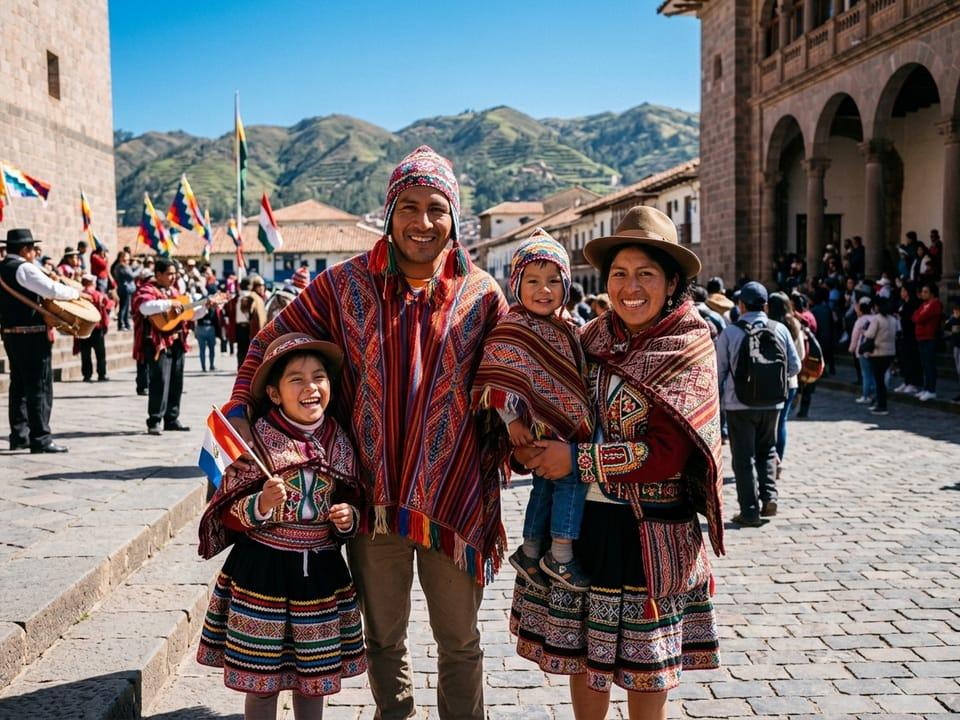
Most children in a school Inti Raymi need only four or five pieces: a knee-length tunic (unku) for boys, a long skirt and a woven shoulder cloth (lliclla) for girls, a woven belt and a simple headband. Ask the school what it already owns, rent only the woven pieces that are hard to make, and sew the plain parts at home. The one thing not to improvise is the mascaypacha, the fringed headdress that belonged to the Sapa Inca alone. And since June mornings in Cusco start near freezing, take the photos at home and keep a poncho over the costume until your child goes on.
June 24 is a school performance day across the Andes
In Peru, June 24 is two things at once. Cusco stages Inti Raymi, the Inca festival of the sun tied to the winter solstice, and the whole country marks the Día del Campesino, the farmers' day. It began in 1930 as the Día del Indio and was renamed in 1969 under the agrarian reform law. Cusco remains the place most associated with the day because of its Inti Raymi reenactment.
Schools stage their own versions too, and not only in Cusco. In June 2025, more than 250 primary and secondary students at the Montessori School in Arequipa performed the Fiesta del Sol for the first time, with the older students acting out the Inca's arrival and the ceremony of thanks to the sun. A reenactment like this has one Inca and a crowd around him: ñustas (princesses), priests, soldiers and the people of the four regions of the empire, who in Cusco's version carry the Inca's litter. Your child is far more likely to be one of the many than the one.
Most roles need four plain pieces
The unku was the tunic worn by men across Inca society, from rulers to farmers. Highland versions were sleeveless and reached the knee, and the designs changed with rank and occasion. For a villager or soldier, a rectangle of fabric with a head opening, sewn at the sides and belted, does the job. A woven belt (chumpi) and sandals, or whatever shoes the teacher allows, complete it.
For girls, the base is a long skirt or wrap dress, with a lliclla on top. That is a rectangular handwoven cloth worn over the shoulders and fastened at the front with a decorated pin called a tupu. For a small child, a large safety pin hidden behind a brooch is gentler than a real metal pin. A ñusta might add a woven headband or flowers.
Be careful with symbols. The mascaypacha, a woven band with red and yellow tassels and feathers, was the single sign of power given to the Sapa Inca at his coronation. Leave it to whoever plays the Inca, and if your child plays him, ask the teacher how the school wants it made rather than copying something from a party shop. The same goes for the dense geometric squares called tocapu on royal tunics. A plain or simply striped unku is more accurate for most roles.