
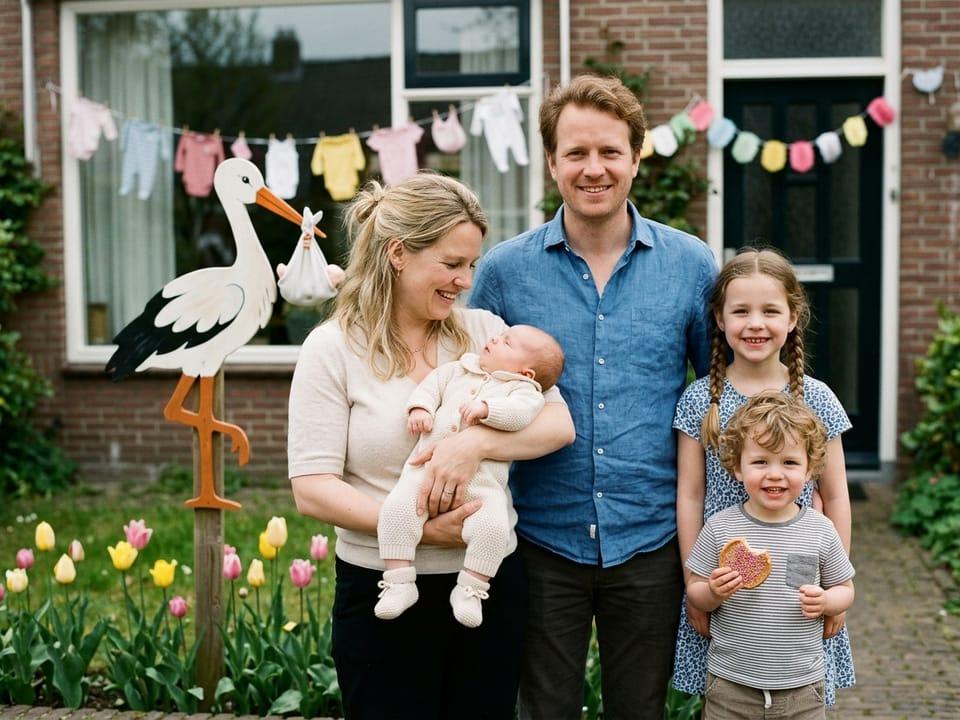
A newborn who won't sleep doesn't ruin a newborn shoot; the session just slows down. Photographers in the Netherlands plan feeds, cuddles and breaks into the time: a studio in Zaanstad says its sessions run entirely at the baby's pace, and a photographer working from Doetinchem lists about an hour and a half for a newborn lifestyle shoot at home. Parents can help by feeding just before, warming the room and giving the mother a proper chair. And if the curled-up sleeping poses never happen, the photos of your baby awake still show the face they had that week.
Crying almost always has an ordinary cause
Thuisarts.nl, the patient information site of the Dutch College of General Practitioners, lists the usual reasons a baby cries: hunger, a dirty nappy, tiredness, wanting to be close to you, trapped wind, being too cold or too warm, or simply lying uncomfortably. It also notes that babies cry for about two hours a day on average in their first six weeks. So a crying spell during a session of an hour or more isn't a sign that something has gone wrong; it's an ordinary part of a newborn's day, happening in front of a camera.
That list doubles as your checklist. Feed, burp, change, hold, and check whether the baby is cold. If the photographer plans shots with the baby in just a nappy, a cool room is an easy reason for protest, so ask what temperature they'd like and turn the heating up well before they arrive.
One thing is not a photo problem at all. In the first week, Thuisarts advises calling the midwife, the GP or the out-of-hours GP service straight away if a baby drinks poorly, for example drinking briefly and falling asleep at once, or is drowsy and doesn't respond well. Many babies turn slightly yellow around the third or fourth day, and the kraamverzorgende (maternity carer) and midwife keep an eye on that. A baby who is unusually hard to wake is something to raise with them, not something to work around for a nicer picture.
What parents can do before the photographer arrives
Time the last feed so it ends shortly before the session starts. Hunger is the first item on that list, and a baby who starts full gives everyone more time before the next break. Keep a spare nappy, a muslin and a change of clothes within reach, for the baby and for whoever is holding the baby.
Then think about the mother. Depending on how the birth went, she may not manage long stretches of standing, or sitting on the floor. Put a chair with a back where she can feed comfortably, keep water and something to eat nearby, and agree beforehand that she can step out while the photographer works with the baby alone or with the other parent. Family shots can wait until she's ready.
If there are older siblings, take their photos early, while their patience lasts, and then let another adult take them off to play. A quiet room does more for a newborn than any prop.
Finally, ask one practical question before the day: what happens if the session runs long? Price pages list photography time and the number of edited photos, but rarely what happens when a baby needs three feeds. You want to know whether your booking has a fixed slot, and whether extra time costs anything. Our guide to newborn shoot prices breaks down what packages include.