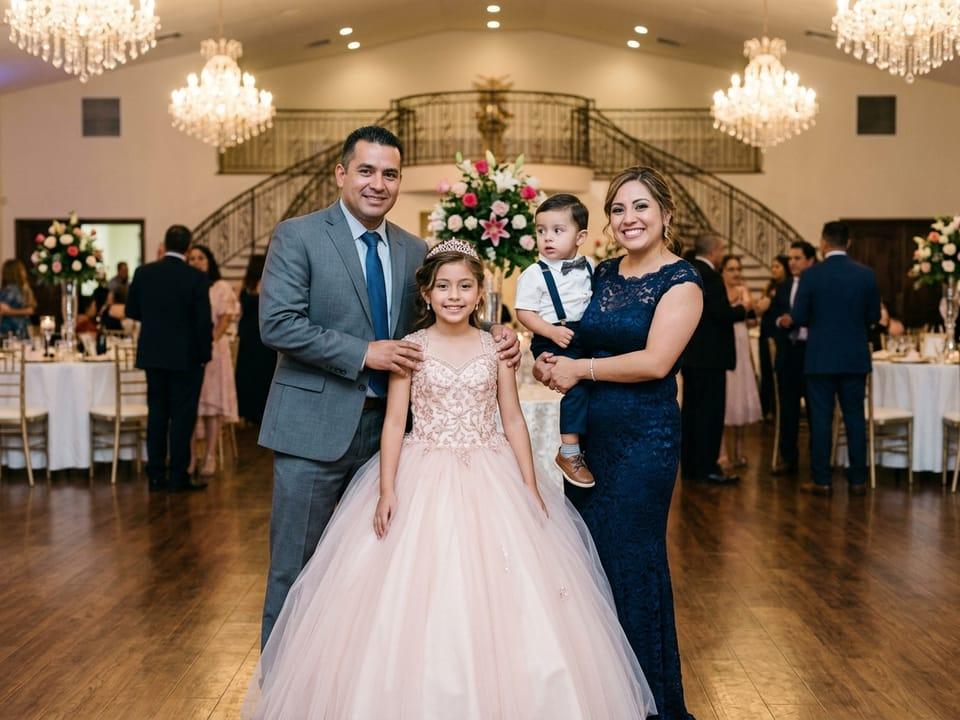
A quinceañera is the celebration of a girl's fifteenth birthday in Mexico and across Spanish-speaking Latin America; in Mexico it is also written XV años. For Catholic families it begins with a thanksgiving Mass and carries on into an evening party with the waltz and a run of family rituals, so it can fill an entire day. What the day rarely leaves is time for relaxed portraits of the quinceañera herself. Plan the portraits for a separate session, and use the day for the rituals and the family.
A celebration of "the fifteen-year-old," with several origin stories
Quinceañera means a fifteen-year-old girl, and the word names both the celebration and the girl at its center. English Wikipedia lists other names too, including fiesta de quince años, quince años and simply quince.
How it began is told in more than one way. Spanish Wikipedia describes a custom rooted in Mexico's pre-Columbian cultures, to which the Spanish added the Catholic Mass after the conquest, and says Emperor Maximilian and Empress Carlota introduced the waltz and the gowns in the 19th century. English Wikipedia adds other accounts: a ball the Duchess of Alba hosted at her palace in Spain, and a reception Carlota held for her court in Mexico City to present young women. The United States Conference of Catholic Bishops (USCCB) notes that the peoples of Mesoamerica, possibly the Maya and Toltecs, held rites of passage and that the Spanish may also have brought the practice with them. It describes the celebration as thanksgiving to God for the girl's life and a prayer for blessing in the years ahead.
The gown is a long ball gown, chosen by the girl, most often with her mother, in her favorite color and style. Spanish Wikipedia says Mexican quinceañeras usually wear pastels, bold colors or white. English Wikipedia mentions both a tiara she receives at Mass and a crowning at the party, when a close relative places it on her head. Once the color is settled, you can pick pre-shoot backdrops that work with it.
From Mass to the party: the moments to capture
The quinceañera arrives at the thanksgiving Mass (Misa de acción de gracias) with her parents, her godparents (padrinos) and her court of honor: damas and chambelanes in pairs, often seven to fifteen of them, though some girls choose only damas or only chambelanes. During Mass her godparents may give her a rosary or a medal of the Virgin of Guadalupe blessed by the priest, and some girls leave their bouquet at the altar for the Virgin Mary.
At the party (fiesta) she usually dances a waltz with her father, who then hands her to her chambelán de honor before the rest of the court joins in; that dance is often rehearsed for weeks. Depending on the family and the region, there may also be a toast (el brindis); the change of shoes (cambio de zapatos), when her father or another relative swaps her flats for her first pair of high heels; the crowning; and the last doll (la última muñeca), when her father hands her a doll usually dressed like her. That farewell to her last childhood toy is said to be based on a Maya tradition. In Mexico City some families also rent a limousine for a ride with the chambelanes past Paseo de la Reforma, the Zócalo and the Ángel de la Independencia before the party. For what each ritual means and where to stand for it, see quinceañera traditions and how to photograph them.
Give your photographer a short written list of must-haves: the whole family at the church door, each set of grandparents, the godparents, the siblings, the full court, the father-daughter waltz, a close-up of the shoe change and one group photo at the end of the night.
Padrinos carry the celebration, item by item
Parents don't necessarily shoulder the cost alone. The USCCB says the custom of padrinos and madrinas (godparents) and other sponsors brings in a wider range of donated gifts and services, and that relatives who are seamstresses, musicians or limousine drivers often give their work as a gift. At a village quinceañera in Sonora reported by The Christian Science Monitor in 2008, about two dozen padrinos split the drinks, the pedestaled cake, the bouquet, the invitations and even the dress and hairstyle. The reporter called the system "a kind of lifelong installment plan," one that spares any single family from carrying the whole burden at once. That night, each set of padrinos was called up to waltz with the quinceañera and her escort.
For the photographer, padrinos are people to capture with whatever they gave: the cake padrinos beside the cake, whoever brought the heels during the shoe change. Hand over a list of who sponsored what, and you won't discover afterward that someone is missing. If padrinos or relatives are paying for the photography, how to keep quinceañera photo costs down goes through the options.
A pre-shoot in the studio or out on the streets
A studio controls the light and doesn't care about the weather. It's the safer choice if you need a portrait for the invitations, a welcome sign or the decorations, since all of those have to be printed before the party. Before you book, ask whether there's a dressing room with space for the gown and someone to help with it, how many retouched photos are included and when they arrive, whether parents and siblings can join for a few shots, and how many backdrops or sets you can use.
For a location pre-shoot (sesión de fotos previa), historic centers, haciendas, gardens and hillside towns of brightly painted houses such as Guanajuato give the photos a sense of place. In Mexico City, some quinceañeras are photographed in front of the Palacio de Bellas Artes, on the western side of the historic center. After a video of security staff interrupting a quinceañera's shoot spread online, the National Institute of Fine Arts and Literature (INBAL), which runs the palace, said on its official Instagram that no permit is needed for these sessions on the esplanade or around it, adn40 reported in March 2024. Other venues, churches and parks may have their own rules, and sometimes fees, so ask before you book rather than on the day.
Timing matters. In Mexico City, most of the year's rain falls between May and October, so if your session lands in those months, set a backup date. Avoid midday: with the sun overhead, faces get dark shadows under the eyes and the gown gets hot. Early mornings also mean fewer strangers in the background.
A ball gown changes the logistics. Bring a car with room for the skirt, comfortable flats for walking between spots, a clean sheet to lay under the hem, safety pins, water and a helper whose only job is to arrange the skirt before each shot.
Let the skirt set the lineup
The gown takes up a lot of width. Put the quinceañera in the center with the skirt spread, and have everyone else angle toward her and stand half a step behind so the dress stays visible. Shoot from slightly below her chest height; shooting down makes the skirt look smaller. With a large court, form two rows and put the back row on a step. For the waltz, use burst mode and shoot as she turns and the skirt opens. And during the shoe change, don't forget her father's face.
Only the day itself? Save 15 minutes, and book the portrait date first
If the budget covers only one, choose coverage of the day. Then build a 15- to 20-minute portrait window into the schedule, right after Mass or just before she enters the party, while hair and makeup are fresh. Church steps work well for large family groups, since they put people in natural rows.
If you're torn, decide by when you'll need the pictures. If you need photos for invitations or decorations, shoot before the day. If relatives are coming from the United States or farther away and the family will only be together that day, put the money into coverage of the day and the group photos. If the gown is rented and goes back the next morning, fit the session inside the rental period or rely on the day. If you can afford both, a short studio session plus coverage of the day is a sensible split.
If some relatives can't make it, pokesta can create an AI family photo of the quinceañera in her gown with the family, in a ballroom or a hacienda garden, from each person's own phone photos. Your first image after signing up is free, and after that it's $1 per photo. You can create a quinceañera family photo or see everyone's quinceañera posts.
Once the party date is fixed, choose the portrait date next and book that photographer before anything else. The rest of the schedule can be built around it.
References