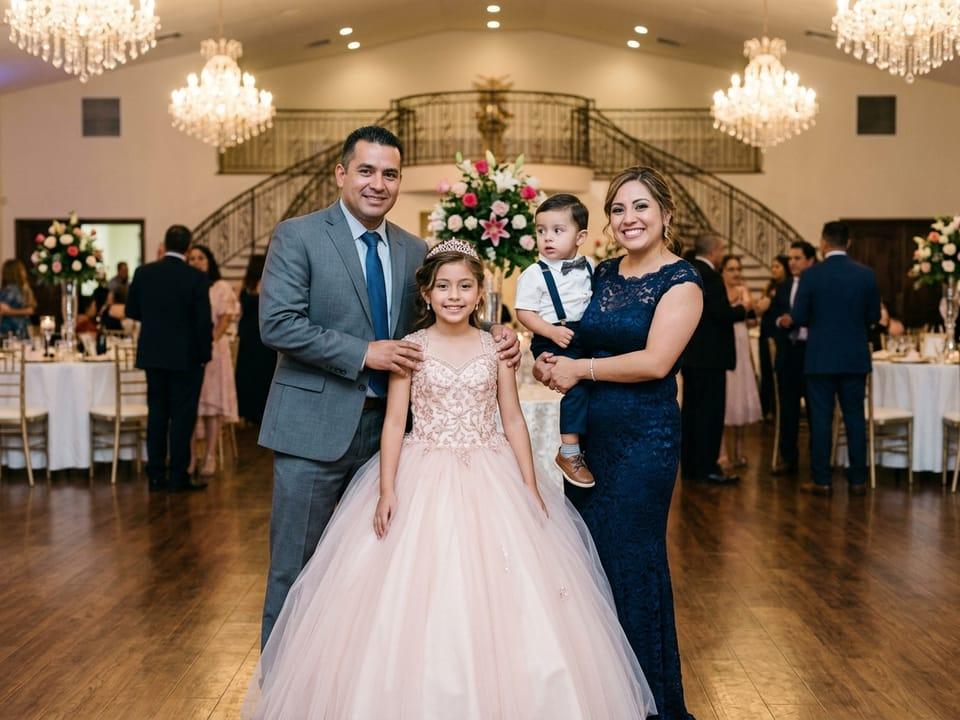
Quinceañera Traditions to Photograph: Last Doll, Shoes and Crown
pokesta Editorial Team · Updated October 12, 2026
Most quinceañera traditions mark the same idea, a girl's step into young womanhood, and they fall into two parts of the day. In church there is a Mass or a blessing of thanksgiving, where she receives blessed gifts. At the party come the family rituals: the waltz, the change from flat shoes to heels, the crowning, the last doll and the toast. Which of these a family keeps, who performs them and in what order differ between Mexico, Peru and Latino families in the United States, and from one household to the next, so the most useful thing a photographer can carry is the family's own program. Knowing what the cambio de zapatos or the última muñeca means before the day helps you stand in the right place when it happens. For the shooting plan as a whole, from portraits to the party, see our guide to quinceañera photo sessions.
The Mass gives thanks, and her gifts are blessed
In Mexico a Catholic quinceañera traditionally begins with a thanksgiving Mass, the Misa de Acción de Gracias, which also honours the Virgin. Her godparents present a rosary or a medal, sometimes one showing the Virgin of Guadalupe, that the priest has blessed, and she may leave her bouquet on the altar for the Virgin Mary. The US Catholic bishops describe the celebration as a way for the family to thank God for her life. Their order of blessing may be celebrated within Mass or more simply outside it, and names signs of faith that may be blessed and given to her: a medal, a Bible, a rosary, a prayer book. In Peru, too, a Mass is part of many celebrations.
These are liturgical moments, and each parish decides how they may be photographed, from flash to where a photographer may stand. The pictures worth having are quiet ones anyway: the godparents' hands with the medal, her face during the blessing, the bouquet left before the image of the Virgin. Ask the parish for its rules well before the day; our questions for a quinceañera photographer include what to check about the church.
The waltz is often several dances
At the reception she usually dances a waltz with her father, to a song the two of them choose. In Peru, as in Colombia and Venezuela, tradition favours a classic such as The Blue Danube, though in Peru the honour dance may instead be her favourite song.
A UNAM ethnography of fourteen girls in Mexico City describes a fuller sequence: four or five dances, each with its own purpose. It opens with a presentation waltz, continues with the waltz of the last toy, the waltz of the first high-heeled shoe and the waltz of the crowning, and ends with the godparents' waltz, in which she dances with each padrino to thank him for his part in the party. There, "waltz" meant any slow, romantic song, a ballad or even a New Age melody as easily as a true waltz, with choreography she rehearsed with her chambelanes for two or three months. The author is careful to say that what she saw can't be generalized to every family.
For photos, the waltz is less about steps than faces. If there are several dances, the handovers are where expressions change: her father letting go of her hand, each padrino stepping in. Stay on her father for a moment after he steps back.
The change of shoes is the step to heels
In the change of shoes, a family member presents her with her first pair of high heels in place of the flat shoes or slippers she has worn so far. Spanish-language Wikipedia notes that in Colombia and Peru it often comes right after her entrance: she arrives in sneakers, and her father swaps them for sandals or heels before dancing the waltz with her. Some girls now skip the slippers and wear shoes that match the dress from the start, so ask whether the ritual is on the program at all. Where it is, the meaning is the same across countries: she is leaving girlhood behind.
It is one of the easiest rituals to photograph well, because it happens slowly and in one place. Put the chair where the light is good and clear the floor around it. Then shoot three things: whoever kneels to swap the shoes, a close-up of the shoes changing hands, and her face as she stands up in heels. Keep the old shoes for a still life later.
The crown and the last doll close her childhood
In the crowning, a close relative places a crown or tiara on her head; in Colombia and Peru a tiara is usually part of her look for the night. In the Mexico City study, the crown had its own godparent, just like the dress, the medal and the shoes, and the author read the crown, the heels and the waltzes together as Cinderella imagery, a night in which the whole family becomes royalty.
The last doll, la última muñeca, stands for the last toy of childhood. It is often dressed in a gown like hers, and some are porcelain and hand-painted. Who hands it over varies. English-language references name her father or her chambelán de honor, and in the Mexico City study it could be a doll or a stuffed animal, given during its own waltz. Some girls dance with the doll, and she often gives it to a younger girl in the family afterwards. That hand-off is a photo in itself, so ask when it will happen.
Roses, candles and the toast depend on where you are
The toast, el brindis, is optional but common, and is usually started by her parents or godparents. In Colombia and Peru, after the opening dance she often hands fifteen roses to relatives and friends she has chosen, fifteen candles are blown out, there is a toast and a parent gives a speech. In Peru the chambelán may also say a few words about her. Then the floor opens, sometimes with a choreography she has prepared.
That is why any printed list of "the" quinceañera traditions is only a starting point. Ask the family which rituals they are doing, in what order, and whether anything is new, because some families add ceremonies according to local custom and others leave some out.
Ask who hands her each thing
Every ritual has a giver: the godparents with the medal, the father or relative with the shoes, the relative with the crown, whoever brings the doll. Those people are the second subject of each photo, and they are the faces the family will look for years later. Before the day, write each ritual next to the name of the person performing it, and give that list to whoever holds the camera. If someone who should be in those pictures can't travel, pokesta can create a family photo with them in party clothes using AI, from each person's own phone photos ($1 per photo, first one free). Other families' celebrations are collected under quinceañera posts.