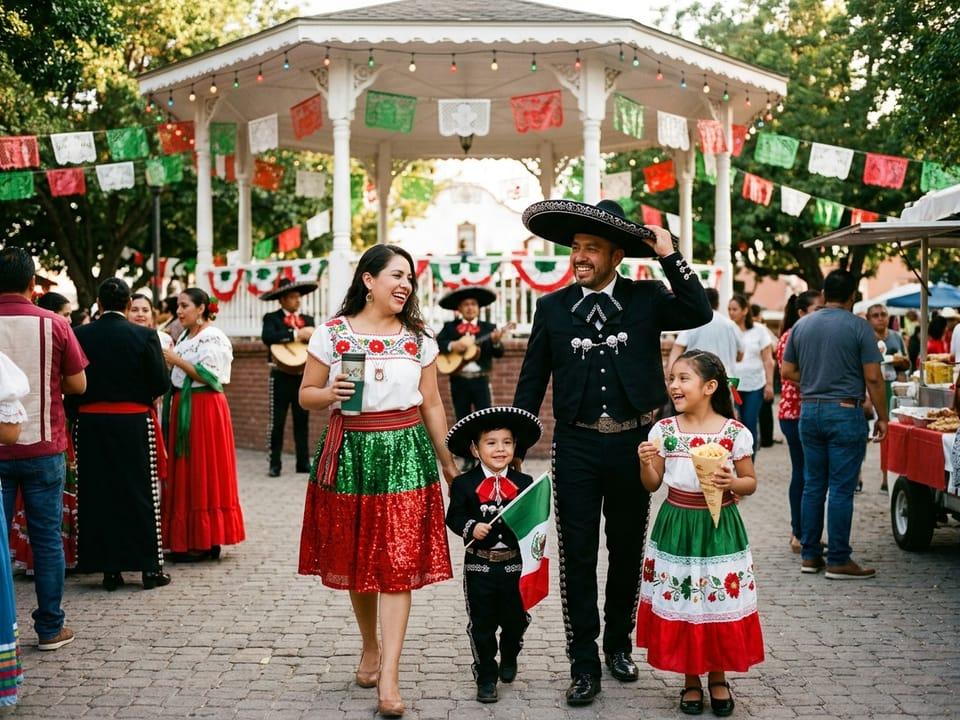
China Poblana and Charro Outfits for the School Fiestas Patrias: Rent, Buy, Borrow or Put One Together
pokesta Editorial Team · Updated October 25, 2026
For a school Fiestas Patrias festival, buy the china poblana or charro outfit only if your child will wear it again or the dance teacher specifies one; otherwise borrow, rent or assemble it from clothes you already have. On Amazon México in October 2026, girls' china poblana outfits were listed from about 430 to 1,650 pesos, and boys' charro outfits from about 350 pesos for a simple mariachi-style set to roughly 1,300 to 1,700 for a fuller suit with a hat. In photos, what people notice is the face: the hair ribbons, the flowers, the hat, the bow tie and the rebozo. Put the money there.
Two outfits with a real history behind them
The note from school tends to come early in the school year, since the festival is held before the 16 September holiday, and it asks for a traje típico. It helps to know what you are dressing your child in. Charrería, the equestrian tradition of Mexico's livestock-herding communities, was inscribed on UNESCO's list of the Intangible Cultural Heritage of Humanity in 2016. UNESCO describes the charro's wide-brimmed hat and the charra's colourful shawl, and notes that the outfits and the saddles and spurs are made by local artisans as part of the tradition.
The china poblana is a different story. The full outfit is a white blouse embroidered with silk and beads, a skirt called a castor covered in sequins, white petticoats with zigzag lace and a rebozo, often the blue-and-white kind from Santa María del Río in San Luis Potosí. It became a national symbol mainly between the 1920s and 1940s, paired with the charro in the jarabe tapatío. The popular story that the dress began with Catarina de San Juan, a woman from India who lived in colonial Puebla, is widely questioned by historians. Your child is wearing a symbol of the country, and it deserves care, but it does not need to be a museum piece.
Decide by how often it will be worn and what the dance demands
Three questions settle most cases. Will your child wear it again? Some schools repeat the festival every September, and a child in a folk dance class may perform in it several times a year; a bought outfit that fits for two seasons costs less per wear than two rentals. Does the dance number specify the outfit? A teacher choreographing the jarabe tapatío may ask for a china poblana skirt wide enough to swirl, and a borrowed blouse and skirt that do not match may not work on stage. And is there an older cousin? A hand-me-down from a relative is free and has already survived a festival.
Costume rental shops also lend traditional outfits for a single event. Ask for the price, the deposit, the size range and what happens if the skirt comes back with a stain from the pozole. Renting suits a child who has outgrown last year's outfit and won't dance again until next year.
What the money buys, piece by piece
The Amazon listings show where the price goes, though titles alone say little. For a china poblana, open each listing and check whether the blouse and skirt are separate or a one-piece dress, whether there is a petticoat, and whether a rebozo or hair piece comes with it. For boys, the cheaper sets are typically a vest, trousers and shirt in charro style; several of the 1,300 to 1,700 peso suits add a bolero jacket or an embroidered shirt, a sash and a hat. A separate child's charro hat was listed at about 370 to 460 pesos, and an embroidered bow tie at about 375. Marketplace prices change daily, so check sizes and photos of the real product, not just the drawing.
Putting one together at home is often enough for a classroom festival. For a girl: a white blouse, a full skirt in green or red, a rebozo or shawl from the family, ribbons braided into the hair and a flower over one ear. For a boy: a white shirt, black trousers, a red or green sash, a bow tie and, if you buy only one thing, the hat. Those face-level pieces are what a phone photo from the third row actually shows.
A studio session, a photographer at school or your own phone
On festival day, parents usually watch from a fixed spot while the class performs, so the close shot depends on where you stand. A school that hires a photographer may sell prints of the dance; ask in advance. A studio or outdoor family session on another day gives you planned light and the whole family dressed up, which is worth it if the grandparents will join and you want a large print. Cronoshare's family-session guide, dated July 2026 and checked in October 2026, gives 2,000 to 3,000 pesos for an hour outdoors and 2,400 to 4,000 for an hour in a studio; prices vary by photographer.
For most families, though, the best photo happens at home before school: your child in the outfit by a window, then with siblings, then with whoever is home. Ten minutes, before the ribbons come loose.
Spend on the face, then add the family
If the budget is tight, buy the hat or the hair ribbons and borrow the rest. That is where a photo looks festive. If you want a September family picture with everyone in traditional dress, and not everyone owns an outfit or lives nearby, pokesta can make one with AI from the phone photos each of you already has. It is a made image, not a photograph of the festival. Each photo is $1 and your first one is free, so try it with a recent photo of your child before you rent a second outfit. For a church occasion instead, see our guide to renting First Communion outfits.