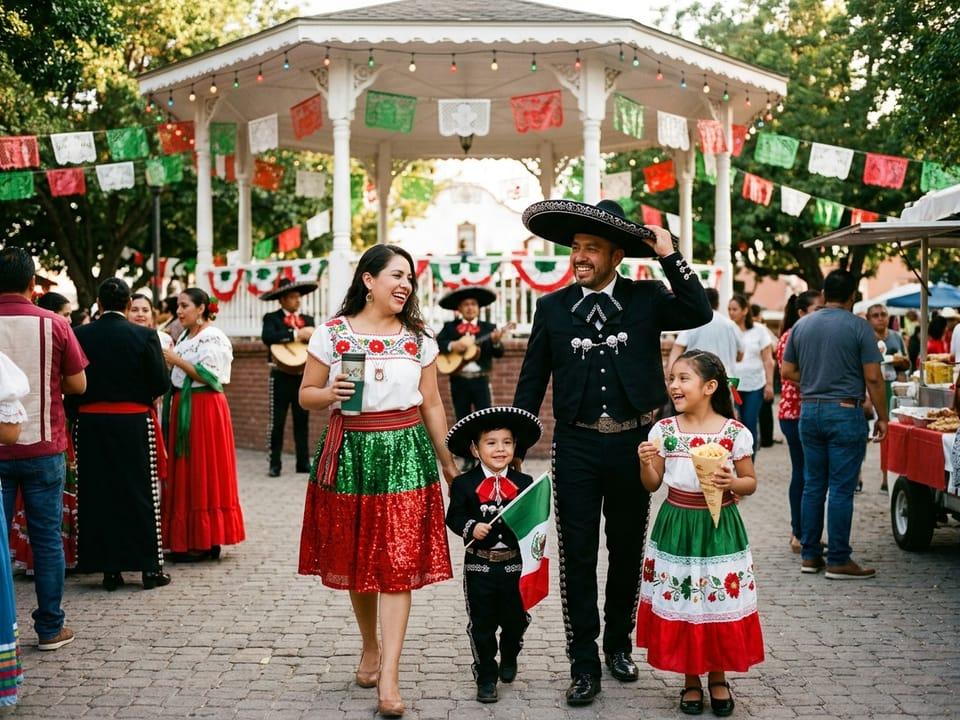
At the school Fiestas Patrias festival, give the dance to video and take your photos at two quieter moments: at your front door before you leave, and right after the performance. The festival falls in the wettest weeks of the year in much of Mexico, and Mexico City averages about 18 rainy days in September, so pack the costume for rain and pick a covered spot for photos before you arrive. If your child refuses the sombrero or the painted mustache, ask for five seconds, not the whole morning.
The festival lands on a rainy day the school chooses
The national celebration centres on the night of 15 September, when the Grito is re-enacted from the National Palace at around 11 p.m. and in town halls across the country. Schools hold their own celebrations too, and where the bell ringing is re-enacted, the head of the school says the traditional words. The 16th is a statutory holiday under the Federal Labor Law and schools are closed, so the school event falls on another day the school picks. Read the circular for the date, the time and the costume expected, and for whether families may take photos or post them online. Those rules belong to each school.
The weather isn't negotiable. The Servicio Meteorológico Nacional's 1991–2020 normals put September in Mexico City (Tacubaya) at 158.1 mm over 18.2 rainy days, Puebla at 180.7 mm over 18.6 days and Guadalajara at 183 mm over about 15. Monterrey is drier in midsummer but has its wettest month in September, at 197.9 mm. Afternoons are the riskier half of the day. Expansión, reporting on a study in Nature Geoscience, explains that strong daytime sun and moist soil favour afternoon storms in central and eastern Mexico during the rainy season. A morning ceremony has a better chance of staying dry; an afternoon one needs a plan.
Film the bailable, photograph your child before and after
During the performance, parents stand several rows deep with phones raised, the children dance as a group, and you can't move to a better angle without blocking someone else's view. Accept it. Hold the phone horizontally, keep your elbows against your body, and record the whole bailable without zooming far in. A steady, wide clip will mean more later than a dozen blurry stills. If another parent has a better spot, ask whether they'd share their video.
The photos happen elsewhere. Before you leave home, take two minutes at the door or by a window, in full costume, with hair done and nothing wet or crumpled yet. After the performance, find your child before the costume comes off, ideally with a friend or the teacher, somewhere with light: a corridor beside the patio or the edge of a covered area, with your child facing the open side. Those are the pictures you'll print.
Keep the costume dry between the house and the patio
A china poblana skirt covered in sequins and a felt charro sombrero don't do well in the rain. If the school lets children change there, send the costume in a garment bag; if not, cover it on the way. A small kit handles most of it:
- a hooded poncho or clear raincoat that fits over the costume
- a large plastic bag for the sombrero
- spare socks and a second pair of shoes
- a small towel, wet wipes and an eyeliner to redraw a smudged mustache
Waterproof sneakers can stay on until the last minute before the dance. In the photos, a raincoat over the costume is honest and often charming, so there's no need to hide it. When the rain is heavy, decide early where you'll stand to wait for your child: covered areas fill quickly with other families doing the same.
When the sombrero comes off, props get five seconds
Hats that slide over the eyes, mustaches drawn in eyeliner, a rebozo that itches: small children often object to the props, not to the occasion. Don't spend their patience before the performance. Ask for one photo with the sombrero on, count to five out loud, then let your child hold it instead of wearing it. Draw the mustache at school just before the dance, or skip it and let them hold a paper mustache on a stick for the photo.
Some children cry, cling or freeze the first time they perform in front of a crowd. Staying calm and close helps more than insisting. If your child is unwell or overwhelmed, the costume can go home in the bag, and a photo next to a friend in a school uniform still records the day.
Festival, studio or home: what each one can give you
The school day gives you the real performance and the classmates, and costs nothing beyond the costume, but you can't reschedule it, you can't choose the angle and rain is a real risk. A studio mini session on another day gives you a dry set, good light and edited photos, and it's the better place for a framed portrait or a picture with siblings; ask what happens if your child is sick on the booked day. A home portrait is the most flexible of the three: if the festival morning is a washout, wait for a sunnier one, and a window and a flag are enough of a backdrop. Our comparison of Fiestas Patrias photo options for kids goes through costs and ages. A professional is worth paying when you want one excellent portrait, or when the extended family is gathering for it.
If the rain wins the day
Some years the patio floods, the ceremony moves indoors and all you keep is a shaky video and a soaked sombrero. For a clean portrait afterwards, pokesta can turn the everyday phone photos you already have into an AI family picture in Fiestas Patrias dress, in a plaza hung with papel picado or around a table of pozole. It's an image made by AI, not a record of the festival, so hold on to the video. Each photo is $1 and the first one is free, so try it with a recent photo of your child and save the costume for next September.
References