
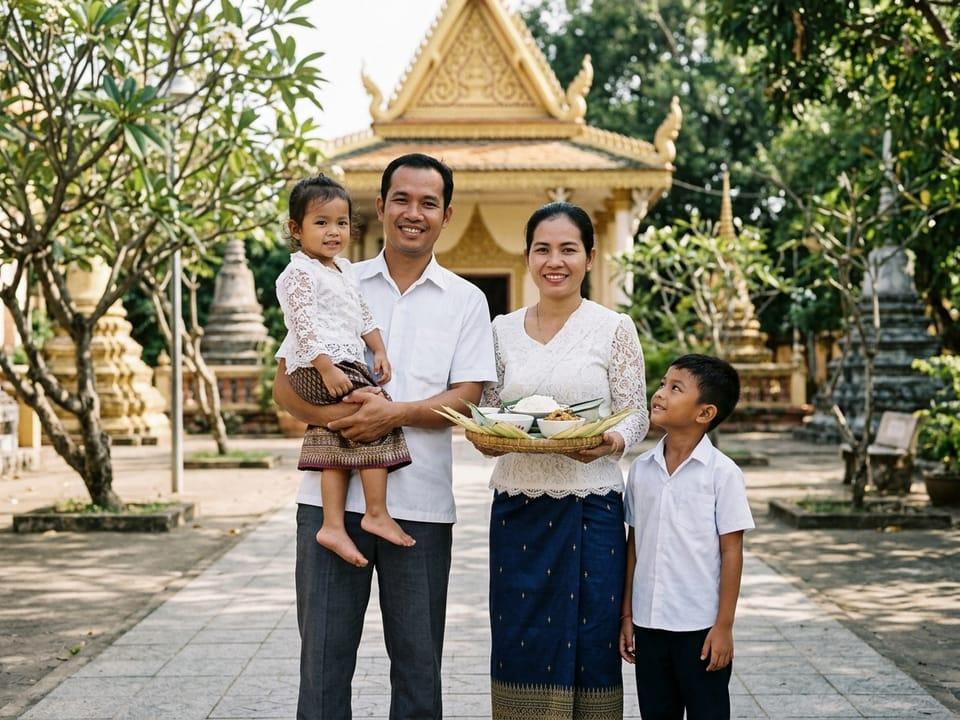
Plan the photo under a roof from the start, and set one time when all three generations will be home, for example late morning, once everyone is back from the pagoda. Pchum Ben falls at the end of the rainy season, when Phnom Penh averages about 179 mm of rain in September and 177 mm in October, against about 71 mm in November. Bring a tripod and use the self-timer, so the person who always takes the picture finally gets to be in it.
Count on rain, mud and a full house
The southwest monsoon brings rain from mid-May to mid-September, and in some years into early October. Pchum Ben sits right at that tail end: the 2026 holiday ran from October 10 to 12, and holiday calendars list September 29 to October 1 for 2027. Humidity during the rains is around 90%. In practice, an outdoor photo plan can be washed out at short notice, yards turn to mud, and pale pagoda clothes don't stay clean for long.
The journey adds its own pressure. Many Cambodians go back to their home towns for Pchum Ben, so expect heavy traffic on the roads out of the cities as the holiday begins. If you can, leave a day early or set off first thing in the morning. The children spend fewer hours in the car, and you arrive in daylight instead of unloading bags in the rain after dark. If your province is prone to flooding, check local authorities' warnings before you set out.
Under the house, under the eaves, by the window
Traditional Khmer houses stand on stilts, as high as three meters, to keep them above the annual floods. If the family home is one of them, the space underneath is roofed, shaded and out of the rain. Clear it first: move the motorbike and anything stacked against the posts, sweep the ground and keep any animals out of the frame. Place the family just inside the edge of the floor above, facing out toward the open side, so daylight falls on their faces instead of behind them.
A veranda or deep eaves work the same way. Stand everyone a step back from the edge of the roof so rain doesn't blow onto their clothes, and turn them toward the yard. Indoors, a large window does the job of a studio light. Seat the grandparents with the window to one side and let the light fall across their faces, and switch off the overhead tube light, which mixes badly with daylight.
Phones tend to darken faces when a bright doorway or window is behind people, so tap a face on the screen to set the exposure before you shoot. Rain in the background, falling past the edge of the roof, can actually make the picture. Years from now, it will say exactly which season this was. Light under a rain cloud is dim, though, so keep the phone on the tripod even for small groups, and if the lens fogs up after the air-conditioned car, wipe it and give it a few minutes to adjust.