
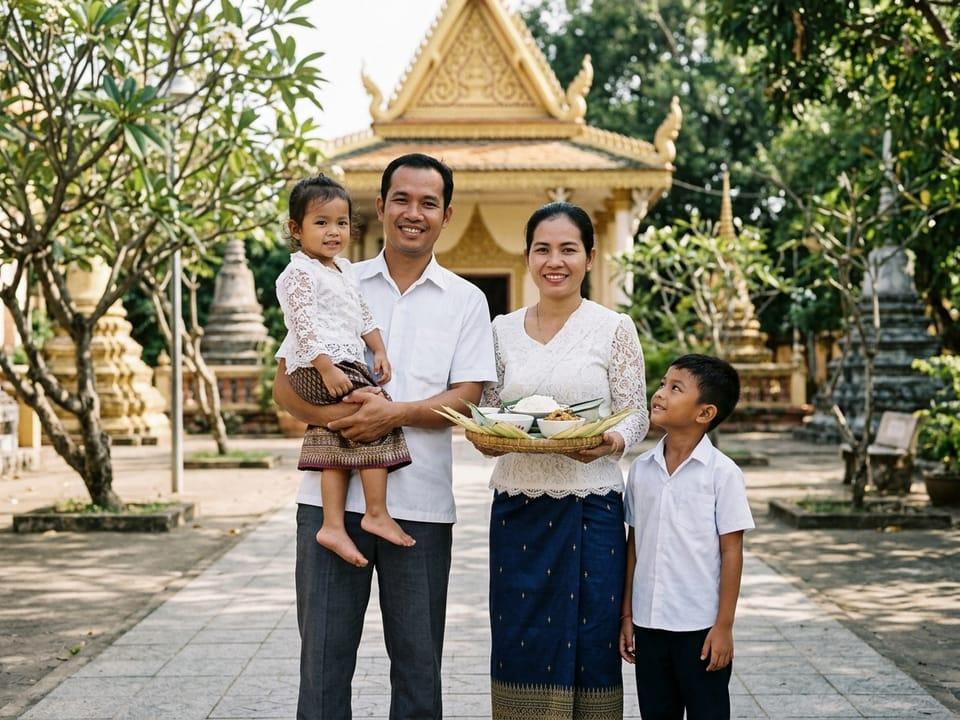
A small child doesn't have to be woken in the dark for the rice-ball offering. Pchum Ben lasts 15 days, and through the first 14, the Kan Ben days, families take turns bringing offerings to their local pagoda at dawn, so one or two adults can go for the bay ben while the children follow once it's light. Choose a Kan Ben day rather than the final day, the most important of the fifteen, and take the family photo after the chanting, outside the main hall, while everyone still looks neat.
The rice balls are offered at dawn, on the Kan Ben days
Pchum Ben starts on the first day of the waning moon in Photrobot, the tenth month of the Khmer calendar, and ends on the fifteenth day, Pchum Ben itself. In 2026 the observance began on September 27, and the three-day public holiday ran from October 10 to 12. Holiday calendars list September 29 to October 1 for the 2027 holiday. The government confirms the official dates in its list of public holidays, so check that before you book time off.
Each dawn during Kan Ben, families arrive at the pagoda with food for the monks and for the spirits. Bay ben, balls of sticky rice, sometimes with sesame, beans or coconut cream, are thrown onto the temple grounds. They're offered at dawn because, the belief goes, ghosts burdened with serious sins can't receive food during the day. In Phnom Penh in the second half of September 2027, first light comes at about 5:30 am and the sun rises at about 5:50, according to US Naval Observatory data. Taking part means leaving home while it's still dark.
The timing has a practical side, too. Pchum Ben usually falls in the heaviest part of the rainy season, when monks find it harder to leave the pagoda on their alms rounds, so the food families bring is especially welcome.
Split the morning: adults at first light, children a little later
With babies and toddlers, the simplest plan is to split up. One or two adults go for the bay ben at dawn. Another adult brings the children once it's light, and the family meets at the pagoda for the food offering to the monks. Agree on the meeting point and time in advance, the pagoda gate once it's light, say, so nobody ends up searching for anyone in the crowd. Nobody skips the ritual this way. The children take part in what they'll remember, carrying a dish or pressing their palms together, rather than being carried, crying, through the dark.
Choose the day the same way. Families take turns visiting the pagoda during Kan Ben, and the final day is the one everyone wants, with many people back in their home towns for the holiday. An ordinary Kan Ben day is likely to be calmer for a small child than the last one.
If an older child wants to come for the bay ben, get ready the night before: lay out the clothes, pack the bag and put them to bed early. Dress them in a thin long-sleeved top and long trousers or a skirt that covers the knees, with slip-on shoes, since shoes come off in the prayer hall. A small torch helps on the walk in the dark, water and a quiet snack carry them through to breakfast, and a rain jacket earns its place, because Pchum Ben falls in the rainy season.
In the grounds, hold children's hands so they don't pick up or step on rice balls that have already been thrown.