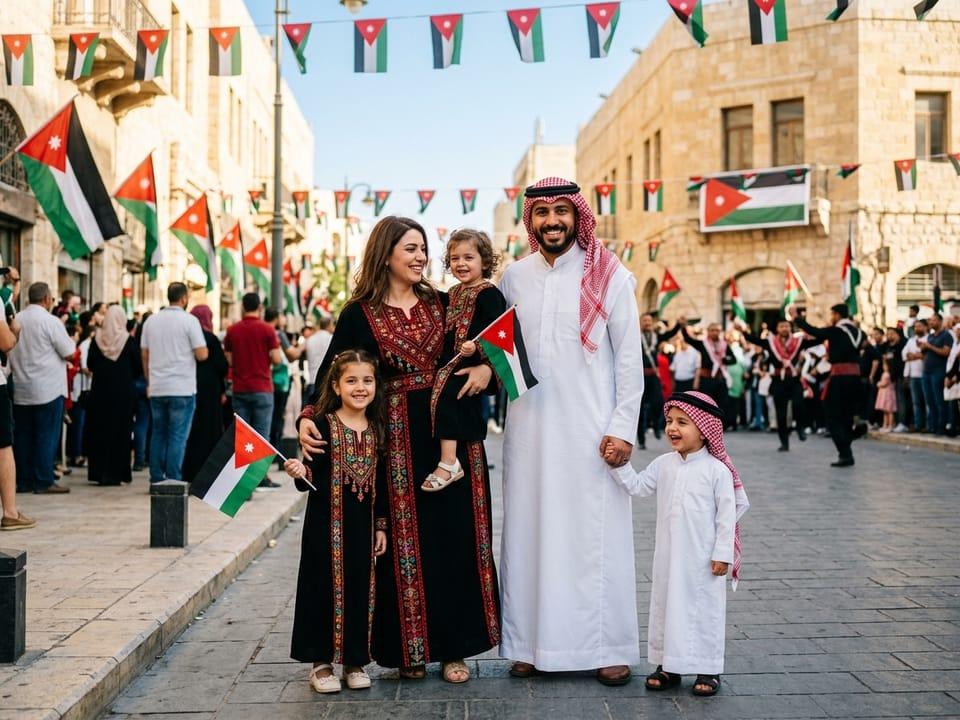
Jordanian Traditional Dress for Kids on Independence Day: Buy, Borrow or Put Together at Home
pokesta Editorial Team · Updated November 5, 2026
For a one-day school event on Independence Day (25 May) or Flag Day (16 April), a child doesn't need a full hand-embroidered thobe that will be outgrown by next spring. Build the outfit around one item: for boys, a red-and-white shemagh with an agal; for girls, one embroidered piece worn over clothes they already own. Borrow from cousins or pass pieces down between siblings, and take the photo in the morning before school, outside your door with a flag.
Two spring dates when schools may ask
Jordan marks Independence Day on 25 May, the anniversary of the day in 1946 when the emirate became an independent kingdom, so 2026 was the 80th. Flag Day falls on 16 April. The Council of Ministers approved it as part of the celebrations of the state's centennial, and on Flag Day 2026 Petra reported that 104 municipalities took part and about 750,000 flags were raised and handed out, with Greater Salt Municipality alone distributing thousands to schools, institutions and residents.
Not every school holds a dress-up day for either date, and those that do ask for different things. Some want traditional dress, some the flag's colours, some simply a flag or a shemagh. Read the note carefully before you buy anything, because "traditional dress or flag colours" leaves you a much cheaper option than "traditional dress" alone. For the holiday itself and what the flag's colours stand for, see our guide to Independence Day in Amman.
What reads as traditional in a photo
For boys and men, the most recognisable piece is the red-and-white checked shemagh. It is associated with Jordan and serves as a national symbol, and a black cord called the agal holds it on the head. For girls and women, it is the long dress, the thob, decorated with cross-stitch embroidery. Styles differ from region to region and even village to village, and Tiraz in Amman, which describes itself as home to the world's largest collection of Palestinian, Jordanian and Arab traditional dress, is a good place to see how wide that range is.
For a school morning, that variety works in your favour. Nobody expects a six-year-old to turn up in a museum piece. In a photo, what says "traditional" is the shemagh's pattern and a band of embroidery, and both come in small, affordable pieces.
Buy, borrow or put it together at home
Hand-embroidered dresses take many hours of stitching, which is why they cost what they do, while a child's size changes every year. Prices vary widely by shop, fabric and whether the embroidery is by hand or machine, so compare a few before deciding. A practical way to build the outfit:
Boys: a child-size shemagh and agal over a white shirt or a plain thobe. A shemagh has no size, so it works again next year and can be worn as an adult later.
Girls: one embroidered piece, such as a vest, a sash or a headband, over a long plain dress or dark clothes she already has.
Siblings: decide which pieces will be handed down, and size for the oldest child.
Family: ask grandparents and aunts first, since many households have a shemagh or an embroidered dress put away.
If you do buy, buy the piece you will use again: the shemagh, or an embroidered vest that fits over next year's clothes. A small agal tends to slip on a small head, so a soft headband underneath helps, and two safety pins at the back keep a shemagh in place through a school day of running around.
Studio, photographer or your own doorstep
Studio portrait in traditional dress
Photographer at a heritage site
Phone at your door
How the cost works
Session fee set by each studio
Session fee plus any entry tickets
Free
Child's mood
Longer in costume, unfamiliar room
Walking and sun, busy on holidays
Five minutes, then school
Changing the date
Usually possible
Depends on the photographer and weather
Any morning
What you get
Even light, posed family portrait
The Citadel or Roman Theatre behind you
A simple, real school-day picture
Suits
A framed portrait with grandparents
Families who want a landmark
Every family
A studio or a photographer is worth it when you want the whole family in full traditional dress, grandparents included, for a portrait that will hang for years, or when siblings are at ages you know won't line up again. For the school event itself, it's an extra rather than a need.
Five minutes at the door before school
Take the picture at home, before school, not at the event. The outfit is clean, the shemagh is straight and you choose the light. By late May the sun in Amman is already strong by mid-morning, so shoot early, on the shaded side of the building or in your doorway facing the open sky. Hang the flag on the door or wall behind, or let your child hold a small one.
Crouch to your child's eye level and take three: one full-length so the embroidery or shemagh shows, one close-up of the face, and one with siblings. Then a detail or two: the stitching on a sleeve, the agal, small hands around the flagpole. Five minutes, and your child goes to school without a costume change. At the event, photograph your own child, and if other children are in the frame, ask their parents before posting or crop them out.
A whole-family portrait without dressing everyone
If what you would really like is the whole family in traditional dress, grandparents and all, without buying or borrowing outfits for everyone, there is an easier way. pokesta creates an Independence Day family photo with AI from your own phone pictures, in embroidered thobes and shemaghs or in the flag's colours, for $1 per photo, and the first one is free. It is a generated image, not a photo of your family in the actual clothes. Make your free first one from this year's school-morning picture, and browse other families' Independence Day photos.