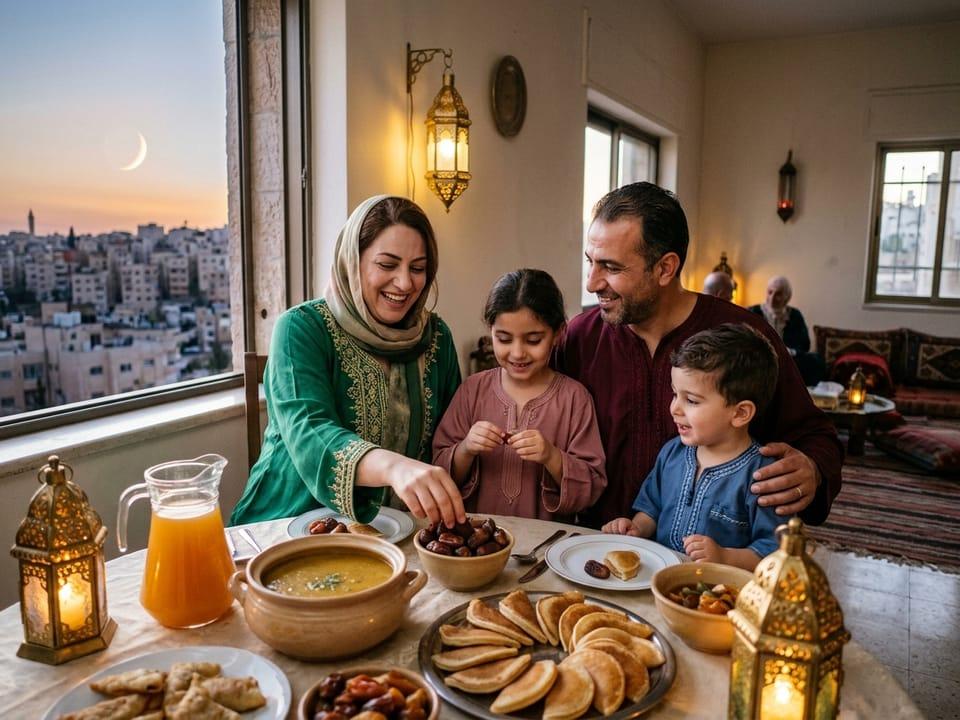
The iftar photo works best in two parts, and neither of them falls on the adhan. Photograph the table, with the food and no people, about 15 minutes before Maghrib while there is still daylight at the window. Take the family photo later, once everyone has broken the fast with dates and water, prayed Maghrib and settled at the table, with the room lights and lanterns switched on before sunset. In Amman, during Ramadan 2027, sunset moves from about 6:16 pm at the start of the month to about 6:39 pm at the end, and the sky is dark roughly 25 minutes after that.
The minutes before Maghrib are the worst time for a portrait
Ramadan 2027 is expected to run from about 8 February to 8 March, going by the Umm al-Qura calendar, though the start is confirmed only by sighting the new crescent and can shift by a day. Fasting runs from dawn to sunset. By late afternoon the adults have gone the whole day without food or water, the kitchen is in its final rush, and the children are hungry too: those below puberty aren't required to fast, but some practise with part of a day, and all of them are at their most restless just before the meal.
So the last half hour is when every family photo tends to go wrong. Smiles are tired, someone is still carrying a pot of soup, and the light at the window is going. When the adhan sounds, that moment belongs to breaking the fast, not to arranging people for the camera. Nobody should be asked to wait with a date in hand while a phone is set up.
Shoot the table, not the people, before the adhan
What you can photograph beforehand is the table itself. Around 15 minutes before Maghrib, most dishes are out and there is still soft light from the window, which flatters food far more than the ceiling light does. In early February that means setting up by about 6:00 pm; by early March, closer to 6:20. The official Maghrib time for your city is listed on the website of Jordan's Ministry of Awqaf and Islamic Affairs, and it is the time to plan around.
Fill the frame with the things that say Ramadan in Jordan: the bowl of dates beside the glasses of water, a jug of qamar al-din, the sweet apricot drink served through the month, or tamar hindi, the sweet-sour tamarind drink. Shoot one picture from directly above and one from seated eye level along the table. If the table is far from the window, set the dates and drinks on a small side table by the window for the close-ups. Don't hold dishes back for the picture. Photograph what is ready and let the cook finish in peace.
If a child wants to help, give them the job of placing the dates. A small hand putting dates into a bowl is a better Ramadan picture than a posed smile, and it keeps them busy during the slowest minutes of the day.
The family photo comes after dates, water and prayer
Iftar traditionally opens with dates, recalling the Prophet Muhammad's practice of breaking his fast with three, and water is the usual drink. Many families then pray Maghrib before the main meal is served. The calm comes after that: plates filled, the first hunger gone, the children happily eating. Take the family photo then, or wait for dessert. Qatayef, the filled pancakes Jordanians associate with Ramadan, are eaten after iftar, and a tray of them makes a natural reason to gather everyone for one picture.
The light is the hard part, because by then it is fully dark outside. Switch on the lamps and lanterns before sunset, not after, so nobody has to get up mid-meal. Put a lamp to one side at face height and turn off a harsh overhead light if it leaves shadows under eyes. Use the standard 1x lens rather than the ultra-wide, prop the phone against something steady, and take a burst. Lantern lights in the background become soft glowing circles, but they won't light faces on their own. And if tonight doesn't work, Ramadan has 29 or 30 evenings; try again tomorrow.
Two courtesies matter. Don't photograph anyone while they are praying, and ask before posting pictures of relatives or guests.
Phone, photographer at home or a studio Ramadan session
|
Your own phone |
Photographer at your iftar |
Studio Ramadan session |
| Cost |
Free |
A fee for the evening; ask for a quote |
A session fee; ask what the set includes |
| Hunger and moods |
You choose the moment after the meal |
Booked time may clash with the meal |
A daytime slot falls while adults fast |
| Changing the date |
Any of 29 or 30 evenings |
Ask before paying a deposit |
Ask before paying a deposit |
| Result |
Real table, real evening |
A record of a large gathering |
Styled lanterns and costumes |
| Suits |
Most families |
A big family iftar with grandparents |
Children's Ramadan portraits |
A photographer earns the fee on the night the whole extended family breaks the fast together and you want a record of the long table without anyone being stuck behind the camera. Remember the photographer may be fasting too: book them from just after Maghrib, and offer dates, water and a plate. A studio set is a different thing, a portrait rather than a record of iftar; the comparison is in Ramadan photos with kids at a studio, the mall or home.
Let the iftar stay a meal
The best iftar photos come from families who decided in advance that the meal comes first. If the evenings pass without a family picture, pokesta can make one with AI from the phone photos you already have of each person: the family in embroidered jalabiyas at a lantern-lit table. It is $1 per photo, and the first one is free, so try it with a picture from this week's iftar. The result is a generated image rather than a record of your evening, so keep the real table photos too. Create a Ramadan family portrait.
References