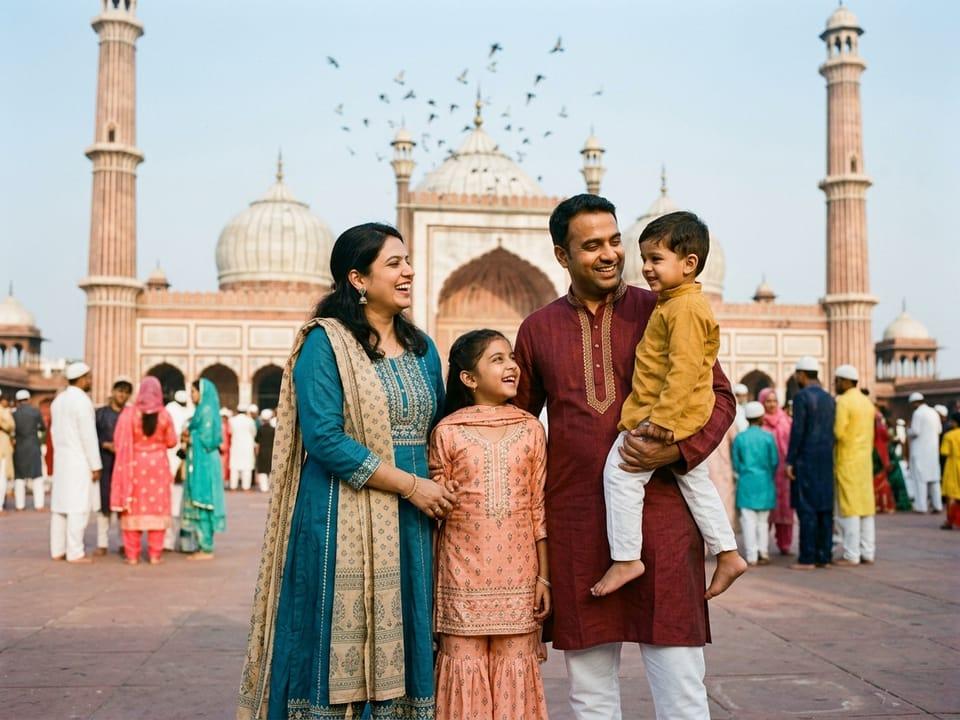
Eid ul-Fitr begins when the Shawwal crescent is sighted after the 29th fast, or after the 30th if it isn't seen, so the date is confirmed only the evening before. In 2026, most of India celebrated on Saturday 21 March, while Kerala, where the moon was sighted at Kappad beach in Kozhikode, celebrated on Friday 20 March. The central government's 2027 holiday list puts Id-ul-Fitr on Wednesday 10 March, a date that can be changed after the sighting. The surest family photo is the one taken at your own door, right after the Eid namaz and before the visits begin.
How the date is decided in India
The Islamic month runs 29 or 30 days. On the evening of the 29th of Ramadan, people look for the new crescent. If it is seen, Eid is the next day; if clouds or a bright sky hide it, Ramadan completes 30 days and Eid follows a day later. In India, moon-sighting committees and religious authorities in Delhi, Lucknow, Mumbai, Hyderabad and other cities meet after the Maghrib prayer and announce the result that night. In 2026 those committees received no sighting on 19 March, so Friday became the 30th fast for most of the country.
Kerala sometimes celebrates on a different day. In 2026 the state's Qazis issued a joint statement after the crescent was sighted at Kappad and then at Chettippadi, and Kerala, where Eid is often called Cheriya Perunnal, celebrated a day earlier than most of the country. Government holiday lists follow the same logic. The 2027 order allows the Delhi holiday to be changed depending on the sighting, and for offices elsewhere the date follows the state government's decision. Plan your photos so they work on either of two days.
Chand Raat: get everything ready the night before
Chand Raat, the night of the moon, is when the waiting ends. In India, families crowd the markets for last-minute clothes, bangles and gifts, and women and girls put henna on each other's hands. It's also the night that decides how sleepy everyone will be at dawn.
Do the photo preparation earlier in the evening, before the announcement if you can. Iron the children's outfits and hang them with the topi, dupatta and footwear beside them. Charge the phone, clear the doorway of shoes and clutter, and decide who will hold the camera. Give children their mehndi early, so it has time to dry before they sleep and doesn't smudge onto new clothes in the morning.
Morning namaz with children
The Eid prayer is offered in congregation at mosques and Eidgahs in the morning, and each mosque announces its own time. Zakat al-Fitr, the charity owed at the end of Ramadan, is given before the prayer, so settle it the night before rather than in the morning rush. Children who were up late on Chand Raat will be slow to wake. Dress them last, after the adults are ready, and carry water and a small snack. At a large Eidgah, keep little ones close and agree beforehand where to meet if you're separated.
Leave the camera in your pocket during the prayer itself. The pictures you want come afterwards, when the congregation breaks up and people embrace and greet each other with "Eid Mubarak".
The doorway photo, right after namaz
Come home and take the family photo before anything else. Clothes are still crisp, mehndi is fresh, and nobody has left for the first visit. Stand in the shade of the doorway, where the light is even, and set the phone on a timer at chest height. Five minutes is enough. Then the sheer khurma and sewaiyan can come out.
Two more moments are worth keeping. One is the children receiving Eidi, the cash gift elders give them, which is easy to catch from the side as the notes change hands. The other is the group at each house you visit. Ask your hosts before posting photos of their home or family, and keep it brief. Visits are about the people, not the pictures.
Booking a photographer when the date can move
|
Studio after Eid |
Photographer on Eid morning |
Your own phone |
| Date risk |
None: book any day after |
Booked day may not be Eid |
None |
| Children's mood |
Rested, set slot |
Up late on Chand Raat |
Shoot when they're ready |
| Changing the date |
By studio policy |
Ask for both possible days |
Not needed |
| Result |
Polished portrait in Eid clothes |
Real morning and greetings |
Doorway photo and visits |
| Suits |
A formal portrait for the wall |
Big gatherings at one house |
Most families |
Booking a photographer for a fixed date carries a real risk, because the moon may move Eid by a day. If you want someone on Eid morning, ask in advance whether they can hold both possible dates and what happens if Eid falls on the other one, and get the answer in writing. A studio session on the second or third day of Eid avoids the problem entirely, while everyone still has their new clothes. A professional is most worth it when twenty or more relatives gather at the grandparents' house for lunch and you want every branch of the family in one frame.
If the visits swallow the day
On Eid it often happens: the day fills with relatives, and nobody remembers the group photo until evening. pokesta can make one afterwards, an Eid family portrait made with AI from the phone photos you already have, with settings such as a festive table of sheer khurma and biryani. It's $1 per photo, and your first photo is free. It's an image created for you, not a photograph of that morning, so treat it as an extra. Make your first one free with a recent photo of your children, and see everyone's Eid posts for more ideas.
References