
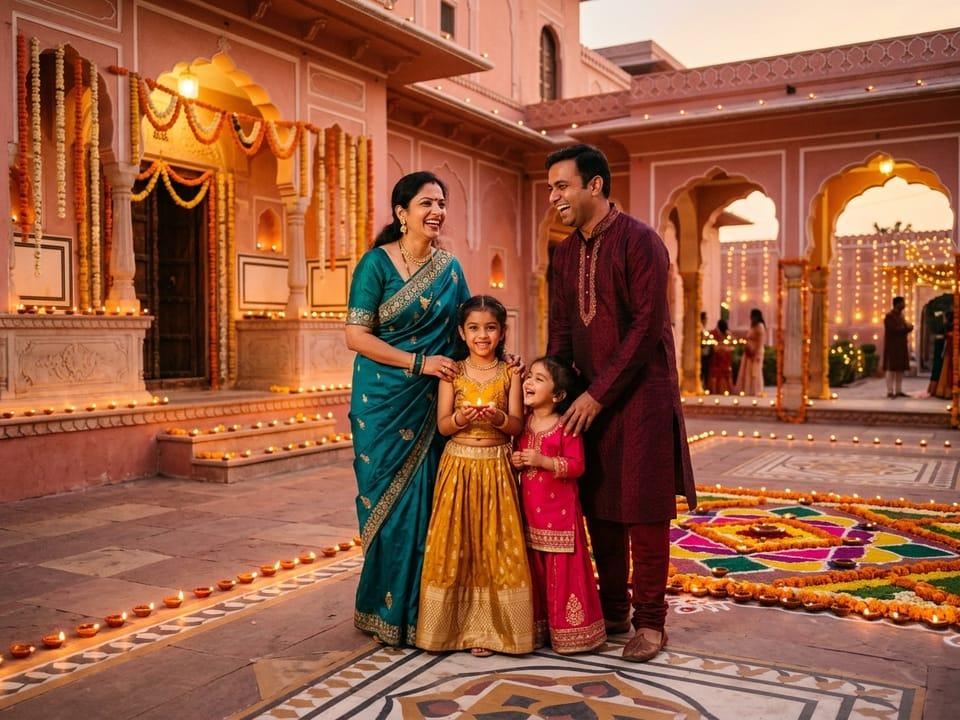
Diwali crackers are hard on a baby's ears and lungs alike. The US Centers for Disease Control and Prevention (CDC) lists a single loud sound near the ear, such as a firecracker, among the causes of noise-induced hearing loss, and the World Health Organization (WHO) notes that children breathe faster than adults and so take in more pollutants. The plan that protects a baby is simple: take the family photo in the half hour after sunset, before the crackers begin, and spend the loudest hours in the room farthest from the street with the windows shut. When the family goes out to watch, the baby stays inside, and if a baby really has to be near the bursts, use earmuffs rather than earplugs.
India's legal limit for a single firecracker is 125 dB(AI) or 145 dB(C)pk, measured four metres from where it bursts. In Delhi-NCR, the Supreme Court allowed only green crackers in 2025, and only from 6 to 7 am and 8 to 10 pm on Diwali and the day before; the rules are set again each year. Diwali falls on 8 November in 2026 and on 29 October in 2027.
Noise, smoke, sleep and fire all land on the same night
The first is noise. The legal limit above applies to each cracker, and the Environment (Protection) Rules lower it further for crackers joined in a series, but on a crowded street dozens burst within a few minutes, often right outside the window. Phoenix Children's, a US children's hospital, explains that because babies have smaller ear canals than adults, the sound pressure entering their ears can be greater. The CDC adds that the louder the sound, the less time it takes for hearing to be damaged.
The second is smoke. Diwali comes as the weather cools, and the Central Pollution Control Board's index sorts air quality into six bands, from Good (0 to 50) through Satisfactory, Moderately Polluted, Poor and Very Poor to Severe (401 to 500). The WHO gives two more reasons children are hit harder than adults: they live closer to the ground, where some pollutants are most concentrated, and their brains and bodies are still developing.
The third is sleep. Lakshmi Puja is held in the evening, and the muhurat can fall right on a baby's bedtime. The fourth is fire: diyas at floor level, sparklers in the hands of older cousins and festive clothes made of synthetic fabric.
The evening plan: photo first, puja next, crackers last
Work backwards from sunset. Give the baby a good nap in the afternoon and a feed shortly before the photo, and dress them last, after the adults are ready. Go to the doorway as the sky turns deep blue, with the diyas lit and the rangoli finished, and take the family photo then. There's still enough light to see faces and the house, and nobody is coughing in smoke yet. Our guide to Diwali family photos at home covers the framing and the self-timer.
If the puja muhurat falls later, the photo still comes first. After the puja, take the baby into the room farthest from the street, shut the windows and run a fan for steady background sound. Toddlers can watch the sky from behind closed glass with an adult. Go back out only when the crackers stop, and leave the baby inside. If you can't avoid carrying the baby through the noise, say on the way to a relative's house, Phoenix Children's recommends earmuffs for babies rather than earplugs. The closer you are to a sound, the louder it is at the eardrum, so keep as far from the bursts as the street allows.