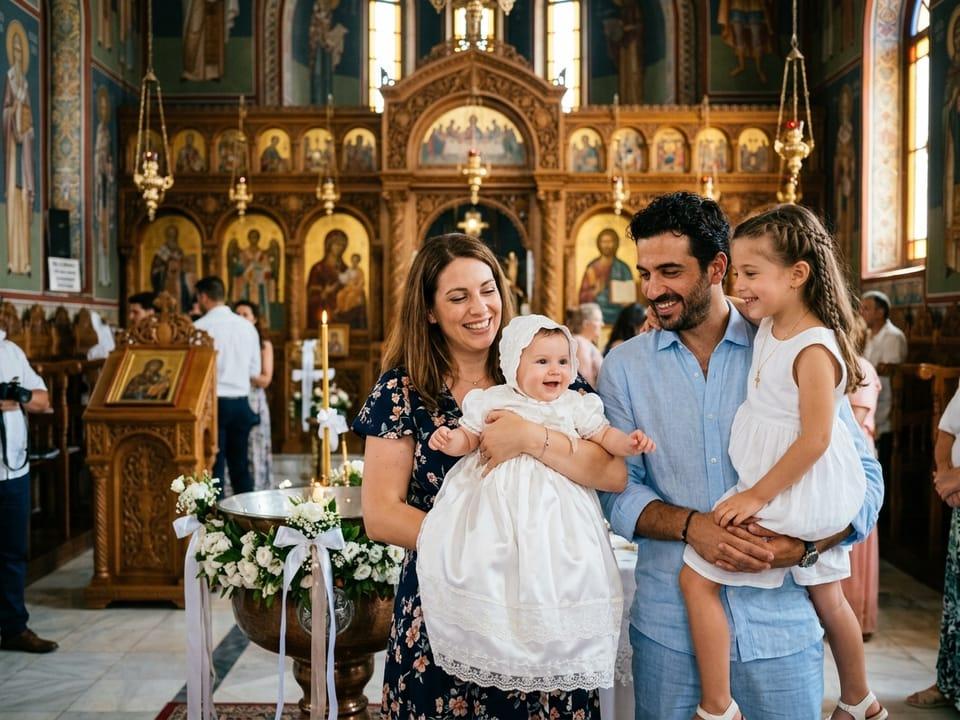
A baptism at a whitewashed chapel by the sea (an exoklisi) comes with two conditions you can plan around. Most of your guests will stand outside, because a small chapel often holds little more than the priest, the godparents, the parents and the font. And from about mid-May to mid-September the meltemi, the dry north wind of the Aegean, can blow hard, usually at its strongest in the afternoon. Put one photographer inside, make the group photo outside the main event, and choose the hour only after you have stood at the chapel and checked the wind and the sun yourself.
First, find out whether the chapel can host a baptism
Before you fall for the view, ask who the chapel belongs to. Small churches in Greece can be parish chapels, monastery or cemetery churches, or private chapels built by a family, and the answer decides whether a baptism is possible at all. The Metropolis of Mesogaia and Lavreotiki in East Attica, which counted more than 600 churches and chapels in its area, ruled in a 2005 circular that weddings and baptisms take place only in consecrated churches that have an antimension. A 2007 circular from the same Metropolis, citing the Holy Synod, restricted sacraments to parish churches and to parish chapels that meet the requirements. Private chapels, it said, serve the owner's family only, and each service needs the Metropolitan's prior approval.
Rules differ from one Metropolis to the next, so read that as an example rather than the law everywhere. The order of steps is the same, though: speak to the priest of the parish the chapel belongs to, ask whether the Metropolis has to approve it, and only then book the taverna. Then ask what a chapel raises and a parish church doesn't. Is there electricity and running water? Who brings the font, and who warms the water for it? How does the priest get there, and is a chanter coming?
One camera inside, everyone else at the door
In a tiny nave, a second photographer or a row of relatives holding up phones ends up between the priest and the font. Agree beforehand that one person shoots inside, whether that's a hired photographer or the steadiest relative you have. Everyone else waits in the courtyard, where the baby will come out in white after the service.
A chapel with thick walls and small windows is dark inside, and the open door is a bright rectangle of glare. If you're using a phone, stand with the door to your side rather than behind the font, tap on the baby's face to set the exposure, and keep the flash off unless the priest says otherwise. Ask a second person to record video from the doorway, so the priest's words at the immersion are kept even if the stills miss.
The meltemi blows out candles and carries off sound
Wind is the problem you'll feel first. The etesian winds can reach force 7 to 8 on the Beaufort scale, and at that strength most inter-island ferries cannot sail. They often ease at night, but sometimes blow for days without a break. On an exposed point that means the lambada, the large baptismal candle, won't stay lit outdoors, ribbons and tulle on the font flap into every frame, and guests' phones record wind noise instead of the chanting.
A few habits help. Light the lambada indoors and carry it outside inside a tall glass lantern, with a spare lighter in someone's pocket. Tie ribbons short and weigh down any decoration. Keep the baby wrapped in the white sheet and out of the draught after the immersion, and dress them inside. In the central Aegean the meltemi comes from the north, so the south side of a chapel is usually the sheltered one for the group photo. In the north Aegean it blows more from the northeast, and in the south from the northwest, so check on the day which wall actually gives cover.
Visit at the same hour a week before
Go to the chapel at the time you plan to hold the service, ideally on a day with a similar forecast. Note where the sun sits, where the shade falls, whether the sea will be behind your guests (backlight, dark faces), and where the grandparents can sit. Whitewashed walls bounce strong light, which is kind to faces late in the afternoon and harsh at midday. If the wind is up at five, ask whether the priest can do a morning or a later evening slot instead, since the meltemi tends to drop toward night. Our piece on summer baptisms in the heat goes further into timing and sunset.
Photographer, relative or your own phones
|
Hired photographer |
A relative with a good camera |
Phones only |
| How the cost works |
Coverage hours plus travel to the chapel |
Free, but that person misses the service |
Nothing extra |
| Wind and a crying baby |
Knows where to stand, quick in low light |
Depends on experience |
Hit and miss in a dark nave |
| Changing the time |
Their own terms; ask before paying a deposit |
Easy |
Easy |
| Result |
Reliable immersion shots and group portrait |
Good family moments |
Lively snapshots, few usable from inside |
| Best for |
Families who want the immersion recorded properly |
Small, relaxed baptisms |
Tight budgets, very small chapels |
A professional earns the fee here mostly inside the chapel: the three immersions are over in seconds, the light is poor, and there is room for one camera. If you hire one, ask whether they have shot Orthodox baptisms before and whether the quote includes the trip out to the chapel. For the moments to brief them on, see our Greek Orthodox baptism photo guide.
If the wind wins, make a calmer portrait
Some chapel baptisms end with a perfect immersion and a group photo of squinting relatives with hair blown across their faces. If that's yours, pokesta can make a family portrait in baptism clothes and a chapel setting with AI, from phone photos you already have. It costs $1 per photo and the first one is free. It is a generated picture, not a record of the day, so keep your real photos exactly as they are. Try it with a recent photo of your baby and see whether it gives you the portrait the wind took.
References