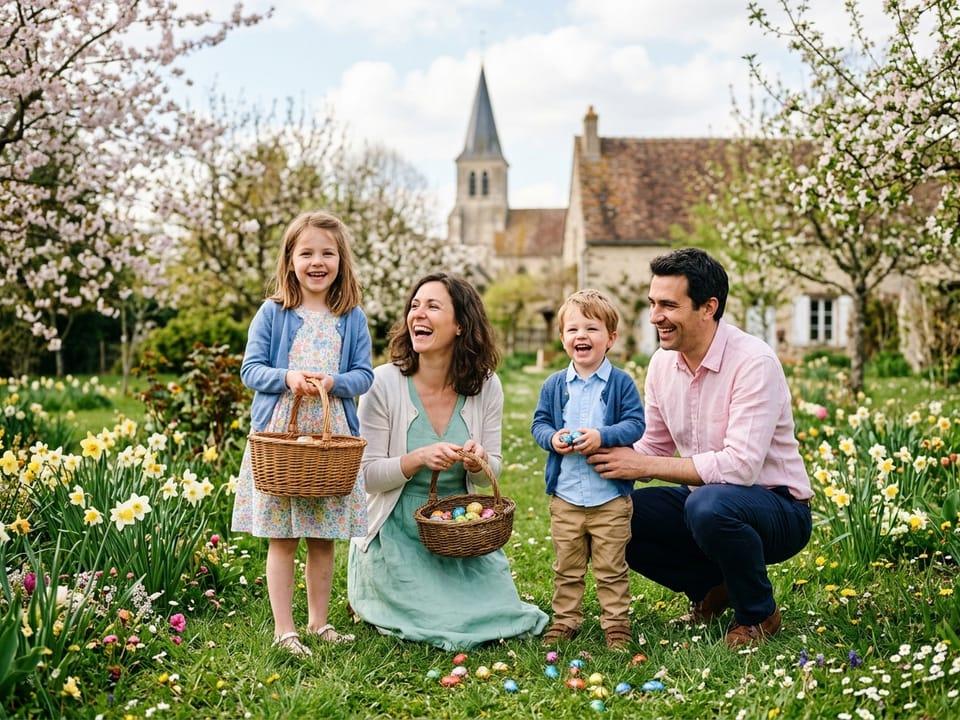
Easter comes early in 2027, on Sunday 28 March, and Easter Monday is a public holiday across France, so a wet Sunday doesn't have to cost you the chasse aux œufs. Late March is often damp: Météo-France's 1991–2020 averages give Paris 9.5 days with at least 1 mm of rain in March, and Brest 13.2. Have an indoor hunt ready in your brightest room, keep the garden for whichever morning is drier, and plan a ten-minute family photo outside in the first dry spell.
Easter is 28 March in 2027, and Monday is your second chance
Service-Public.fr lists Lundi de Pâques on 29 March 2027. In Alsace and Moselle, Good Friday (26 March) is also a holiday in communes with a Protestant church or a church shared by both denominations.
The story behind the hunt leaves room too. The Catholic Church in France explains that church bells fall silent for three days after the Maundy Thursday Mass as a sign of mourning, and only ring out again in the night between Saturday and Easter Sunday. Children were long told that the bells had flown to Rome to be blessed by the Pope and would come back loaded with treats. In much of France the chocolate eggs land in the garden overnight; in Alsace, French Wikipedia notes, it is the Easter hare that brings them. Nothing in either story says the eggs must be found before Sunday lunch. If it's pouring at nine, the bells can have been held up by the weather.
Late March is wet and chilly, especially in the west
The averages are worth a look before you promise a garden hunt. At Paris-Montsouris, March has 9.5 days of rain on average, a typical high of 12.8°C and a low of 5.6°C. April is a little kinder, with 8.6 rainy days and a high of 16.6°C. At Brest-Guipavas, March averages 13.2 rainy days and a high of just 11.9°C. An Easter as early as 2027's sits at the very end of March, so expect cold, wet grass in the morning even if the sun comes out after lunch.
Check the forecast on Saturday evening and make the call then, not at the back door with excited children.
Move the hunt to the room with the biggest window
Indoors, light decides everything. Pick the room with the largest window, open the curtains fully and switch off the ceiling lights, because warm bulbs mixed with daylight turn skin orange on one side of the face and blue on the other. Hide most of the eggs in that room at a small child's eye level: behind cushions, under a chair, on the windowsill, inside a boot by the door. You'll know where the action will be, and you can stand with your back to the window so the light falls on the children's faces.
Give each child a set number of eggs, or a foil colour of their own, so the youngest isn't cleared out by an older cousin in thirty seconds. Crouch to their height, use burst mode for the moment an egg is spotted, and leave the flash off; it flattens the room and makes the foil glare. Our galette des rois guide uses the same window-light approach for a January table.
If you still want a short outdoor round between showers, hide only foil-wrapped eggs outside and keep the area small, so everything can be gathered before the next downpour. Bring the eggs in as soon as it's over and dry the foil with a tea towel. Count them on the way out and on the way back, or someone will find a soggy egg in the flowerbed in May.
Take the garden photo in a ten-minute dry spell
The family photo doesn't need the hunt to happen outside. Have everyone dressed, boots lined up by the door, and when the rain stops, go out for ten minutes: one shot of the whole family under a tree or against the house, one of each child with a basket, one close-up of muddy boots beside the eggs. Overcast light is soft on faces, so a grey sky is no reason to wait for sunshine. Wellies and a bright raincoat look better in a photo than a child shivering in a party dress, and an open umbrella gives the smallest ones something to hold.
If the dry spell never comes on Sunday, try Monday morning.
Studio, a photographer at home, or your own phone
A studio session is indoors, so the weather never decides for you, but you book a fixed slot weeks ahead and your child may turn up tired. A photographer who comes to your garden captures your own place and your own hunt, but rain puts you back in the booking terms: before paying, ask whether a washed-out session moves free of charge and how much notice they need. Your own phone costs nothing and can wait for both the weather and your child's mood.
|
Studio session |
Photographer at home |
Your own phone |
| How the cost works |
Session fee set by the studio |
Session fee plus travel |
Free |
| Rain |
No effect |
Session may move; check the terms |
Wait for a dry spell |
| Child's mood |
Fixed time slot |
Some give on the day |
Shoot when they're happy |
| Changing the date |
Studio's policy |
Photographer's terms |
Any time |
| Result |
Even light, posed portraits |
Your garden, real moments |
Natural, uneven quality |
| Suits |
A framed portrait |
Big family gatherings |
Families with small children |
A professional is worth paying for when grandparents, aunts and cousins are together for one day and you want everyone sharp in a single frame, or when you want a print big enough for the living-room wall.
If the garden photo never happens, make one from your phone photos
Some years it rains all weekend. pokesta can turn the phone photos you already have into an Easter family portrait with AI, set in a spring garden full of hidden eggs, even if the real hunt took place behind the sofa. It is a created image, not a record of the day, so keep the indoor photos as the real memory. It costs $1 per photo and the first one is free, so try it with a recent photo of your child before the bells come back, or look at Easter photos other families have shared.
References