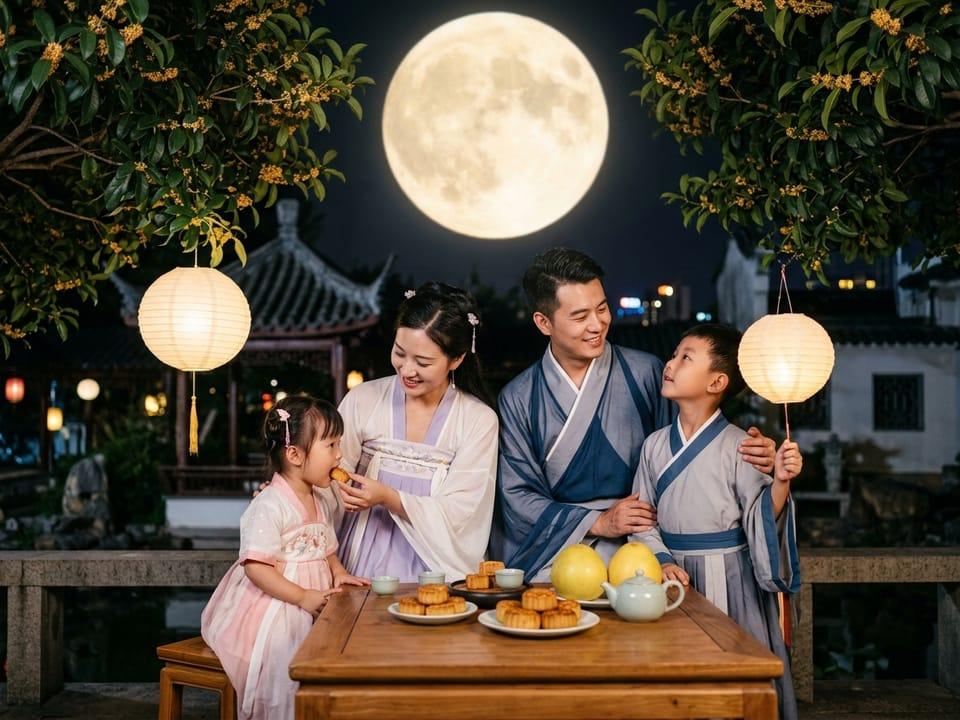
A phone struggles with "the moon plus the family" because the moon is far brighter than people standing in the evening dark: expose for faces and the moon turns into a white blob, expose for the moon and everyone becomes a silhouette. There are three ways round it. Shoot just after moonrise while the sky still has some light, light the family with lanterns or a phone torch once it's dark, or photograph the moon on its own and pair it with the family shot. Mid-Autumn 2027 falls on September 15 according to the Hong Kong Observatory's calendar, and if that night is cloudy, the moon on the 16th is just as close to full.
Why the moon always comes out as a white dot
The full moon is lit directly by the sun, while your family on the balcony has only a little lamplight and what's left of the sky. The gap is too wide for a phone. Shoot at default settings with people in the frame and the moon blows out to white; tap the moon on screen and pull the exposure down, and its surface appears while the people all but vanish.
So don't expect one frame to get both perfect. Either bring the two brightness levels closer, or shoot them separately.
Moonrise, while the sky is still light, is the easiest time
The simplest moment is just after the moon comes up. NASA's guide to moon phases explains that a full moon rises around sunset and sets around sunrise. Around Mid-Autumn the moon is close to full, so it climbs over the eastern horizon at about the time the sun goes down. The sky still holds some blue, faces catch the last daylight, and a phone can capture both in one frame.
Check your local moonrise time in a weather app beforehand and find somewhere with an open view to the east: a rooftop, a riverbank, an open square in your housing compound. Stand the family three to five paces from the phone and put the moon in a corner of the frame. A newly risen moon sits low beside buildings and trees, which makes it look bigger. Set a few mooncakes and a pomelo on a small table in the foreground, and the picture says Mid-Autumn at a glance.
There's a second advantage: it isn't bedtime yet. Wait until the moon is high and the youngest may already be asleep on the sofa.
After dark, let lanterns light the faces
Once it's fully dark, the people need light. The most festive source is a lantern: have your child hold one and lean in a little, and its warm glow falls right on their face. Or an adult can switch on a phone torch and shine it through a sheet of white paper or a paper lantern for much softer light.
Leave the phone's own flash off. It only reaches a metre or two, bleaches faces and makes the sky and moon behind even darker, while drowning out the lantern's warmth.
Night mode needs a steady phone. Rest it on a railing or a stand, use the self-timer, and ask everyone to huddle together and hold still for two or three seconds, the same approach as Spring Festival family photos at home. If the children won't keep still, photograph them from behind as they look up at the lanterns or the moon; the silhouettes are lovely on their own.
Shoot the moon alone, then pair it with the family
If your phone has a telephoto lens, give the moon its own frame. Zoom until it fills part of the screen, tap it and lower the exposure until you can see light and shadow on its surface. Then take the family photo using one of the methods above. Put the two side by side in a collage, or next to each other in the album, and they still tell the story: this Mid-Autumn, we watched the moon together.
A pair is easier than a composite, and more honest. Paste a giant moon behind the family and one day your child may leaf through the album and ask whether it was real. If the family wore hanfu, the pair looks especially good; hanfu family photo costs runs through what outfits and styling cost.
Clouds or a typhoon? The sixteenth-night moon is your backup
A Mid-Autumn without a visible moon is nothing unusual. Autumn clouds and rain arrive quickly, and along the southeastern coast there are typhoons to think about. The Chinese Wikipedia article on typhoons says they are most frequent in the western North Pacific from July to October, with August the busiest month, followed by July and September. Keep an eye on the National Meteorological Center's forecasts in the days before.
Luckily, the saying "the moon of the fifteenth is roundest on the sixteenth" (十五的月亮十六圆) is more than folklore. According to a Xinhua report from September 2026, the moment of full moon (望) can fall on the 14th, 15th, 16th or 17th of the lunar month, most often the 16th and next most often the 15th. At Mid-Autumn 2026 it came at 00:49 on September 27, already the 17th, though even on the 15th more than 98% of the moon's face was lit. NASA's table of moon phases puts the 2027 full moon at 23:04 Universal Time on September 15, about 07:00 on September 16 in Beijing, so the nights of the 15th and 16th sit roughly equally close to it. The moon does rise a little later each day, though, so head out a bit later on the 16th.
It's worth planning for two nights from the start: take pictures during the family dinner on the 15th, and if the sky won't cooperate, bring the lanterns out again on the 16th.
If both nights are cloudy, let AI make the moonlit portrait
If clouds cover both the 15th and the 16th, or someone in the family is far away this year, pokesta can create a Mid-Autumn family portrait with AI from the photos already on each person's phone, with everyone together beneath the moon, for $1 per photo, and the first photo is free. It's a generated image, not the moon you actually saw that night, so still take the real pictures of eating mooncakes and carrying lanterns together. Generate your first one free from a recent photo of your child.
References