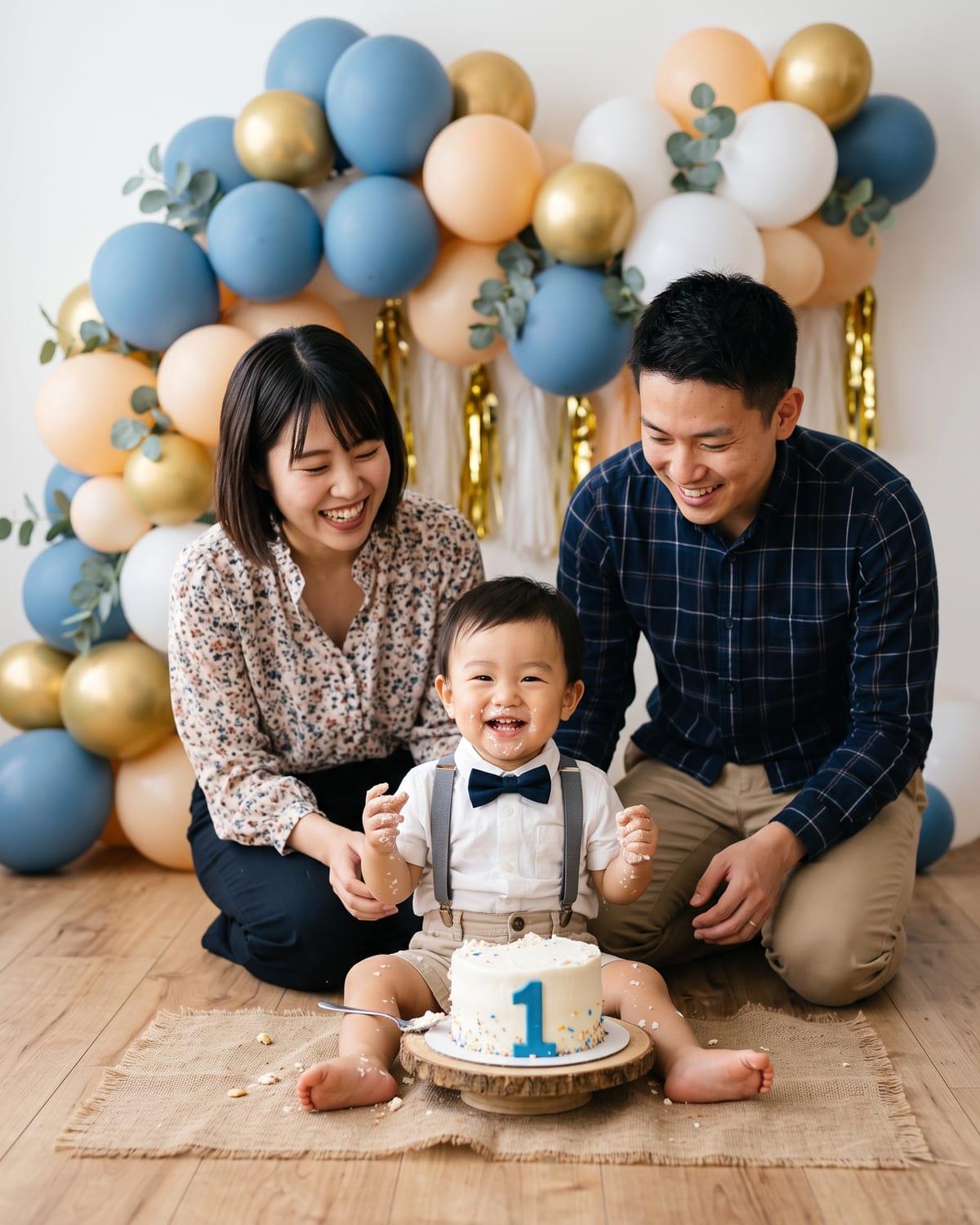
If your child has an autumn birthday and turns three just as Shichi-Go-San comes around (a Japanese celebration where children of three, five and seven visit a shrine in their best clothes), shooting both at one studio visit means one session fee and one trip. Studio Alice, a children's photo studio chain in Japan, lets families do several commemorative shoots on the same day and charges a session fee of 5,500 yen (tax included) per family however many poses you take. The prints and files you buy set the total, though, and photos for two occasions add up. Given a 3-year-old's attention span, two outfits in a day is a sensible limit, a kimono for Shichi-Go-San and one Western outfit for the birthday; if you want more, split the days.
Celebrate by actual age and an autumn birthday lands on Shichi-Go-San
Shichi-Go-San was traditionally counted in kazoedoshi, the old system where a baby is one at birth and everyone gains a year on New Year's Day. Today many families use the child's actual age instead. The age-three celebration comes from a rite called kamioki, and according to the Association of Shinto Shrines it was held for both boys and girls.
For an autumn 2026 celebration, the age-three children are those born in 2023 by actual age, or in 2024 by kazoedoshi. A child born in autumn and celebrated by actual age hits Shichi-Go-San right around their third birthday. The date doesn't have to be November 15; many families go on a weekend or holiday during November, and in colder regions such as Hokkaido it is often held a month earlier, on October 15.
Choose kazoedoshi and the same child celebrates a year earlier, in the autumn they are two, alongside their second birthday instead. Which year you pick changes which birthday you can combine it with. Go by whether your child seems ready that autumn to spend two hours at a studio in a kimono. For more on counting ages and when to start preparing, see when to celebrate Shichi-Go-San.
Shooting both together means one session fee and one visit
The main advantage of combining is the session fee and the number of visits. Studio Alice's FAQ says you can do several commemorative shoots on the same day, with a session fee of 5,500 yen (tax included) per family however many poses you take, and gives examples such as Shichi-Go-San with Omiyamairi (a baby's first shrine visit), or a 1-year-old's and a 4-year-old's birthdays together. Children's outfits are free however many your child wears, and you can bring your own kimono for children up to about age seven.
The total, however, depends on products more than on the session fee. Buy a mounted print set for Shichi-Go-San and another for the birthday, and you pay for two. Combining saves on the session fee and travel; how many photos you buy is a separate decision. Before you sit down to choose, agree on a plan such as "one mounted set for Shichi-Go-San, files only for the birthday." Prices were checked on the official site in October 2026 and vary by season, location and plan, so check the official site of the studio you book.
Two outfits a day is plenty for a 3-year-old
The thing to watch in a combined session is your child's stamina. Studio Alice puts a session at roughly two hours, give or take depending on the child's mood. Each change adds time, and a 3-year-old's ability to stay focused in front of a camera is shorter than adults expect.
A useful limit is two outfits in one day: the Shichi-Go-San kimono and one dress or tuxedo for the birthday. Do the kimono first. Shichi-Go-San at age three happens once, while birthday photos come around again next year. Decide in advance that if the kimono wears your child out, the birthday outfit becomes a photo at home, and you won't push them on the day.
If you find yourself wanting a third or fourth outfit, that's your cue to split the days. For how many outfits to choose for Shichi-Go-San itself, see how many Shichi-Go-San outfits to wear at a studio.
If you split them, do the birthday at home and Shichi-Go-San at a studio or shrine
Splitting lets you choose the best place for each. The birthday at home with cake; Shichi-Go-San at a studio or at the shrine on the day of the visit. Cake and candle moments are easier at home without a clock running. Tips are in birthday family photos at home.
The Association of Shinto Shrines notes that shrines fill with families in festive clothes on the holidays around November 15. Pack photos into the shrine day too, and it becomes a long day for a 3-year-old. With birthday photos done at home first, Shichi-Go-San day can be just the shrine visit and kimono pictures.
Splitting means more visits, but birthday photos at home cost almost nothing, so the extra is at most one studio session. The bigger strain is two big events in one autumn. Leaving a free weekend between the birthday and Shichi-Go-San lets everyone take them one at a time.
Studio, on-location photographer or DIY: a studio suits a combined shoot
|
Photo studio |
On-location photographer |
DIY |
| How pricing works |
Session fee plus products; two occasions on one day still mean one session fee (Studio Alice) |
Hourly rate with files included |
Equipment only |
| Strain on your child |
Longer with every outfit change |
Can move between spots within the time |
A little at a time, whenever you like |
| Rescheduling |
Depends on the studio's policy |
Free date change for illness or weather (fotowa) |
Any time |
| Results |
Professional dressing and lighting |
The shrine visit and family at the shrine |
Everyday expressions |
| Best for |
Getting kimono and Western outfit in one go |
Recording the shrine visit itself |
Families happy with birthday photos at home |
A studio is worth it when you want both the kimono and a Western outfit captured with professional dressing and lighting in one go. To record the shrine visit itself, an on-location photographer fits; fotowa charges 24,200 yen on weekdays and 29,700 yen on weekends and holidays (tax included) for about 60 minutes including setup and packing up, with at least 75 digital photos. Birthday photos taken at home cost almost nothing.
The second outfit can be added in a photo
Limiting the day to two outfits may leave one you never got to. You can create that look afterward. pokesta uses AI to make family photos in birthday outfits or Shichi-Go-San kimono from each family member's own phone photos, at $1 per photo, with your first photo free. It is a created image, not a record taken at the studio, but it lets you add the dress your child didn't get to wear, or a picture with grandparents who couldn't come, from home. Start with a photo of your child on your phone and try making a birthday photo.
References