
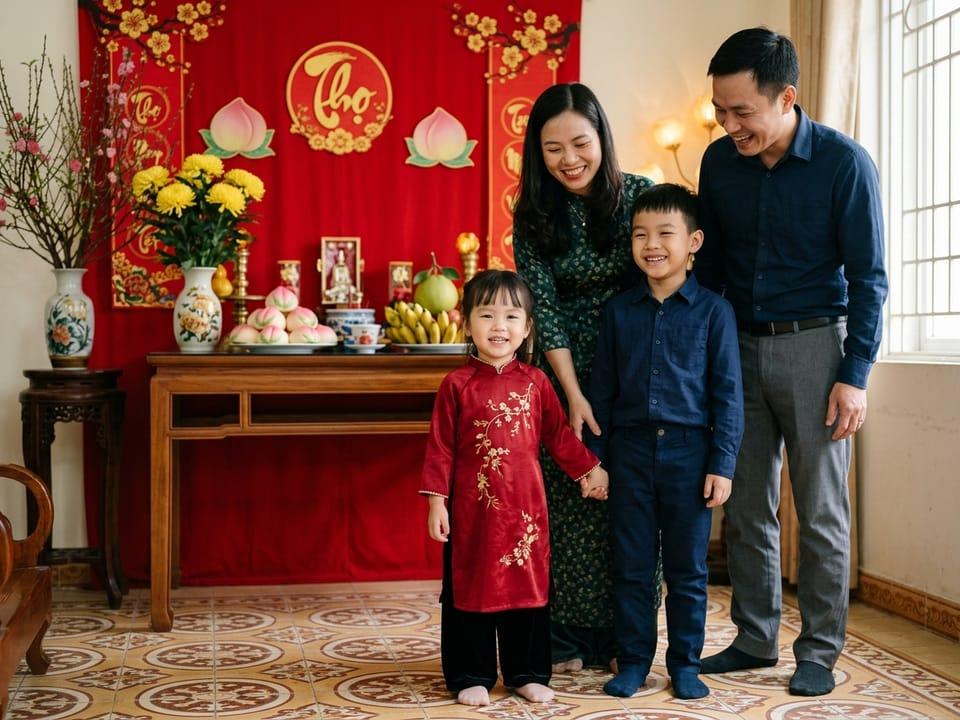
At a mừng thọ, the longevity celebration Vietnamese families hold for an elder, keep the honoree seated and plan just three photos: the moment they receive the family's wishes, a four-generation picture, and a portrait of the couple. Fifteen minutes is enough for all three. At the home celebration, children and grandchildren offer longevity wine and words of good wishes, so the best pictures come from a ritual you are already holding; the camera only needs to be ready.
Plan the day around the elder, not the camera
Vietnam's Law on the Elderly sets the milestone ages at 70, 75, 80, 85, 90, 95 and 100 and over. The commune or ward, the local Elderly Association and the family organise a celebration on Vietnam Elderly Day (6 June), the International Day of Older Persons (1 October), Tết, or the elder's birthday. At 90 the chair of the provincial People's Committee sends wishes and a gift, and at 100 the State President does. Some families attend the local ceremony first and hold their own party at home afterwards; there is no fixed order, so you can arrange it around your grandparent's energy. If the honoree is too frail to attend, the organisers bring the certificate and gift to the house.
That flexibility is useful. If your grandparent is at their best in the morning, use that time, before the guests, the food and the noise. If there is a community ceremony at midday, do the posed photos at home before leaving, or after a proper rest, not in between. Keep everything posed to fifteen minutes in total, with the elder in one chair while everyone else moves around them.
The three photos worth the effort
The first is the moment of wishes. As each branch of the family offers the longevity wine, gifts or couplets, stand to the side at the elder's eye level and shoot in bursts. Aim for your grandparent's face, not the backs of the people greeting them. Nobody has to pose, and these frames tend to look the most natural.
The second is the four-generation photo, sometimes called tứ đại đồng đường, four generations under one roof. Seat the elder in the center and resist lining people up in rows by generation: with a big family, the back rows get deep and the honoree shrinks to a small face in the middle. Build it in clusters instead, each adult child beside the elder, their own children just behind them, and the youngest great-grandchild on a lap or a low stool right next to the oldest person in the photo. Step back and zoom in a little, so the people at the front aren't stretched at the edges. Whoever is shooting belongs in this picture too, so finish with one frame on a tripod and the self-timer.
The third is the couple's portrait. Angle two chairs slightly toward each other, ask them to hold hands or rest one hand on the other's, and use a plain background. This is the picture most likely to be framed, so take your time on focus and keep it simple.