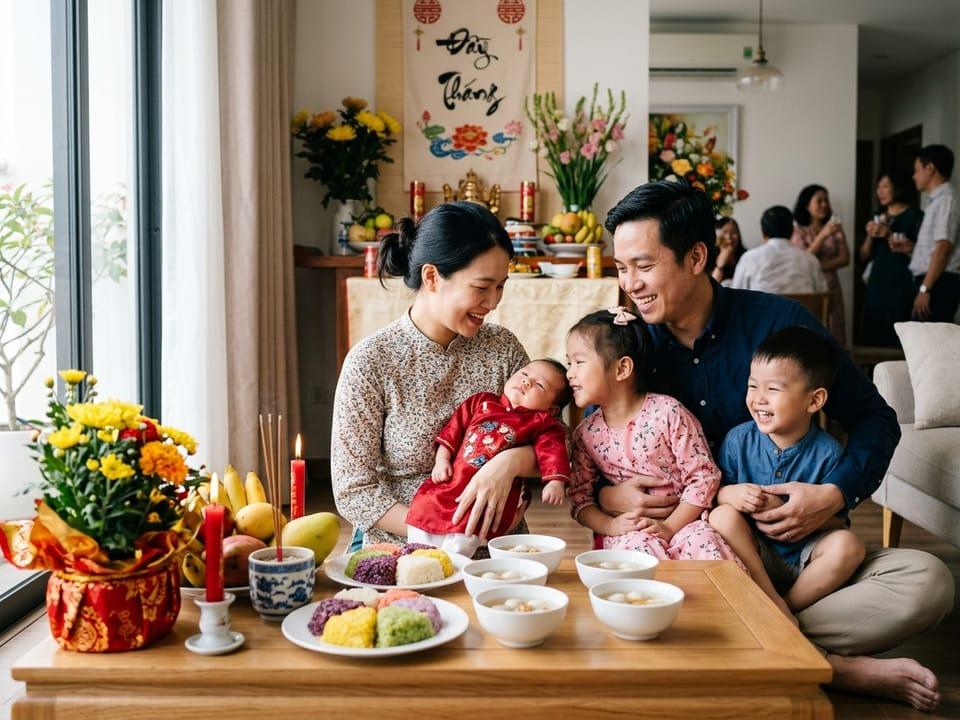
Đầy Tháng Photos While Mom Is Still Recovering: Calm, Short Ways to Photograph the One-Month Ceremony
pokesta Editorial Team · Updated October 29, 2026
At a đầy tháng, the ceremony held when a baby turns one month old, three photos are enough: the baby with both parents in front of the offering trays, a grandparent holding the baby, and close-ups of tiny hands and feet. Mom can stay seated and be photographed from the waist up. Take them in the quiet half hour around the offering, which many families hold in the morning, before the house fills with guests for the meal.
The ceremony closes ở cữ, and the mother is still recovering
Đầy tháng gives thanks for a baby's safe first month. In the cúng Mụ offering, the family thanks the twelve Bà Mụ, the midwife deities believed to shape and watch over a newborn, and the Đức Ông. A common arrangement is twelve small bowls of sweet chè, three larger bowls of chè and three plates of sticky rice (xôi) for the Bà Mụ, and a boiled duck with crossed wings and bowls of rice porridge for the Đức Ông, though what goes on the trays differs from region to region. The day also formally introduces the baby to relatives and marks the end of the mother's ở cữ, the postpartum confinement.
That timing is the photographic problem. A Vinmec obstetrician writes that doctors suggest women observe postpartum rest for about a month, so on the day of the ceremony the mother is roughly four weeks past birth, often short of sleep, possibly healing from a cesarean, and in no mood for makeup or a long lineup. Plan the photos around her energy, not around a shot list from social media.
Follow the family's date and hour, then fit the photos in
The date is usually set by the lunar calendar. A widely repeated saying is "gái lùi hai, trai lùi một": a girl's ceremony is held two days before the full month, a boy's one day before. Other families count differently, hold it on the exact date, or use the solar calendar, so ask the elders who will be there. For the hour, VOH, Ho Chi Minh City's public broadcaster, lists before noon in the north, between 9 a.m. and 5 p.m. in central Vietnam, and before 9 a.m. in the south, with early morning or late afternoon considered good.
A morning ceremony helps the photos. Open the curtains near the altar the night before so you know where the light falls. During the prayers themselves, stay back, keep the flash off and don't ask anyone to pose. The parents lighting incense and carrying the baby to the trays can be photographed from the side without interrupting anything. After the offering comes the khai hoa (also called bắt miếng), which some families also like to have recorded.
Three shots, and Mom stays in her chair
For the first shot, seat the mother in a chair beside the offering table with the baby in her arms and the father standing or kneeling beside her. Frame from the waist up so nobody worries about clothes below that. On clothing, the same Vinmec article says the belief that new mothers must wear long sleeves only makes sense in cold weather; in ordinary weather, airy clothes that let sweat escape are better. A light, comfortable top she already likes will look more natural than something bought for the day.
The second shot is the one the grandparents want: a grandparent holding the baby, seated, with the other grandparents beside them. The third is detail: fingers wrapped around a parent's thumb, the soles of the feet, a tiny bracelet. These are easiest while the baby sleeps after a feed, near a window. All three together take about fifteen minutes. If the baby starts to cry, stop and come back later; none of these shots depend on the exact moment of the ceremony.
Before the guests arrive: room, air and one photo helper
Ask one relative to be the photographer for the morning, someone who isn't also cooking or serving. Set the chair by the window before the ceremony and clear the clutter behind it. Point fans and the air conditioner away from the baby. The American Academy of Pediatrics advises that a baby only needs one more layer than an adult would wear in the same room, so resist bundling the baby in extra blankets for the photos.
Guests usually come for the meal after the offering. Once they arrive, each relative will want to hold the baby. A simple rule helps everyone: guests take their photo seated, with the baby passed over by a parent, and the baby goes back to the mother between visitors.
Family, a hired photographer, or a studio later
A family member with a phone is free and knows everyone in the room, though they may get pulled into the kitchen. A photographer at home suits a large gathering where you want every relative in the pictures. For reference, MABOO Studio in Ho Chi Minh City lists an at-home baby session at 3,500,000 VND for 60 minutes (as of October 2026); prices vary by studio and plan, so check official sites. Ask whether they've photographed one-month-olds, agree that the ceremony comes first and that there's no flash, and ask what happens if the mother or baby is unwell, since the page doesn't state rescheduling terms.
A studio session during ở cữ asks a lot of a recovering mother and a newborn, so it's reasonable to wait. A studio portrait fits the first birthday well; see thôi nôi photos at a studio or at home. If you'd like more newborn photos at home in the meantime, see DIY newborn photos at home.
When someone couldn't be in the picture, there's a gentler way
Maybe a grandparent abroad couldn't come, or Mom just didn't feel up to being photographed that morning. pokesta can create an AI family portrait for the đầy tháng from phone photos each of you already has, with the baby in a tiny red áo dài beside a celebration table. It's $1 per photo and the first one is free, so try it with a recent photo of your baby before booking anyone to come to the house. The picture is made by AI, not taken at your ceremony, so keep it alongside the real ones. Create a đầy tháng family photo