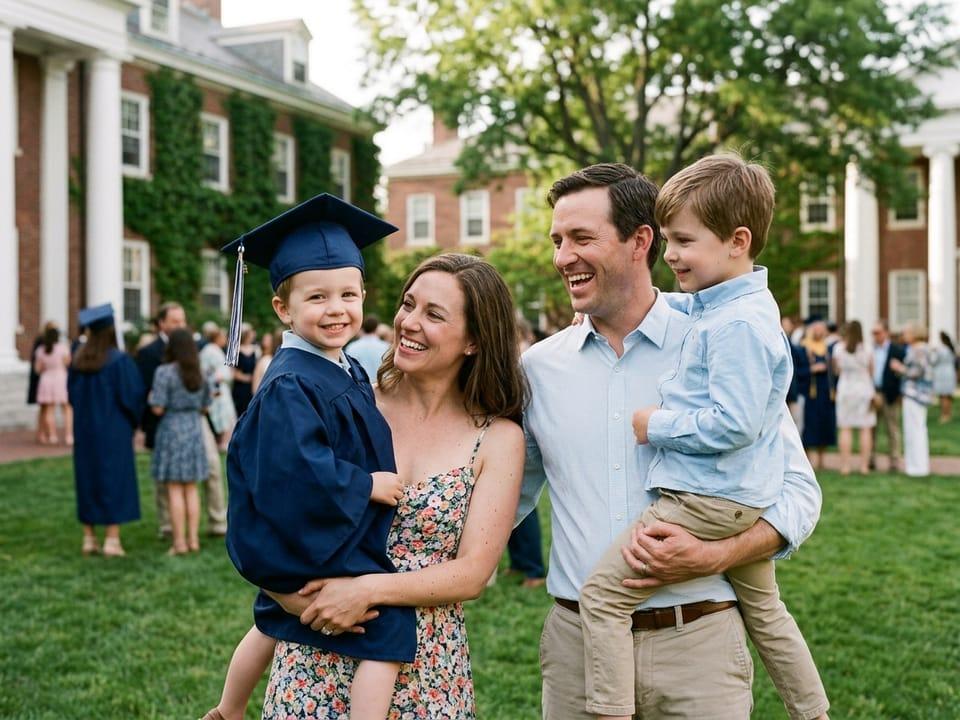
US Graduation Family Photos: Plan the Shots for Before and After the Ceremony
pokesta Editorial Team · Updated October 5, 2026
Graduation in the US isn't just a college thing. High schools hold full commencement ceremonies, and middle schools, elementary schools and even kindergartens often mark the end of the year with caps and gowns of their own. Most ceremonies fall between late May and June, as the school year wraps up.
The catch is that the ceremony itself is the hardest place to get a family photo. Graduates sit in rows with their class, guests sit in the stands, and the walk across the stage takes a few seconds. Plan on getting the family shots in the half hour before and the hour after, and you won't miss them.
Kindergarten, high school and college ceremonies are very different
If your child's ceremony is a small one in a classroom or gym, with a song and a paper diploma, an aisle seat and a phone in your hand are usually enough.
High school commencement is bigger. Some schools hold it in a stadium or a rented arena, and some limit how many guest tickets each graduate gets. College can be bigger still: a university-wide commencement, plus smaller ceremonies for individual schools or departments where every name is read. If there are both, the smaller one is the better bet for family photos.
Before the day, find your school's commencement page and note three things: when graduates have to check in, the rules for guests (tickets, bags, where you can stand) and whether a professional photographer will shoot each graduate crossing the stage. If one will, you can stop worrying about that moment and simply watch it.
Gown details that show up in photos
Gowns arrive folded in a bag, and the creases are deep. Hang yours a few days early and read the care label before steaming or ironing; a polyester gown can melt under a hot iron. If your graduate has long hair, pack bobby pins for the cap.
The tassel is easy to forget. At colleges that do the tassel turn, undergraduates commonly start the ceremony with it on the right and move it to the left once degrees are conferred, while master's and doctoral graduates usually keep it on the left throughout. High schools have their own customs, so ask. A "before" shot with the tassel on the right and an "after" shot with it moved make a neat pair.
Honor cords and stoles are a common sight at US graduations, even though the formal academic costume code says nothing else should be worn on the gown. Put them on before the first family photo so you don't have to redo it.
In Hawaii, lei are part of graduation, and it's not unusual for graduates to end up wearing so many that they reach their ears. If your family gives lei, take a clean shot of the gown first, then another round once they start piling up. Fresh flowers wilt in the heat, so photograph them early.
Before the ceremony: the calm half hour
Often the best family photo of the day is the one taken at home or near the venue before check-in, while the gown is smooth, the cap is straight and nobody is tired yet. Choose a simple background: a front door, a tree in the yard, a campus building with open space in front of it. Put the graduate in the middle, a little forward, and bring a chair for any grandparent who can't stand for long. Hold the phone at chest height and use the 2x lens from a few steps back; the wide lens stretches people at the edges of the frame.
Shoot the whole family first, then the graduate alone, then the combinations: siblings, each set of grandparents. With a tripod and the self-timer, the person who usually holds the phone gets into at least one picture.
During the ceremony: one person records, everyone else watches
From the stands, a phone can't zoom far enough for a sharp shot of the stage. Agree that one person records the moment the name is read and everyone else just watches. If the school has an official photographer, they'll have a far better angle than you. Stay out of the aisles and follow the ushers.
After the ceremony: agree on a meeting spot in advance
When it ends, hundreds or thousands of families start looking for their graduate at once. Before the ceremony, pick a meeting spot away from the main exits, such as a specific statue, sign or building corner, and make sure everyone knows it.
This is the time for the tassel-on-the-left photo, the diploma cover and the shots with friends. If you want a cap toss, toss just one or two caps and keep small children out of the landing zone; the corners are stiff. Burst mode will catch the cap at the top. A gown in June sun gets hot fast, so keep this session short and bring water.
Senior portraits, a photographer or your own phone?
Senior portraits are formal portraits taken during the last year of high school. Some schools contract one photographer for yearbook portraits, others accept photos from different photographers, and sittings can include a cap and gown. They're about the graduate, though, not the family on the day.
The choice is simpler than it looks. For a framed portrait with a clean background, use the senior portrait or a studio. For the whole family with the campus behind you, book a photographer for 30 to 60 minutes right after the ceremony, and book early, because everyone's graduation lands on the same few weekends. On a tight budget, a phone on a tripod before the ceremony gets you most of the way there.
When someone can't be there
Grandparents overseas or a sibling who lives far away may miss the day. pokesta can create an AI family photo of everyone in caps and gowns on campus from each person's own phone photos. Your first image after signing up is free, and after that it's $1 per photo.
Open your school's commencement page, write down the check-in time and the guest rules, then choose the meeting spot and tell the family. The rest can be worked out on the day.