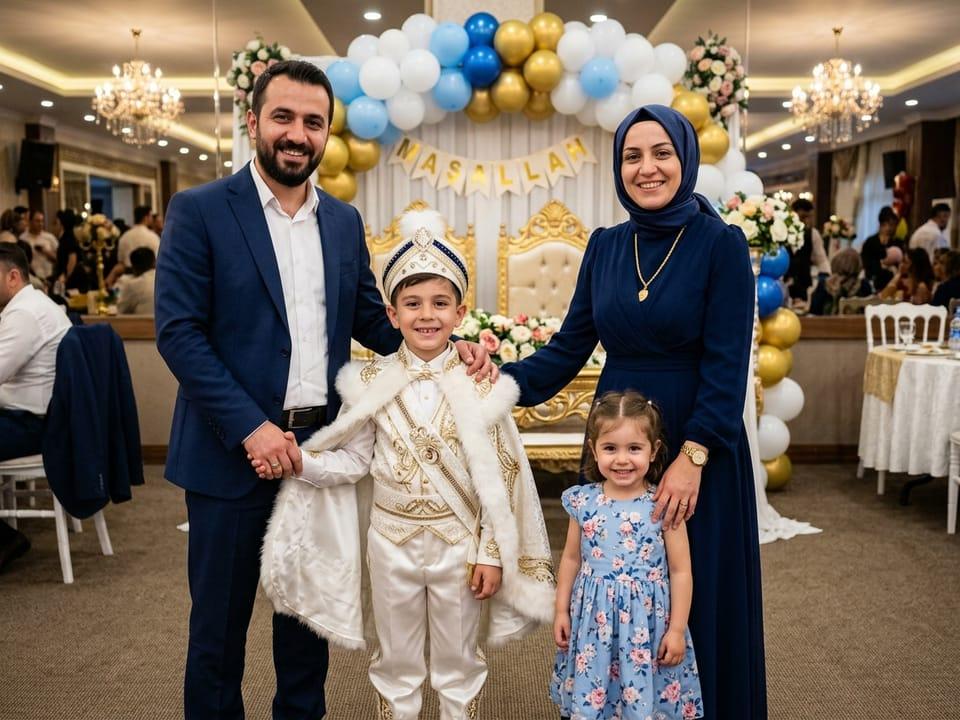
Both orders are used in Türkiye. In the traditional sequence the Ministry of Culture and Tourism describes for Bursa, the celebration comes first: a henna night on Saturday, a mevlit (a recitation of a religious poem) at home on Sunday, and the ceremony that afternoon. In cities, some parents instead have their sons circumcised in hospital right after birth. Whichever order you choose, take the costume portraits before the procedure or on a separate day once he is comfortable again, and let the doctor decide the date and how long recovery should take.
The traditional order puts the celebration first
The culture portal's account of Bursa reads like a timetable. Preparations start about a month ahead. A few days before the procedure, henna is put on the boy's fingers. His bed is made up on Thursday, the celebration opens with the henna night on Saturday, and on Sunday a mevlit is recited at the family home around midday. The boy is driven around town before the procedure, and the ceremony usually takes place in the afternoon, in recent years often in a rented hall. Afterward he is laid in a decorated bed that stays up for one to two weeks, and visitors drop money into a hat left open beside him.
The Ministry adds that there are no fixed rules about age or timing. Boys are usually circumcised before they start school, or at least before puberty. Thursdays were once the usual day; today Saturdays and Sundays are preferred, especially in big cities. Spring, summer and autumn are the favored seasons. Customs differ from region to region and family to family, so read Bursa as one well-documented example, not a rule.
Procedure first, celebration later
The other pattern separates the two. The Ministry notes that some urban parents have their sons circumcised in hospital right after birth, to spare them pain and fear at a later age; a family that does this can still hold a celebration when he is older. With an older boy, you can also have the procedure first and hold the party once he has healed.
How long that takes is a medical question, not a photography one. Acıbadem's patient information says healing usually takes from a few days to a week, about a week in newborns, and that in older children it can take 10 to 15 days. Ask your doctor directly when he will be able to wear trousers, sit through a long evening and run around, and set the party date from that answer, with a few days of slack.
If the hall and the photographer are booked first, it's tempting to bend the procedure date around them. The smoother order is the doctor first, then the hall, then the photographer, and it helps to bring two or three possible party dates to the appointment.
Where the photos fit in each schedule
|
Celebration first, then procedure |
Procedure first, celebration later |
| Costume portraits |
A week or two before, or the morning of the ride around town |
Any day before the procedure, or after the doctor gives the all-clear |
| Ride around town |
Before the procedure, in full costume |
On the day of the celebration |
| Party photos |
He is fresh and in costume, before the procedure |
He has healed, so the whole evening can be photographed |
| After the procedure |
A few quiet photos at the bedside, no costume |
Nothing to photograph |
| What to watch |
A long, tiring day that ends with the procedure |
Two separate dates to organize |
In the first order, the procedure day is crowded. If you can, do the formal portraits on an earlier day so that morning is only for the ride and a few family pictures. In the second, his comfort sets the timetable, and the costume can come out on the party day without any worry about soreness.
If he was circumcised as a baby, the celebration can be timed around the family alone: the school holidays, when relatives can travel, the season. In the first order, photograph the decorated bed before he lies in it; that keeps the memory of the visiting days without catching him at an uncomfortable moment. If he is old enough to understand, give him a say in the dates and the photos; a boy who helped choose the day is usually more willing to stand for the camera.
Studio, on-location photographer or phones: fit them around his recovery
A studio session is short and indoors, and easy to place a week or two before the procedure. An on-location photographer needs good weather and more of his energy, so book that early in the schedule, never in the days right after the procedure. A studio date is also simpler to move if he catches a cold. Family phones are the most flexible of the three: you can catch him when he is happy, at home, on the ride or at the party, and simply stop when he is tired.
A professional is still worth having for the party's group photos with all the relatives, and for the ride around town, where everything moves and phones struggle. After the procedure, keep it to a few photos of him with his gifts on the bed, only if he wants them, and never photograph the procedure itself. The guide to the sünnet outfit covers what to leave out of the album, and our comparison of studio, outdoor and DIY shoots goes into the costs.
When the dates won't line up
Sometimes the doctor's date and the family calendar simply don't match, or a relative abroad can make neither. pokesta can make a sünnet family portrait with AI from the phone photos each of you already has, at $1 per photo, with the first photo free. It is a created image, not a record of the day, but it gives you the costume portrait without asking him to dress up again while he is healing. Try one with a recent photo of your son first. Try a sünnet family portrait
References