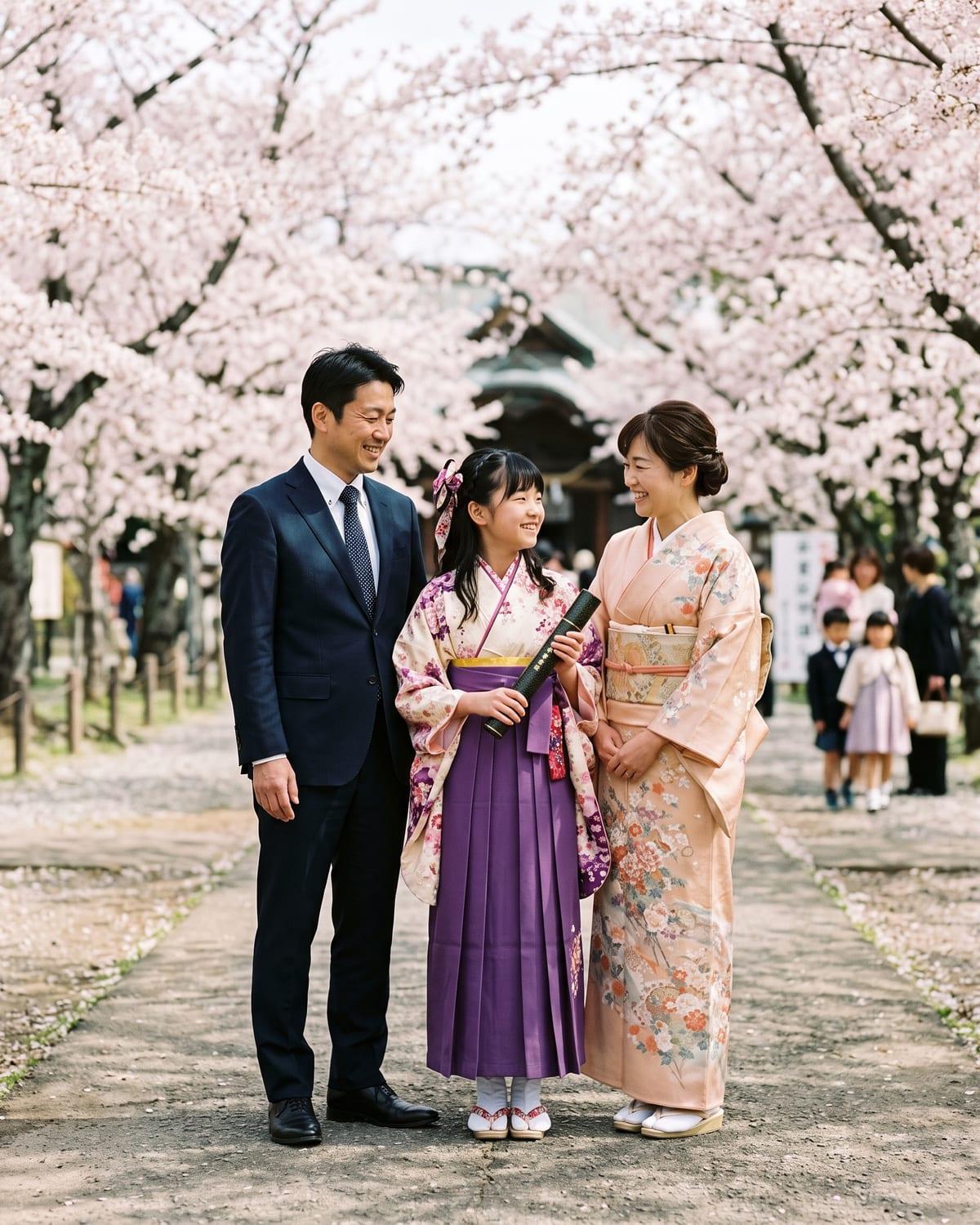
In Japan, finishing kindergarten or nursery school is called sotsuen, marked by a ceremony, the sotsuenshiki, where each child receives a graduation certificate. A few weeks later comes the nyugakushiki, the entrance ceremony for elementary school. A single combined shoot comes down to three choices: when to shoot, what your child wears, and how to make photos taken on one day read clearly as "graduation" and "school." The ceremony itself is covered in our guide to the graduation ceremony, and poses in the graduation poses article. This one covers planning and dressing for the combined shoot, down to socks and shoes, and the same approach six years later, when elementary graduation and junior high entry come back to back.
When you shoot decides what you can capture
Under Japan's school education regulations, the school year starts on April 1 and ends on March 31, so graduation falls in March and the entrance ceremony in early April, with only spring break in between. There are three windows; choose by what you want in the pictures.
Before graduation (around December to February)
Studio slots are easy to get and nobody is rushed. A column from a major children's photo studio also says December to March, before school starts, is the unhurried time for school entrance photos. If the randoseru, the sturdy backpack children in Japan carry from first grade, has arrived, you can take the school photos too. The certificate isn't in your hands yet, though, so the kindergarten uniform and hat carry the graduation theme.
After graduation, before the entrance ceremony (mid- to late March)
Certificate and randoseru are both on hand, which makes this the best window. Studios are busy in graduation season, so hold a few dates as soon as you know the ceremony date.
After school starts (mid-April onward)
This is the window for things you only get once school begins, such as a uniform, school cap or PE clothes. The same studio column recommends mid- to late April, because early April is taken up with settling in. The graduation photo becomes a look back, but with the certificate or kindergarten hat in hand it's still a fine keepsake.
Assume teeth and cherry blossoms won't cooperate
Baby teeth often start giving way to permanent ones with the lower front teeth at around five and a half to six, right at graduation and school entry, and the timing varies by more than a year between children, so planning around teeth isn't realistic. The gap-toothed smile belongs to this age.
Cherry blossoms are just as unpredictable; in some areas they have fallen by the entrance ceremony. If they matter to you, shoot yourselves so you can watch the trees nearby and decide "this weekend." For a studio, check whether they have a cherry blossom backdrop.
What to wear: the kindergarten's rules and the March chill decide it
A kindergarten graduation is a formal ceremony. The usual rule for graduations in Japan is a uniform at schools that have one, and a suit, formalwear or hakama at schools that don't. If the kindergarten has a uniform, that is the strongest graduation marker you can put in a photo. Without one, the child-sized equivalent of a suit is a jacket with trousers, short or long, for boys, and for girls a dress, or a blouse and skirt, with a bolero or jacket on top.
Hakama, the pleated trousers worn over a kimono, are a familiar sight at Japanese graduations, and some children wear them for sotsuen. They are graduation wear, so they won't double for the entrance ceremony. In a combined shoot, rent them at the studio for the graduation shots only, then change into a dress or suit for the school shots. The studio column mentioned above (Studio Alice) lists kimono and hakama among its rental outfits, alongside dresses and suits. Whether hakama are fine at the ceremony itself is up to the kindergarten.
Japan Meteorological Agency normals for 1991–2020 put Tokyo's March average at 9.4°C with a daily low of 5.0°C, against 14.3°C and 9.8°C in April, so March runs about 5°C colder. For outdoor shots in March, choose clothes that take a vest, cardigan or tights underneath; a cold child hunches their shoulders in every frame. Elsewhere, check the local normals.
Necklines and feet show up more than you'd expect. In an article on HugKum, the parenting site run by the publisher Shogakukan, a manners instructor answering questions about entrance-ceremony outfits suggests a white collared shirt for boys because it brightens the face, and says that with shorts, sock color matters more than length: navy, gray, black or white keeps the look together. For shoes, soft leather (faux leather is fine) or, with sneakers, a dark pair. For boys and girls alike, keep hair tidy around the face. Everyday sneakers stand out in a full-length shot, so settle shoes and socks before you leave.
If the kindergarten has no uniform, says casual clothes are fine, and you'd rather not buy a suit, aim for smart casual: a collared shirt, a cardigan and chinos. Even at elementary school graduations in Japan, that combination is a standard for boys alongside suits and blazers. Skip big logos and cartoon prints, so the eye goes to your child's face rather than the shirt.
Make one outfit look like two milestones
The classic mistake is that every photo has the same clothes and background, and nobody can tell graduation from school entry. You don't need to change everything, only the markers in the picture.
What goes in the graduation photos
The certificate, the kindergarten uniform or smock, the hat, the name badge. The uniform may be handed down or returned to the kindergarten, so photograph it while your child can still wear it.
What goes in the school photos
The randoseru, the school cap, the bags for indoor shoes and PE clothes. Photograph the randoseru from behind as well: it looks this big against a child's body only around the start of school.
For an outfit that does both ceremonies, start with navy or gray
A navy or gray base works in March and April alike. For graduation, keep the jacket on, hold the certificate and stay sober. For school, take the jacket off, put the randoseru on, and add spring with a corsage, a tie or brighter socks. The same manners instructor suggests that when a graduation outfit is reused, boys swap the tie for a bow tie or a brighter one, and girls change their hairstyle or the color of their socks or tights. A change of backdrop helps too, such as a plain wall for graduation and a window or the front door for school.
Buying big for spring growth leaves sleeves covering the hands, and the outfit looks borrowed. Choose by shoulder fit, then tack up sleeves and hems.
A studio, or close to home
Combining at a studio
Before booking, check these points:
- Whether one session covers both scenes
- Whether you can bring the kindergarten uniform and randoseru, and rent outfits like hakama
- Whether family or grandparent shots can be added
- How you'll receive the photo files, and what triggers extra charges
Two scenes back to back make the session longer, and even a six-year-old loses focus after an hour in front of the camera with a change of clothes in between. Start with whichever scene your child is more excited about: the randoseru for a child itching to wear it, graduation for one who loves the kindergarten uniform. Build in a break for a drink and a snack.
Shooting at home or in the neighborhood
For graduation, shoot from outside the kindergarten gate on a day off, with the building behind; check with the kindergarten before going onto the grounds. The entrance ceremony sign at the school often isn't up until the day itself, so for earlier school shots, your front door or a room with the randoseru set out is more reliable. Indoors, shoot near a window while it's light; the article on brighter indoor photos explains how.
When grandparents can't be in the photos
If you want a photo with grandparents who live far away, pokesta can generate a commemorative photo with AI from photos of each family member. It doesn't replace a real shoot, but it can fill in the people who couldn't be there (one free try after signing up, then $1 per photo).
Six years later, split the ceremony outfit and the junior high uniform
Elementary graduation and junior high entry also sit on either side of a spring break. HugKum's article on elementary graduation ceremonies lists formal suits or blazers, or chinos with a cardigan, as the standard for boys, in black or navy, and dresses, suits or hakama for girls, in calm colors such as black, navy or gray. If the school sets a dress code, follow it.
The same article says most areas don't require the junior high uniform at elementary graduation, and many schools have students start wearing it at the junior high entrance ceremony. For a studio shoot covering both, take the graduation shots in the ceremony outfit with the certificate tube, then change into the junior high uniform: the same split as six years earlier. Book the shoot once the uniform has arrived.
Hakama look striking in photos, but children find them hard to move in and awkward for bathroom trips, and some schools ban them. Even then, they can be worn for the graduation shots at the studio. Poses for 12-year-olds with hakama and a randoseru are in the studio section of the poses article linked at the top.
The milestone that matters more decides the month
If kindergarten memories come first, go with March. If the new uniform and randoseru are the focus, go with mid-April or later. If both matter equally, book early for mid- to late March, when everything comes together. For March, pick clothes that take a layer; for a shared outfit, set aside two swap-in props for each scene so the change on the day is quick.
References
- Studio Alice, "When to take school entrance photos: recommended timing and tips for the shoot" (Japanese) https://www.studio-alice.co.jp/shortcut/school/column/detail15.html
- Lion Foundation for Dental Health, "Mama, Anone": five things to watch for as baby teeth give way to permanent teeth (Japanese) https://www.lion-dent-health.or.jp/mama-anone/baby-teeth/article/teeth-grow-19/
- Wikipedia (Japanese), "卒業式" (graduation ceremony): attire at Japanese graduations, kindergarten sotsuenshiki and certificates https://ja.wikipedia.org/wiki/%E5%8D%92%E6%A5%AD%E5%BC%8F
- Wikipedia (Japanese), "学年" (school year): start and end dates of the school year https://ja.wikipedia.org/wiki/%E5%AD%A6%E5%B9%B4
- Japan Meteorological Agency, climate normals (yearly and monthly), Tokyo (Japanese) https://www.data.jma.go.jp/obd/stats/etrn/view/nml_sfc_ym.php?prec_no=44&block_no=47662&year=&month=&day=&view=
- Shogakukan HugKum, "Entrance ceremony dress etiquette: a manners instructor on what to wear" (Japanese, February 27, 2023) https://hugkum.sho.jp/456894
- Shogakukan HugKum, "Elementary school graduation ceremonies: dates, the day's schedule, and choosing outfits for parents and children" (Japanese, February 6, 2026) https://hugkum.sho.jp/118274