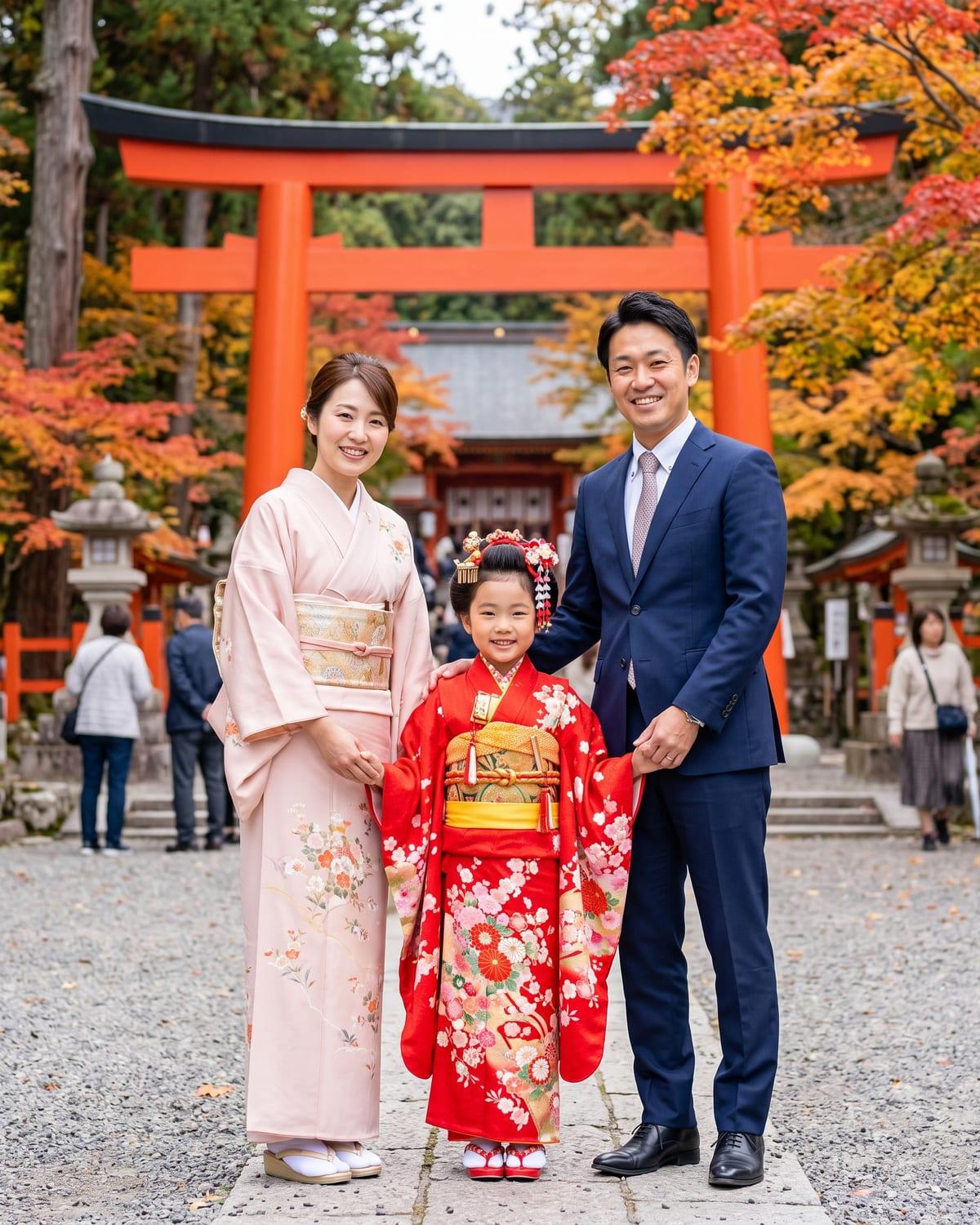
If dad (or mom) is posted to another city or abroad and can't be there for Shichi-Go-San, the surest approach is to separate the shrine visit from the photos and take the photos when the whole family is home. (Shichi-Go-San is the Japanese celebration for children aged three, five and seven, who dress up, often in kimono, and visit a shrine.) According to Studio Alice's columns, studio sessions before the season (maedori) mostly happen from April to October, and sessions after it (atodori) from December to March, so the photos don't have to be taken on the day of the shrine visit. If the dates still won't line up, you can shoot separately and composite, or create a family photo with AI from phone pictures. And the absent parent can join the visit itself by video call.
The shrine visit and the photos can be on different days
The Association of Shinto Shrines (Jinja Honcho) explains that celebrating Shichi-Go-San in a big way on November 15 dates back to the Edo period, and shrines are still busy with dressed-up families on the weekends around that date. It isn't a fixed requirement, though. Kawagoe Hachimangu, a shrine in Saitama, simply invites families to visit on an auspicious day when boys and girls are three, boys are five and girls are seven.
Photos can be separated from the visit too. Whoever is available goes to the shrine on a November weekend, and everyone is photographed on the day the absent parent comes home. Split like that, the feeling of "the Shichi-Go-San someone missed" fades a good deal. The thinking is the same as in our piece on Omiyamairi when the family can't all be there.
Match the trip home: a summer early shoot or a winter late one
If visits home fall in the summer holidays or over New Year, both line up with studio seasons.
Studio Alice's column on early shoots says July and August, with schools on break, make it easier for families who rarely share free days to find one. If the absent parent is home in summer, an early shoot then is the natural choice. It's hot, so keep walking around outdoors in kimono short and do the shoot indoors to spare the child.
If they're home in winter, go for a late shoot. The same studio's column notes that late shoots mostly take place from December to March, once the November peak has passed, when bookings are easier and there are more costumes to choose from. It also flags some cautions: shooting right at the end of the year may be too late for printing New Year cards, slots get scarce near Coming of Age Day photo shoots, and children catch colds more easily in winter. Book as soon as the travel dates are set and keep two candidate days. For planning an early shoot, see Shichi-Go-San early photo shoots.
Compositing a later shoot: match the light and the angle
If even the trip home doesn't line up, you can photograph the absent parent on another day and composite them into the family photo. Whether studios offer this, and at what cost, varies, so ask when booking. The on-location service fotowa says its fee doesn't cover image editing such as skin retouching, compositing or background removal, so with a hired photographer, plan to arrange compositing separately.
Composites tend to look off when the light direction, body size or gaze doesn't match. Shoot both sessions where the light comes from the same side, keep the camera at the same height, and tell the parent where they'd be standing in the family photo so they can take the same pose. Showing them the family photo on a phone during the shoot helps. Dress to the same level of formality as the child, too.
Bring the absent parent to the shrine by video call
Separately from the photos, you can share the visit itself. With a video call, the parent can watch the child walk through the torii gate or wave a bag of chitose-ame, the long red-and-white candy sticks of the day. Have an adult other than the one holding the child's hand manage the phone. If the parent is in another time zone, factor that into the visit time.
Take care during the blessing ceremony. Kawagoe Hachimangu asks that no one other than its official photographer take pictures during prayers, as a rule, while families are free to take photos on their own phones as long as they don't bother other visitors. It's safest to hang up during the ceremony and call again once you're back outside. A photo with the parent on the screen won't be a full family portrait, but it's very much a picture of that year's Shichi-Go-San.
Later shoots, compositing and AI compared on cost, authenticity and strain
|
How cost works |
Authenticity |
Strain on the child |
Scheduling |
| Studio early or late shoot |
Session fee plus products |
Everyone really stands together |
Dressing to shooting can run long |
Book around the trip home |
| On-location shoot on the trip home |
Time-based fee with digital files |
Everyone together at the shrine |
Outdoors, so heat or cold |
Some services change dates for free |
| DIY on the trip home |
Just equipment |
Everyone together; quality depends on you |
Stop any time |
Flexible |
| Shoot later and composite |
Ask each studio whether it's offered and the cost |
Looks off if light or angle differ |
Two shoots |
The parent can come another day |
| Create with AI from phone photos |
A fee per photo |
A generated image, not a record of the day |
No new shoot needed |
Any time |
fotowa charges 24,200 yen on weekdays and 29,700 yen on weekends and holidays (tax included), for about 60 minutes including setup and packing up, with 75 or more digital photos (as of October 2026). Date changes are free, which suits families whose travel plans may shift. Prices can change, so check the official site.
A studio earns its fee most when the family is together for just one day: professionals handle dressing and hair, and you leave with a whole-family portrait. If you shoot yourselves, a tripod and self-timer get everyone in the frame.
Let the child's age decide how you capture everyone together
If you're unsure, choose by the child's age and stamina. With a three-year-old, avoid repeating dressing and shooting; do it all once on the day the parent is home. A seven-year-old can handle a separate visit and photo day, so a summer or winter shoot timed to the trip home works well. In a year when nothing lines up, pokesta can create a family Shichi-Go-San photo with AI from each family member's phone pictures. It's a generated image based on your photos, not one taken with everyone standing together, but it costs $1 per photo and you can make it at home without waiting for the trip back. The first photo is free, so start with the photos you already have and create a Shichi-Go-San family photo. For where AI photos work well and where they don't, see AI photos for Shichi-Go-San.
References