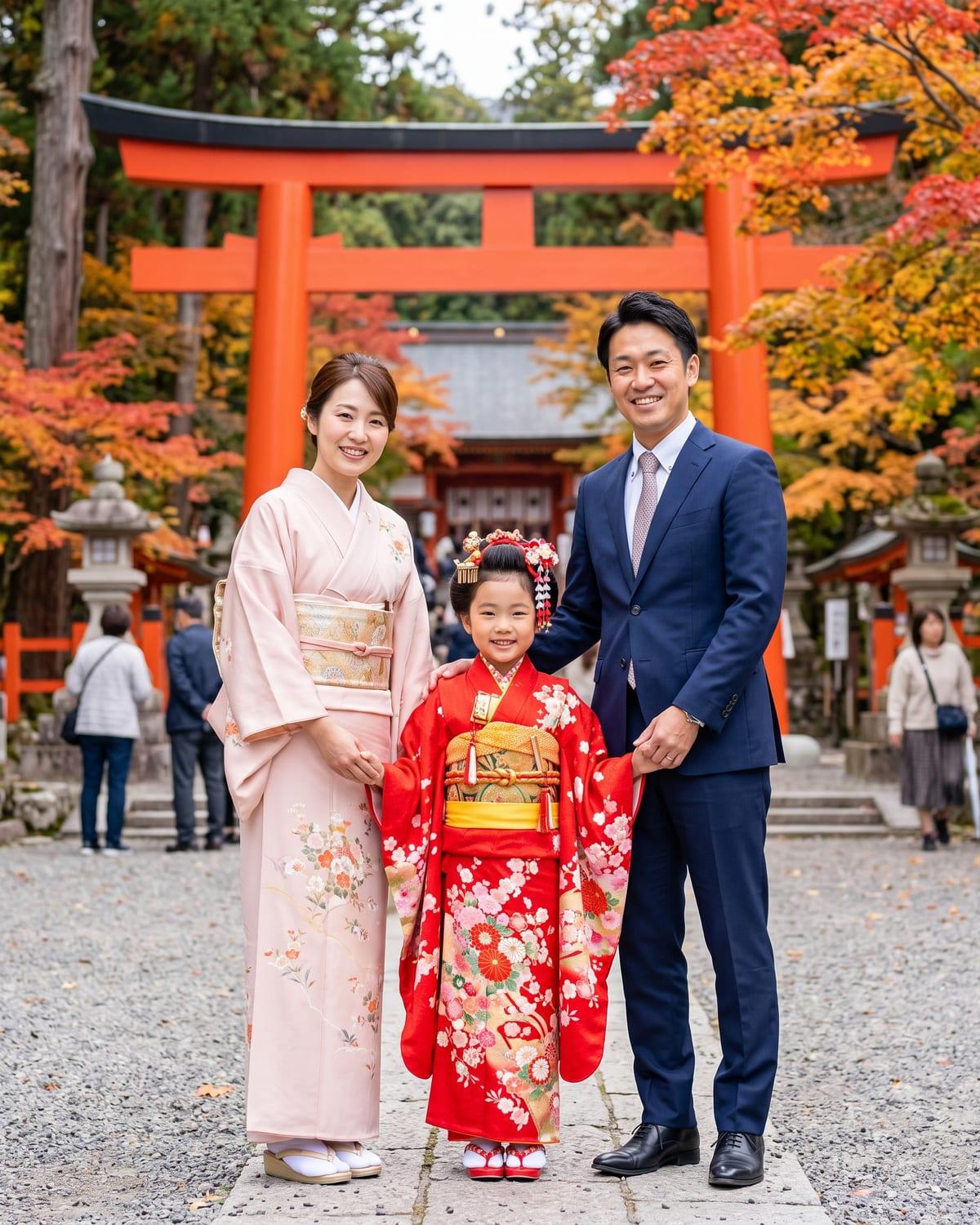
Missing Front Teeth at a 7-Year-Old's Shichigosan: How It Shows in Photos and How to Ask for Retouching
pokesta Editorial Team · Updated October 22, 2026
A gap-toothed smile at a seven-year-old's Shichigosan (the autumn shrine visit for children aged three, five and seven) is completely normal. According to the Japan Dental Association, the first permanent teeth come in at around age six, and the upper front teeth are replaced about six months to a year after the lower ones, which lands right on Shichigosan. A smile with missing teeth is a photo you can only take at this age, and if your child is self-conscious, closed-mouth smiles and profile shots still make lovely pictures. Some studios also retouch missing teeth; the children's studio chain Studio Alice charges 550 yen (tax included) per shot.
Trying to schedule around the gap rarely works
The Japan Dental Association explains that the first permanent teeth appear at around six. The first molar used to come first, but these days the lower front teeth are often replaced earlier. About six months to a year after the lower central incisors come in, the teeth beside them and the upper central incisors are replaced, followed a few months later by the upper lateral incisors. The association cites a Japanese Society of Pediatric Dentistry study on eruption timing as its source.
The months between losing the upper front teeth and the new ones filling in often overlap with the Shichigosan season. A child celebrating at seven by actual age is right in that window, and even a child celebrating at seven by the traditional count (kazoedoshi, which can make them five or six) may be starting the changeover that begins around six. You can't predict when a tooth will fall out or grow in, so moving the shoot date for teeth rarely pays off. Choosing the day around your child's health and the family's schedule tends to leave you happier with the result. New teeth coming in isn't necessarily the fix you'd expect, either. The association notes that permanent teeth are larger than baby teeth, so a freshly grown front tooth among small baby teeth looks especially big. That, too, is a face that belongs to this stage.
If your child is self-conscious, change how you prompt rather than pushing for smiles
The real problem usually isn't the teeth; it's a child who stops smiling. If friends have teased them about it, some kids clamp their mouths shut in front of a camera. Saying "smile!" over and over only stiffens their face.
Talking it over as a family beforehand helps. Losing teeth means they're growing up, and this is the only age they'll look like this. There are plenty of ways to take photos without showing teeth. Practice once in front of a mirror smiling with the eyes, lips closed, and on the day you can just say "do that face again." If they don't mind, take one photo with the gap showing too.
Tweak your prompts while shooting as well. Instead of "big smile," try "give a little laugh through your nose," which tends to soften the face while the mouth stays closed. If you're booking a studio, mention when you reserve that your child's front teeth are out and you'd like extra closed-mouth shots.
Closed-mouth smiles, profiles and back views give you photos without the gap
There are many ways to keep teeth out of the frame: a closed-lip smile with just the corners of the mouth lifted; a profile with the body angled and the face turned slightly; a calm expression looking into the distance while holding a folding fan at the chest. Back views showing the tied obi, essential for a seven-year-old's kimono, and over-the-shoulder glances hardly show the mouth at all. For the glance, stand your child with their back to the camera, call their name, and have them turn only their head; you get the obi and the profile in one frame.
Seven is already an age that suits a calm, slightly grown-up expression. The basic set of shots (full-length front, angled view of obi and sleeves, close-ups of accessories) is covered in photographing a 7-year-old's Shichigosan, and back views in Shichigosan back-view photos. Pick two or three gap-free compositions from those in advance and you won't be scrambling on the day.
Before booking, ask whether they retouch teeth, the price, and whether files are included
Some studios offer tooth retouching. Studio Alice lists "missing tooth retouching" among its image editing services, adjusting missing or half-grown teeth in ordered photos to look natural, for 550 yen per shot. The official page doesn't say whether the retouch carries over to digital files, so ask in store if you plan to keep files.
Studio Caratt's FAQ says it can retouch scratches or birthmarks on a child's face for 2,200 yen per shot (tax included), but says nothing about teeth. The location photo service fotowa states that image editing such as individual skin retouching, compositing and background removal isn't included in its fee. If you want retouching, ask three things before booking: can they retouch teeth, how much per shot, and will it apply to both prints and files. Also ask whether it must be ordered when you choose photos or can be added later, so there are no surprises at the register. Prices were listed on official sites in October 2026 and vary by branch and season.
We don't recommend families drawing in teeth themselves with an app. Edits that change the shape of a face tend to look unnatural and may not be reversible. The approach of limiting your own edits to straightening and brightness is laid out in editing commemorative photos.
Studio, location photographer or DIY, compared through the lens of teeth
Photo studio
Location photographer
Do it yourselves
How cost works
Session fee (5,500 yen per family at Studio Alice) plus prints; retouching per shot
Hourly fee with files, editing not included
Gear only
Your child's mood
Experienced staff coax out expressions
Natural expressions while walking
Retake at your child's own pace
Handling the gap
Some offer retouching
Work around it with angles
Work around it with angles
Results
Even lighting, kimono patterns in sharp detail
Your child in the light and scenery of the shrine
Everyday expressions, uneven quality
Best for
Handing off retouching too, mounted prints for grandparents
Capturing the visit itself
Kids who hate being photographed in public
A studio is worth it when you want dressing, hair and retouching handled together, or a well-lit group photo with grandparents. A location photographer is good at catching natural moments where the mouth isn't the focus, like your child walking the grounds or a side view holding chitose-ame (the long candy given at Shichigosan). For a child who dislikes being watched, giving the family more time alone to shoot and waiting for the right moment can produce the best face of all.
Keep the gap-toothed photo, and consider one more
Keep the photo with the gap as the record of the day. If you later want another shot from a different angle, pokesta can create a commemorative kimono photo from pictures of your child already on your phone, for $1 per photo, from home. The result is a newly created image, not a record of the day. The first photo is free, so try it with a favorite snapshot: create a Shichigosan photo.