
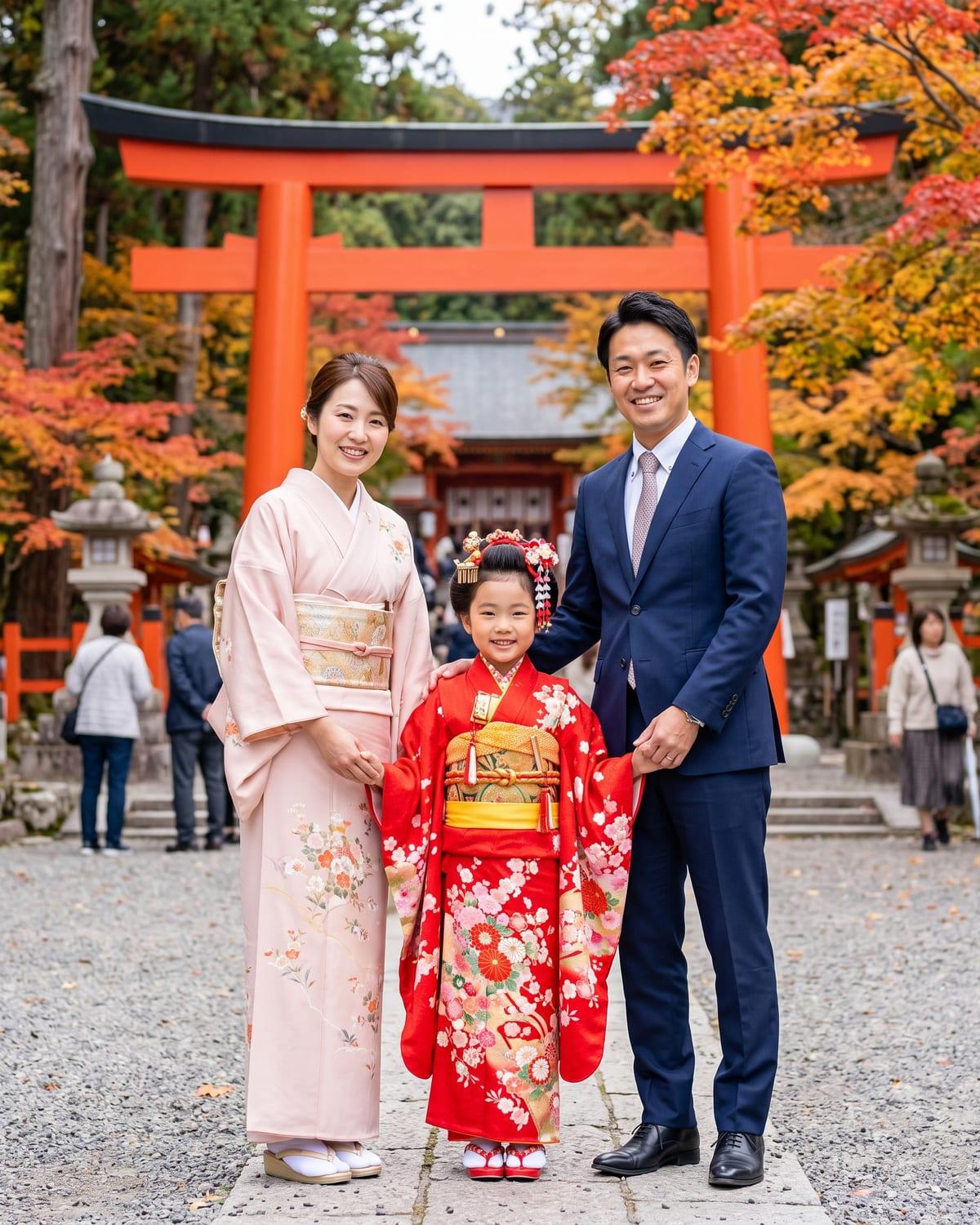
When one of you wants studio photos for Shichi-Go-San (the Japanese celebration for children aged three, five and seven, marked with a shrine visit in kimono) and the other thinks the quote is far too high, stop arguing about whether to book at all. Talk first about what the photos are for and how many you need. A photo studio bill is driven less by the session fee than by how many prints and files you buy, so this turns a vague argument into concrete numbers. Then agree on a cap within your household budget and fit the shoot to it, for example a short studio session plus phone photos on the day. Nobody has to win the argument about whose sense of money is right.
You disagree because you're picturing different numbers
There are no official statistics on what families spend on Shichi-Go-San photos, and private surveys show a wide spread. In a 2025 survey by Meetsmore of 145 people who had requested quotes for on-location Shichi-Go-San shoots, spending on photos and kimono dressing was 10,000 to 20,000 yen for 22.7%, 20,000 to 30,000 yen for another 22.7%, 30,000 to 50,000 yen for 19.1%, 50,000 to 100,000 yen for 24.6%, and over 100,000 yen for 6.4%. It's a small sample, but it shows that "normal" can differ several times over from one family to the next.
Studio price lists also read differently depending on where you look. Studio Alice charges a session fee of 5,500 yen (tax included) per family, yet one 10x12-inch print brings the total to 12,760 yen and three prints to 27,280 yen. Studio Mario's session fee is also 5,500 yen, and its sample Shichi-Go-San plans run from 40,700 to 85,300 yen including that fee. If one partner has the advertised 5,500 yen in mind and the other is picturing an 80,000-yen package, of course you're talking past each other. Start by looking at the same price list together. For the full range and breakdown, see Shichi-Go-San photo costs and what's included.
Studio Alice's prices were checked on its official site in October 2026. Studio Mario's site was down for maintenance, so its figures come from official pages archived in August and September 2026. Prices change with season, location and plan, so confirm before booking.
Talk in this order: uses, number, cap
Trading figures straight away tends to become a "too expensive" versus "not that much" standoff. Change the order and list the uses first.
- Photos to display at home (how many, what size)
- Photos for grandparents and relatives (how many households, how many each)
- Files for greeting cards or to look back on (needed or not, how many shots)
- Whether you want an album
Once it's written down, you can see which uses one photo covers and where files are enough. With a number in hand, it becomes clear whether single prints, a set, an on-location photographer or your own camera fits best. For help counting, see how many Shichi-Go-San photos to buy.
Ask the partner who objects to separate their reasons, too. Is it the amount itself, the idea of a studio, or worry about a small child sitting through a long shoot in unfamiliar kimono? If it's the amount, talk about the cap; if it's the format, talk about how to shoot; if it's the child, talk about timing and length.
Set the cap after seeing what that number of photos costs, based on where photos sit among your household's priorities. If the kimono for the shrine visit, a family meal or grandparents' travel fall in the same year, there's less left for photos. It helps for the objecting partner to name a figure they'd accept, and for the keen partner to name the one photo they won't give up.