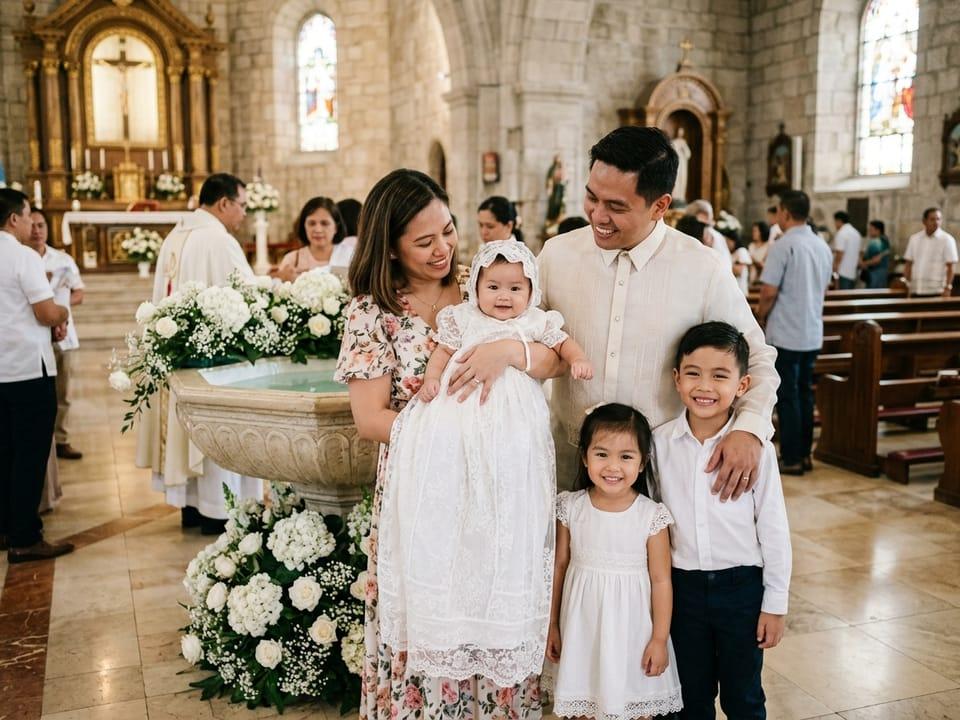
A baby crying at the font is one of the most ordinary sights at a binyag, and it changes nothing about the baptism. The heart of the rite is water poured over the head three times with a single sentence, which takes seconds whether the baby is calm or howling. The things worth planning for are hunger during a long group-baptism morning and heat, especially from March to May. For the photos, make two lists: pictures that work even with tears, and calm ones you take later at the handaan or at home.
Tears at the font are part of the record
The Catechism of the Catholic Church describes the core of the rite plainly. In the Latin Church, baptism is usually conferred by pouring water three times over the head while the minister says, "N., I baptize you in the name of the Father, and of the Son, and of the Holy Spirit." Around it come the anointing with sacred chrism, the white garment, and a candle lit from the Easter candle. None of these steps depends on the baby being quiet.
Babies cry at this point for simple reasons: water on the head, a stranger's hands, a crowd, being woken up. You can soften most of them. Let whoever settles the baby best hold them at the font, keep the pacifier in a pocket rather than at the bottom of the diaper bag, and keep talking to the baby through the pouring. Then let it go. A red, open-mouthed face under the stream of water is what that minute actually looked like, and years later it tends to be the picture that gets a laugh at family gatherings.
A group baptism is a long morning, so time feeds to your turn
Regular baptisms are often part of a longer block. At St. Jude Parish in San Miguel, Manila, the Sunday regular baptism starts with a 9 a.m. seminar for parents and godparents, then Mass at 10, then the baptism at 11. That is close to three hours in church before any water is poured, and in a group baptism your child may be one of the last.
Feed the baby shortly before the rite starts rather than the moment you arrive, so they are full but not yet due for the next feed when the priest reaches you. Bring what you need to feed in a quiet corner, ask the parish office on registration day where parents usually step out, and sit near an aisle so you can leave and come back without crossing the whole church. Change the diaper before the gown goes on, not after.
Heat is a bigger risk than tears
PAGASA, the state weather bureau, calls March to May the hot dry season and says it is "especially uncomfortable" because temperature and humidity reach their peak. May is the warmest month, with a mean temperature of 28.3°C. In a full church without air conditioning, a lined lace gown, a bonnet and a parent's warm arms add up quickly.
The World Health Organization's advice for infants in heat is practical: lightweight, loose clothing, shade, and never covering a pram or stroller with dry fabric, which traps heat. For a binyag, that means travelling in a thin cotton romper, putting the gown on just before your turn, and taking it off again soon after. A pamaypay, a damp cloth and water for the adults doing the holding help more than any outfit choice. HealthyChildren.org, the American Academy of Pediatrics' site for parents, lists a fever after time in a very hot place, or a child who looks very ill or unusually drowsy, among reasons to call the doctor right away. The photos can wait. For lighter gown options, see our guide to christening gowns on a budget.
Two shot lists: one that survives tears, one for later
The first list is for the church, and every item on it works with a crying baby: the water being poured from the priest's hand, the parents' faces watching, a godparent holding the lit candle, the white garment. In a group baptism other families stand at the same font, so ask before posting pictures with their children in them. The full church plan, from sponsor groupings to parish rules, is in our binyag photo guide.
The second list is for when the baby has calmed down. Sleeping babies photograph well: on a lola's lap at the handaan, or back in the gown for five minutes at home in the evening when the house has cooled, with each ninong and ninang by a window. Nobody needs the baby awake and smiling at 11 a.m. for the day to be well remembered.
A studio is calmer, but only coverage on the day records the rite
Each way of getting photos handles a crying, overheated baby differently, so choose by what you want on record.
|
Studio session on another day |
Photographer at the church |
Family phones |
| What you pay for |
A posed session package |
Coverage time and deliverables |
Nothing extra |
| Fussy or unwell baby |
Indoors and cool; ask about rebooking |
Shoots through the crying, but the rite has no second take |
Flexible, but whoever holds the baby can't shoot |
| Changing the date |
Up to the studio's policy |
Tied to the parish date |
Free |
| Result |
Calm, well-lit portraits, not the ceremony |
The rite, the sponsors, the handaan |
Candid; dim church shots may blur |
| Suits |
Families who want a calm gown portrait |
Long sponsor lists, special baptisms, big handaans |
Small family gatherings |
A professional earns the fee on moments that can't be repeated: the pouring of water and a big group of sponsors on the church steps. A studio session gives you the calm portrait the font rarely does, but it belongs to a different day and isn't a record of the baptism.
If every gown photo is a teary one
If the church pictures all show a wailing baby and you'd like one calm family picture in the white gown as well, pokesta can turn the phone photos you already have into a binyag family portrait made with AI. It is a generated image, not a record of the day, so keep the real photos too. It costs $1 per photo and the first one is free, so before booking a separate studio session, try it with a recent photo of your baby.
References