Bautizo and Primer Añito on the Same Day: How Peruvian Families Combine Them and Save on Photos

pokesta Editorial Team · Updated November 3, 2026

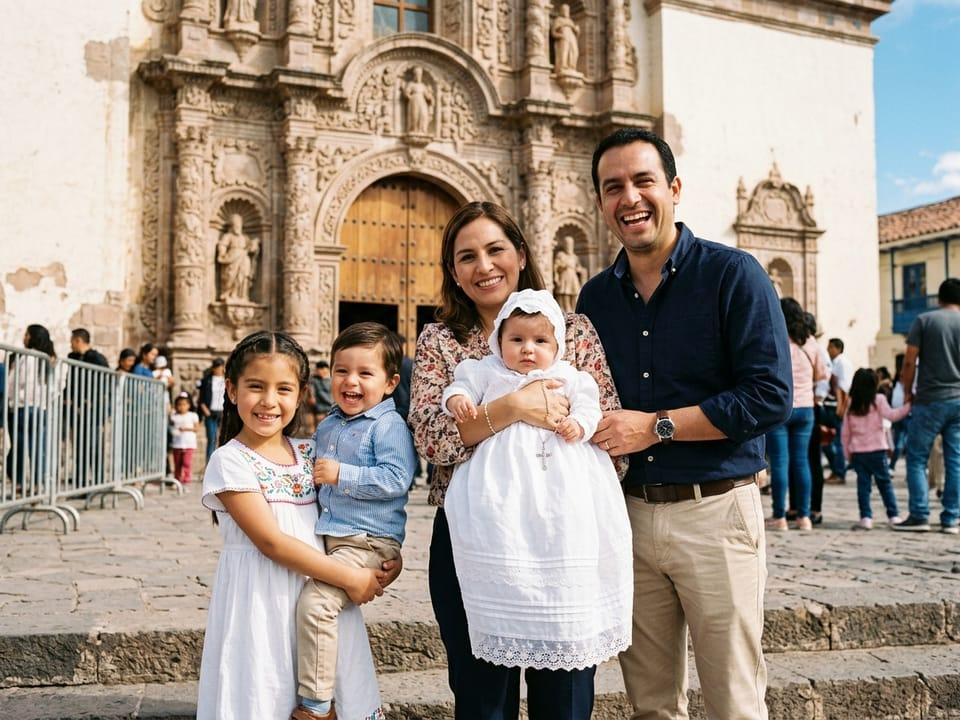
Baptism family photo (AI-generated image)

Holding the bautizo in the morning and the primer añito (the first birthday party) in the afternoon works, and it means one gathering of relatives, one day of travel and one photography booking instead of two. The Lima parishes we checked all baptize on Saturdays, between mid-morning and mid-afternoon, and take children up to six or seven under the same requirements as newborns, so a one-year-old fits without extra steps. The plan only fails when it ignores the baby: take the earliest slot you can get, put a nap between church and party, and bring two outfits and two shot lists.

A one-year-old is still baptized as an infant

Each parish sets its own age rules, and the ones we read are generous. Santa María Reina, the Marianist parish in Lima, lists baptisms for children "de 0 a 6 años". The Fátima parish in Miraflores takes children up to seven; older children first need baptismal catechesis. That matches canon law, which applies the rules for adults to anyone who has reached the use of reason. The same Code also asks parents to arrange baptism within the first few weeks after birth, so if you've already waited a year, call the parish now rather than moving the date again for a venue.

Book earlier than you expect. At Corazón de Jesús in Magdalena del Mar, a private baptism (particular) has to be booked up to a month ahead, and Fátima opens bookings on the first working day of the previous month. Parents and godparents must also attend the pre-baptism talk (charla pre-bautismal): two weekday evenings at Corazón de Jesús, the evening before at Fátima, the Monday of the same week at Santa María Reina. Have the birth certificate ready (Fátima wants it printed, not on a phone; Corazón de Jesús asks for the original), plus copies of the parents' and godparents' DNI, and a letter from your own parish if you live outside the parish boundaries.

The parish offering belongs in the budget too. As of October 2026, Corazón de Jesús lists S/150 for a particular baptism and S/50 for the comunitario (group baptism), Santa María Reina asks for S/85, and Fátima asks for a minimum donation of S/100 per child. Confirm current amounts with the parish office.

Take the earliest slot and plan the nap into the gap

Timing decides whether this works. Corazón de Jesús holds particular baptisms at 10:30 and 11:15 on the second and fourth Saturdays and at 11:00, 11:45 and 12:30 on the first and third, with the comunitario at noon. Santa María Reina baptizes on Saturdays at 1 p.m. Fátima's group baptisms are at 3 p.m. on the first and third Saturdays, which leaves no room for an afternoon party; pair that one with an evening gathering.

With a morning slot, a workable day looks like this: church in the late morning, a short lunch, then a real nap at home or in a quiet room at the venue, and the party from mid-afternoon. Don't cut the cake straight after church. A one-year-old passed from aunt to padrino to grandmother needs sleep before the singing. If the nap doesn't happen, bring the cake forward, not back.

Two outfits and two shot lists

Keep the clothes for each celebration separate. Corazón de Jesús asks families to dress the child in white and bring a candle, and the ropón (christening gown) belongs at the font, not near frosting. Change into party clothes after the nap, so the gown stays clean and the photos show a clear switch between the two celebrations. Our guide to baptism outfits on a budget covers borrowing or renting the white clothes.

Write separate shot lists as well. For the church: the water, the lit candle, the padrinos holding the baby and the whole family at the church door. For the party: the cake and candle, the baby with each set of grandparents, and one big group photo taken early, before anyone starts leaving.

One booking covers both, if the parish lets an outside photographer in

The saving comes from booking one continuous block instead of two separate minimum bookings and two trips. First ask the parish whether an outside photographer may work during the rite; rules differ. Santa María Reina says guests and photographers may attend. Virgen de Nazaret in El Agustino doesn't allow photographers inside the ceremony and offers its own photo service. Then ask the photographer whether the drive between church and venue counts as working time, and what happens to the date and the deposit if the baby gets sick.

Photographer for the day Studio session on another day Relatives with phones
How the cost works One block for church and party; travel may count Separate fee for a portrait session No fee
Baby's mood and health Has to last a long day Short, can be timed around naps Shoot whenever the baby is calm
Changing the date Church, venue and photographer all move Easier to rebook Nothing to rebook
Results Rite and party as one story Controlled, even light Uneven but candid
Suits Large families, grandparents travelling in Families who want one formal portrait Small parties on a tight budget

A professional earns the fee at the font, where the water is over in seconds, and in the big group photo where someone has to get every aunt, cousin and padrino looking the same way. The party is the part relatives cover well with phones, so a booking that ends after the cake is a fair compromise. For the rite itself, see what to do if the baby cries at the bautizo.

If the portrait in the ropón never got taken

On a long combined day, the family portrait in white sometimes never happens: the baby falls asleep, or grandparents in another region can't travel. pokesta can turn the phone photos you already have into an AI bautizo family portrait at a colonial church door or a garden reception, for $1 per photo, and the first photo is free. It's a generated image, not a record of the day, so keep the real snapshots as they are. Try it with a recent photo of your child before you pay for an extra session: make a baptism family photo.

References