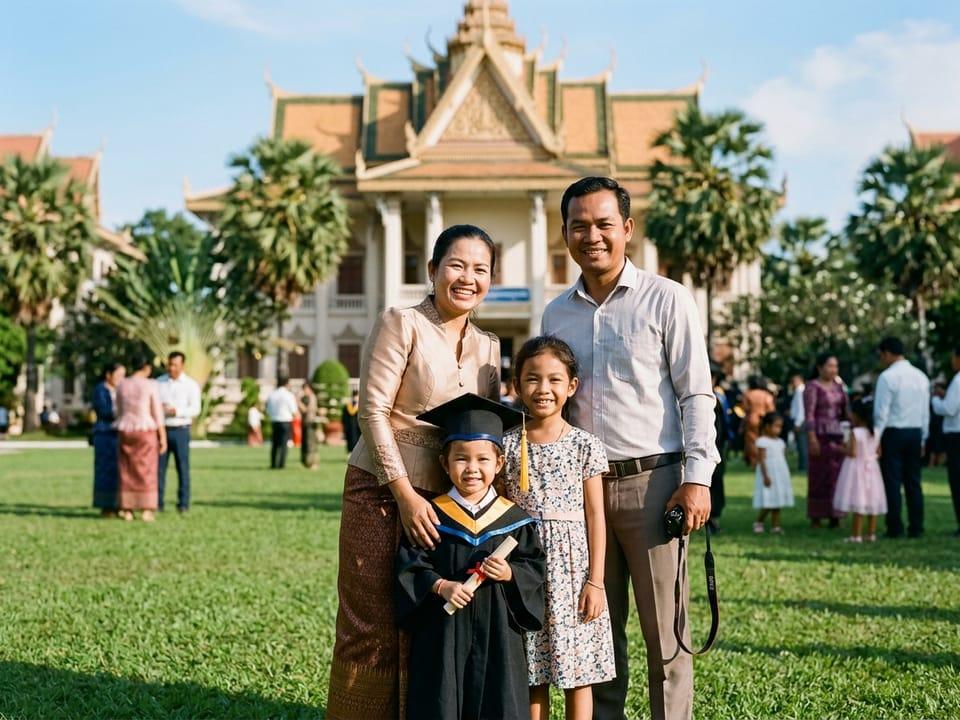
Three things set the price of a framed graduation photo: the size, the finish (an acrylic or glossy "crystal"-style panel, a canvas, or a wooden frame with glass), and whether the file was retouched by a studio or comes straight from a phone. If you can get the high-resolution files, the usual way to save is to enlarge one picture for the living room and print the rest small. And in Cambodia, where humidity runs around 90% in the rainy season, how the print is protected matters as much as the frame you pick.
What a framing quote is really charging for
When a studio includes a large framed print in its package, or suggests one as an add-on, the price covers more than paper. It usually bundles the retouching, a color check on the studio's own printer, the frame and sometimes delivery. A print shop charges mainly for the print and the frame, and the retouching is whatever is already in the file you bring. Neither is automatically cheaper. Ask both for the same size and finish, and ask the studio one more question: can you buy the retouched file instead of the frame, or as well as it?
The answer depends on the package, so read what is included before you book. Some photographers sell digital delivery as the main product. Localgrapher, which lists packages in Phnom Penh, says edited images arrive in a password-protected online gallery within four business days and are stored for two years. Angkor Wat Photographer in Siem Reap says its shoots include professionally edited images delivered in high resolution. With files in hand, you decide where and how large to print.
One large print for the wall, the rest small
Most families need only one picture big enough to see from across the room. Choose that one first, then size everything else down: a smaller frame for the grandparents, a few prints for relatives, and the rest kept as files. Choose with the wall in mind. A wide family group suits a horizontal frame above a sofa, while a portrait of the graduate in the gown suits a narrow wall or a shelf. If the picture will hang high, a group where faces are large enough to recognize from below works better than a full-length shot with small faces. To settle the size, cut a sheet of newspaper or cardboard to the print size, tape it to the wall for a day, and look at it from where you usually sit.
The finish is partly taste and partly practical. A glossy acrylic panel looks bright but shows reflections from windows and lights; canvas has no glare but texture softens fine detail; a wooden frame with glass sits between the two and can be opened later if the print needs replacing.
Before taking a file to a print shop, check pixels and shape
A printer reads a file's pixels-per-inch value as an instruction for how large to print it, so the pixels you need equal the print size multiplied by the resolution the shop asks for. Ask the shop what it needs, then do the sum. At 200 ppi, for example, a 16 × 20 inch print needs 3,200 × 4,000 pixels. Take the original file from the photographer's gallery or from the phone itself; a photo forwarded through a chat app may have been compressed.
Shape matters as much as pixels. Many phones shoot in a 4:3 frame, while a 16 × 20 inch print is 4:5, so part of the picture will be cut. Ask the shop to show you the crop before printing, and check that nobody's head or hands are trimmed at the edge. If you already know a frame is coming, leave some space around the group when you take the picture.
Studio framing, a print shop, or printing your own photos
|
Studio framing option |
Photographer's files, print shop |
Your own photos, print shop |
| What you pay for |
Retouching, color check and frame together |
Shoot fee, then print and frame |
Print and frame only |
| Retouching |
By the studio |
By the photographer |
None unless you do it |
| Main risk |
Small; you see a proof |
Crop and color are your call |
Too few pixels for a big size |
| Best for |
The formal portrait for the living room |
Outdoor sessions |
Small prints, ceremony-day snapshots |
Paying the studio to frame makes sense for the one formal portrait that will hang for years, especially when you want it checked against the studio's own printing. For ceremony-day phone photos, small prints are the honest size, because a picture snapped in a crowd may not hold up at poster size. If you are still choosing who takes the photos, see studio or freelance photographer for which files each tends to deliver.
Humidity, not the frame, decides how long the print lasts
The Library of Congress calls relative humidity the single most important factor in preserving most photographic prints, and recommends keeping it between 30% and 50%, with changes of less than 5% within 24 hours. Cambodia's rainy season, from about mid-May to mid-September, brings humidity around 90%, so a print on a living room wall sits far outside that range for months.
A living room will never be an archive, but you can lower the risk. Hang the frame on an inside wall rather than an outer wall that gets damp in the rains, and away from the kitchen and bathroom. A room that is air-conditioned for part of the day helps. During the rains, take the frame down now and then and check the back and corners for spots; caught early, they are easier to deal with. Keep it out of direct sun, since the same guidance advises limiting light exposure, and if the photo is matted, ask for acid-free board with no adhesive on the print. Most important, keep the original file backed up in two places, so you can reprint if the picture fades or spots.
Pick the picture for the wall before paying for the frame
The costly mistake with a frame is a picture you later wish you had chosen differently. pokesta can make a graduation family portrait with AI from phone photos you already have, including relatives who could not be at the ceremony, for $1 per photo, and the first one is free. It is a generated image rather than a photograph of the day, so it belongs beside the real photos, not in place of them. Try a version with your family before you order an enlargement.
References