
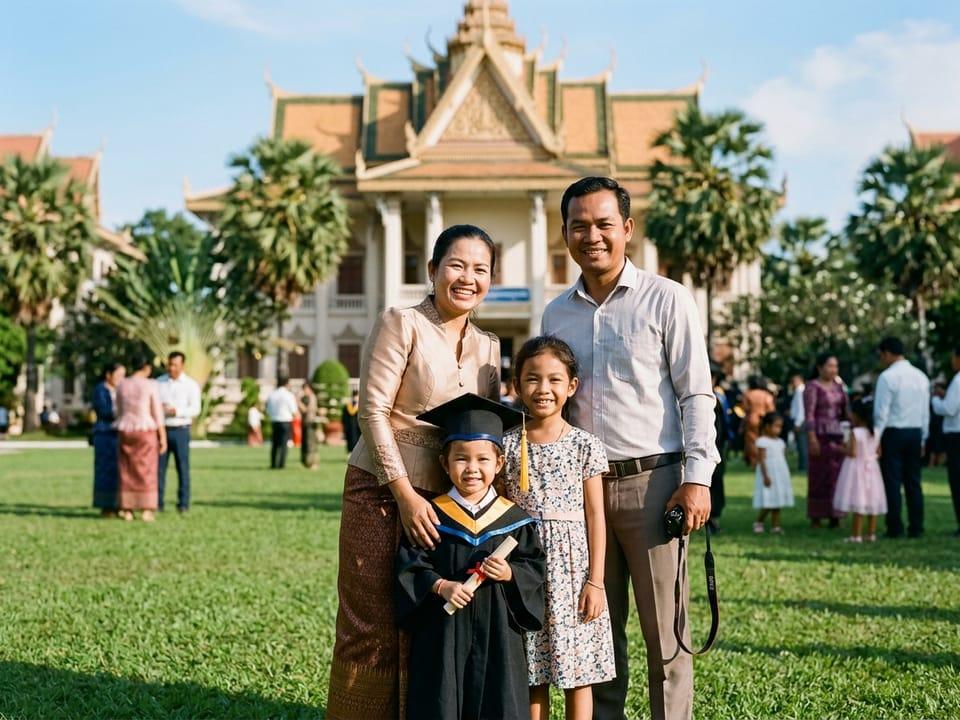
What you pay for graduation makeup comes down to three things: where it is done (at home, at a salon or inside a studio package), how early the artist has to start, and how many faces are in the booking. For most families the sensible split is to pay a professional for the graduate, who is closest to the camera in every shot, and let parents and siblings do their own. In Phnom Penh, where the average daily high in April and May is 35°C, a look that lasts through an outdoor shoot matters as much as the look itself.
Place, time and the number of faces set the price
A home-service artist comes to you, which saves the graduate a trip across the city before dawn, though the quote may include travel. A salon can work out cheaper per person, but someone has to get there and back while the morning traffic builds. A studio package with makeup included is the simplest of the three, except that the makeup then happens at the studio's time and place, not before the ceremony.
Time is the second factor. The Royal University of Phnom Penh's ceremony in August 2017, presided over by then Prime Minister Hun Sen, had more than 3,300 graduates, and with that many people in one hall you should expect to arrive well before the start. Check the reporting time in your university's notice and work backwards from it. Photographers who work in the heat plan early starts too. For its traditional-dress shoots, Angkor Wat Photographer in Siem Reap sets out an itinerary that begins with a fitting at 6:30 am and the shoot at 7:30 am, and says changing and preparation usually take 45 to 60 minutes. Hair and makeup there is an optional extra, arranged on request.
The third factor is the number of faces. Every extra person adds time in the chair, which pushes the first appointment earlier, and if the artist charges more before normal hours, the whole booking costs more. When you ask for a quote, have these items listed separately so you can compare two or three artists on the same basis: makeup per person; hair styling, and whether it includes fixing the mortarboard; false lashes; travel; any early-start charge; and whether the artist stays for touch-ups. Ask to see their work photographed in daylight, not only under a ring light, since much of your day will be outdoors.
Pay for the graduate's face, let the family do their own
The graduate is in every frame and every close-up, while parents and grandparents appear mostly in group shots, a step or two back. A professional finish shows most where the camera is closest, so that is where the money works hardest. Parents, and grandparents in particular, usually photograph best looking like themselves, and doing their own makeup at home lets the family leave together without a second early appointment.
Doing your own does not mean doing nothing. Parents can follow the same idea as the graduate, only lighter: a base that matches the neck, powder only where shine appears, and a lip color a shade brighter than usual so faces don't look washed out in group shots. Test your sunscreen with a flash photo the evening before, because some leave a white cast. Fathers and brothers need little more than a haircut a few days ahead and blotting paper in a pocket, and small children need no makeup at all; tidy hair and a spare top matter more.
There are exceptions. If a mother wants professional makeup for a formal studio portrait, book her for that session rather than the ceremony morning. If the graduate rarely wears makeup, ask for a lighter look, and a trial if the artist offers one, so the face in the photos still feels like theirs.