
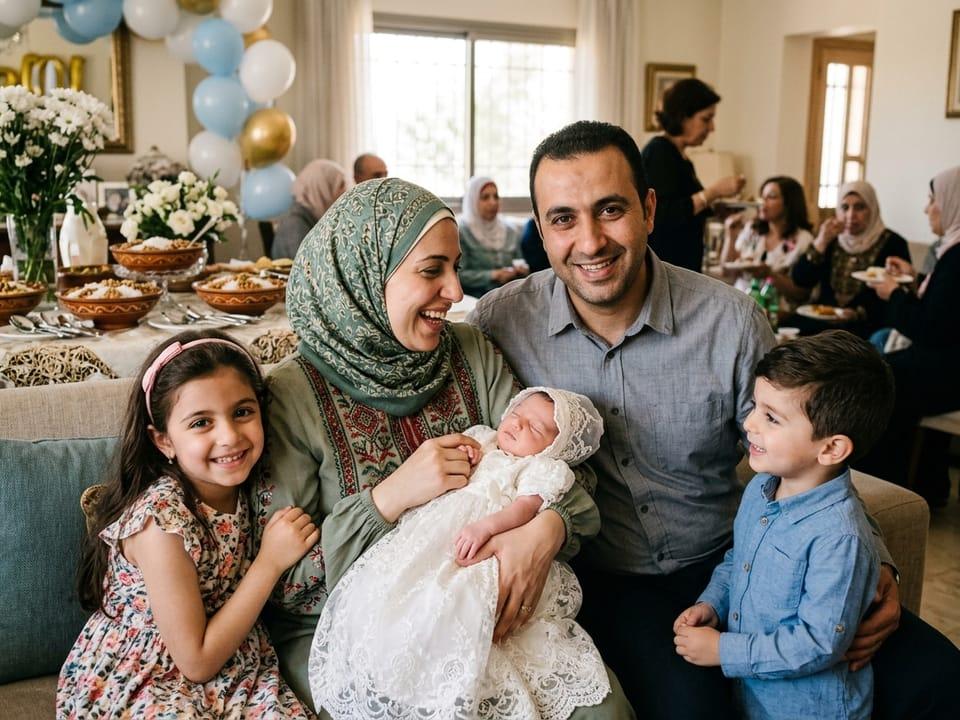
For Muslim families in Jordan, the largest single cost of welcoming a baby is usually the aqiqah, the sacrifice offered in thanks for a child. The recommended number is two sheep for a boy and one for a girl, and official estimates reported in May 2026 put a sheep at 240 to 300 JOD, depending on weight and origin. The mughli for visitors, small giveaways and decorations come next and add up quietly. The photos need the least money: a family portrait taken at home before the guests arrive costs next to nothing and catches the mother at her calmest.
The aqiqah is the biggest bill, and the rules leave room
Jordan's General Iftaa' Department describes the aqiqah as a confirmed sunnah, a recommended act rather than an obligation. On the seventh day after the birth, counting the day of birth as the first, two sheep are slaughtered for a boy and one for a girl; a baby born on a Saturday has the aqiqah on Friday, and for a baby born at night the count starts the next day. Food is prepared for relatives and friends and part of the meat goes to charity. The baby's head is shaved and the weight of the hair given in gold or silver to those in need, and the child is given a good name. The department adds that joy can be shown with sweets and celebration, without extravagance.
The arithmetic is simple. At the May 2026 estimates, two sheep for a boy come to 480 to 600 JOD and one for a girl to 240 to 300 JOD, before butchering and cooking. Those figures were gathered ahead of Eid al-Adha, when demand peaks, and the market moves through the year, so ask your butcher for this month's price.
The same department's guidance leaves families more room than many expect. A single sheep for a boy is permissible and still fulfils the sunnah. A seventh share of a camel or a cow also counts. If money is tight, the aqiqah can wait until you are able to afford it. At least a little of the meat, about half a kilo, must go to the poor; the preferred split is a third for the household, a third to the poor and a third as gifts to friends and neighbours, and sending cooked food to the poor is better than inviting them. You may also appoint a restaurant to slaughter and cook a sheep as your aqiqah, though buying a ready-cooked sheep that was not slaughtered with that intention does not count. For a question about your own situation, ask the department or your imam.
A charity can carry it out for a fixed price
Tkiyet Um Ali, a Jordanian charity, accepts aqiqah donations. As of October 2026, it lists 270 JOD for an aqiqah carried out in Amman's slaughterhouses in the month after you donate, and 155 JOD for one carried out outside Jordan after Eid al-Adha, with the meat distributed to eligible families. Check its page for the current figures before you pay.
The trade-off is plain. You pay one fixed price, nobody has to organise a butcher, and the meat reaches people who need it. On the other hand, it will not happen on the seventh day, and none of it comes back to your own table for the gathering. Which matters more, the meal with relatives or the giving, is a decision for the family to make together.