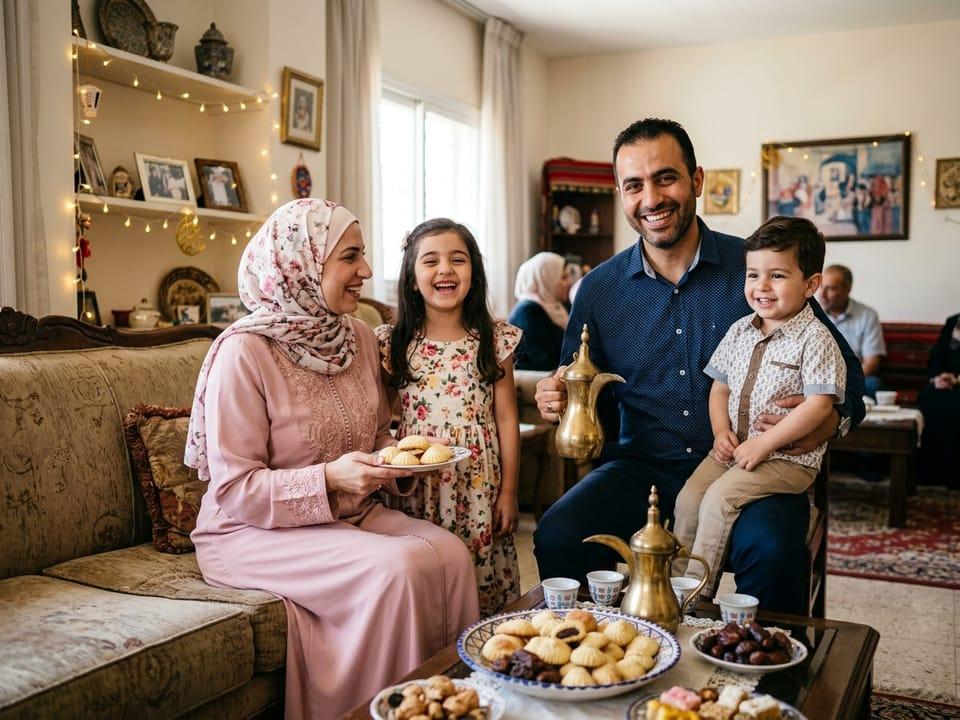
For the next few years Eid al-Fitr falls in late winter, around 9 March in 2027, 26 February in 2028 and 14 February in 2029, when Amman can be rainy and cold. Plan the family photo indoors by a large window from the start, and treat the morning of the second day of Eid as the backup rather than scrambling for one on the first. If a child is unwell, let them rest in comfortable clothes; the Eid holiday in Jordan usually runs for several days, so the photo can wait.
Eid moves into late winter for the next few years
Eid al-Fitr begins on the first day of Shawwal, the month after Ramadan, and the date depends on the sighting of the new moon, so it is confirmed only at the last moment. Because Eid follows the lunar Islamic calendar, it arrives earlier in the Gregorian year each time. The predicted dates listed on Wikipedia, from Saudi Arabia's Umm al-Qura calendar, are 9 March 2027, 26 February 2028, 14 February 2029 and 3 February 2030; dates in Jordan can differ, depending on the local moon sighting. Office Holidays lists the 2027 holiday in Jordan as 9 to 12 March, and the government announces the official days each year.
Those weeks are among the wettest in Amman. In February, average highs are about 12 to 14°C and lows about 3 to 5°C, and the airport station records rain on around 11 days in an average month. March is a little milder, with highs of about 16 to 18°C. Snow falls once or twice a year, mostly on the higher western and northern parts of the city. An Eid morning photo outside in front of the building, the classic plan, may simply not happen.
Children are often tired too. A month of late nights, suhoor before dawn, visits and excitement can leave them worn out just as Eid arrives, and winter colds do the rest.
Plan B indoors: the window, the salon and the stairwell
Choose your indoor spot the evening before Eid, not on the morning. The best light in most homes is the largest window. Sit the family facing it, about one to two metres back, so the daylight falls on faces, and turn off overhead lights that mix in a yellow cast. On a grey day, window light is soft and flattering, which is the one advantage of rain.
The salon or majlis, where guests will be received, makes a natural Eid background: the plates of ma'amoul, the coffee pot, the cushions. Clear the clutter from one corner the night before, and take the photo before the first visitors arrive. In a building with a wide stairwell or a bright entrance hall, that works too for a quick picture of the family in coats on the way out.
Keep outdoor photos short if you take them at all. Five minutes in the doorway under an umbrella, with coats off just for the shot, is better than a cold, damp half hour in the street.
A child who is unwell doesn't need to be in today's photo
If a child has a fever or a bad cold, don't put them into stiff new clothes for a picture. Health guidance such as the NHS advice on fever in children treats a temperature of 38°C or more as a high temperature, recommends plenty of fluids and rest, and warns against wrapping a feverish child in too many layers. A baby under three months with a fever, or a child who seems unusually unwell, needs medical advice, and the decision about whether a child is well enough to visit relatives belongs to your doctor, not to the photo plan.
A child who is mildly under the weather can still be in a gentle photo on the sofa in pyjamas, held by a grandparent. Those pictures often end up being the ones the family remembers.
Make the second morning the backup from the start
The simplest change is to plan two photo slots. Aim for the first morning, after the Eid prayer, and agree in advance that if it rains, a child is ill or the morning runs away, the photo moves to the second morning. Leave the Eid clothes on hangers rather than in the laundry basket, and tell the grandparents too, since the gathering may be at their house. On the second morning, use the same window spot you chose the night before, so there is nothing to set up again, and shoot in bursts with the standard 1x lens so you can pick the frame where every child's eyes are open. Our guide to Eid al-Fitr family photos in Jordan covers the scenes of a normal Eid, from ma'amoul baking to the eidiyah line.
Studio, photographer or home when the weather may turn
A studio is weatherproof, with steady light and heating, and a session in the days before Eid, in the new clothes, avoids both the rain and the holiday rush. Its weakness is the fixed slot: if a child falls ill, you depend on the studio's rescheduling policy, and opening days over the holiday vary. A photographer who comes to the house works well indoors and is worth it for a big gathering, but ask in advance what happens if the date has to move. Taking the photos yourself is the most flexible option for a family with small children, because a sick day costs nothing to reschedule. Studios and photographers quote their own fees in dinars, so compare what each package includes on their official sites.
When the day itself didn't cooperate
If Eid came and went with rain, a fever and no family photo, pokesta can turn ordinary phone photos of each family member into an Eid al-Fitr family portrait with AI, in new Eid clothes in a room set with ma'amoul and Arabic coffee, or in front of a mosque on a bright morning. It's an image the AI generates, not a photo from that day. Each photo is $1, and the first is free, so try it with a photo of your child from this week before you plan another outing.
References