
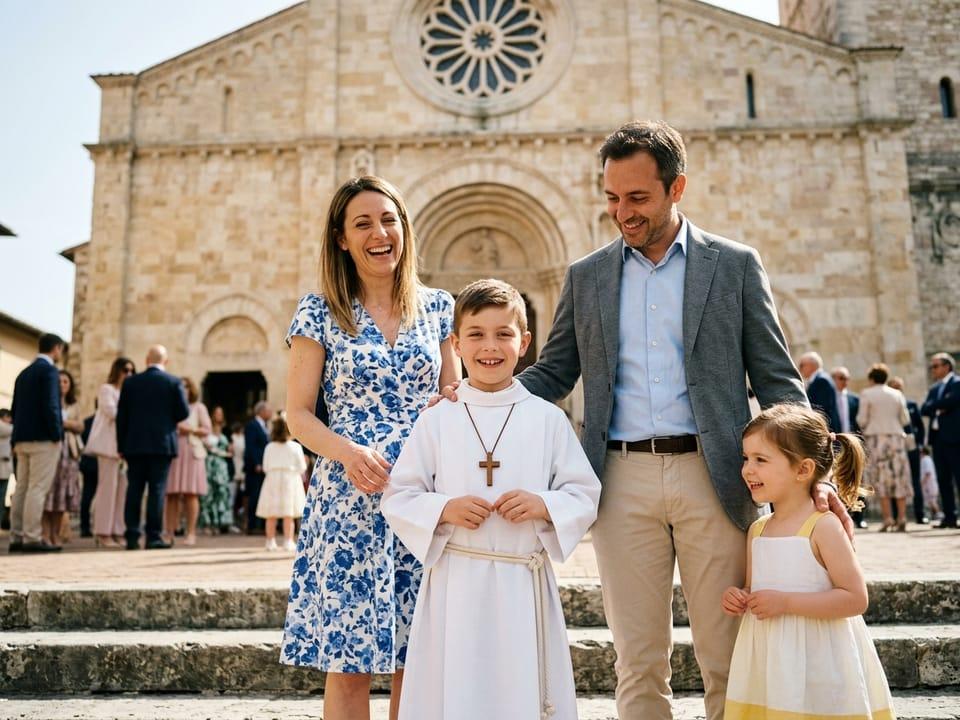
In many Italian parishes, the First Communion Mass is photographed by one photographer agreed with the parish, and parents are asked to keep their phones away during the celebration. The Cathedral of Aosta's 2026 letter to First Communion families said it in two lines: no photos or filming during the celebration, and a photographer will provide the photo service. So the real decision is not who shoots inside the church. It is who takes the family photos before and after, and that part you can do yourselves or give to a photographer you choose.
One photographer for everyone protects the Mass, not a business deal
The rule has a long paper trail. In 1995 the liturgy office of the Diocese of Bergamo reissued its guidelines on photography and video during celebrations, after training meetings attended by more than two hundred professional photographers. For First Communion and Confirmation Masses, it calls it good practice to settle early, with the parents or the parish pastoral council, who will take the photos and how, so that there are no misunderstandings and no crowd of camera operators. When a celebration involves many people, one photographer or videographer, possibly with one assistant, works for all the families, and everyone else is warmly invited not to use their own cameras.
The same text describes how that photographer should behave. They shoot from one or two set positions outside or at the edge of the sanctuary, never walk into it and avoid flash as far as possible. They do not shoot during the Gospel, the homily or the Eucharistic prayer, and keep pictures of the Communion itself to a minimum agreed beforehand with the celebrant. These are diocesan guidelines that each parish adapts to its own church, so the letter from your catechists is what applies to you. If it says nothing about photos, ask the parroco, the parish priest.
There is another reason a single photographer helps. A First Communion is usually celebrated with the whole catechism group, so nearly every picture of the aisle has other people's children in it. Italy's data protection authority, the Garante privacy, says photos parents take at school plays and trips for the family are fine, but spreading images of minors online requires the consent of those with parental responsibility. A church photo full of classmates raises the same question before it goes on social media.
Parish photographer, your own, or phones side by side
| Parish photographer | Your own photographer | Family phones | |
|---|---|---|---|
| During Mass | Often the only one allowed | Only if the parish agrees | Usually not |
| Cost | Ask what the parish photographer offers each family | About 100–600 € in Cronoshare's guide | Nothing extra |
| Family portraits | Short, shared with many families | As long as you book | As long as the child lasts |
| Child tired or unwell | Tied to the Mass time | Can move before or after | Whenever suits |
| What you get | The moment of Communion, the group photo | Planned, edited portraits | Relaxed, uneven quality |
Cronoshare's price guide, dated January 2026 and checked by us in October 2026, gives indicative national figures of 100–300 € for coverage of the church service only, 150–450 € with a printed album of about 20 pages, and 300–600 € for a package that adds photos of the preparations at home and an album or video. It notes that prices run higher in the north and in big cities. Rates change by photographer, season and package, so check each photographer's own site and get a written quote. Our breakdown of what a First Communion photographer costs goes through a quote line by line.
The parish photographer is worth paying for at least once. They are often the only person who can photograph your child receiving Communion, and they usually take the group photo with the priest and catechists, which nobody else can arrange on the day. If you buy only one thing, buy that.