
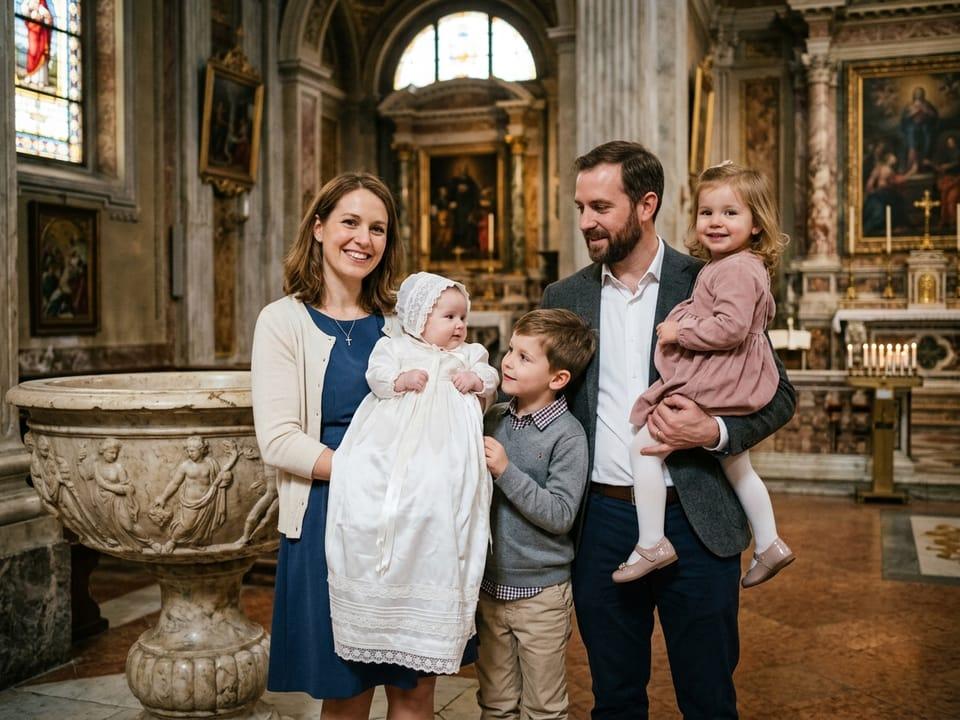
You don't need a professional photographer for a battesimo, but your parish may already have made part of the decision for you. Several Italian dioceses ask that one photographer cover a celebration for everyone, from fixed spots at the edge of the sanctuary, and the Archdiocese of Trento's guidelines say that at group celebrations, when an authorized professional is present, nobody else may take photos or video. The moments that matter, the water and the lighting of the candle, are over in seconds. So the real questions are what your church allows, how dark it is, and whether you can spare one relative from taking part.
Ask the parroco before you ask a photographer
Photography rules are set diocese by diocese, and often parish by parish. The Diocese of Bergamo's guidelines, which cover baptisms as well as weddings and First Communions, ask for one or two fixed positions outside or at the edge of the presbytery, the raised area around the altar, and no moving about inside it. Along the nave a photographer may move discreetly, and flash should be avoided as far as possible. Where several families are involved, the parish should choose a single photographer who works for all of them, and guests are strongly encouraged to leave their own cameras alone. The Diocese of Vittorio Veneto follows a national framework drawn up by photographers' associations and approved by the Italian bishops' liturgical office: more than one photographer is ruled out in principle, and flash is for when it's strictly necessary, never during the most intense moments of prayer.
Trento goes further. Photographers who complete a diocesan course receive a card valid for five years, and the archdiocese gives parishes the list. Anyone asked to do the job without a card must read the rules and sign an acceptance form for the parish priest before the celebration. So if your baby is being baptized with other families on a set Sunday, first ask whether the parish already works with a photographer. Your real choice may be whether to buy that photographer's pictures, not whether to bring your own.
The moments that matter are over in seconds
Trento's guidelines list the moments worth photographing at a baptism: the entrance into the church, the sign of the cross on the forehead, the anointing on the chest, the pouring of water (or immersion), the anointing of the head, the white garment and the lit candle, and the closing rites at the altar. During the readings and the homily, any photos should be taken with the greatest discretion, and there is more room for group pictures once the celebration is over. The order of the rite is in our guide to the four parts of the battesimo.
The water is poured three times and that's it. A relative who has never watched the rite from the right side of the font is usually a step too far away, or stuck behind the godfather's shoulder. Light matters too. Old churches are often dim, and a phone copes with dim light by exposing longer and processing heavily, so a hand pouring water or a baby turning its head tends to blur. A professional with a camera built for low light can get a sharp frame from a fixed spot halfway down the nave. A phone usually can't.