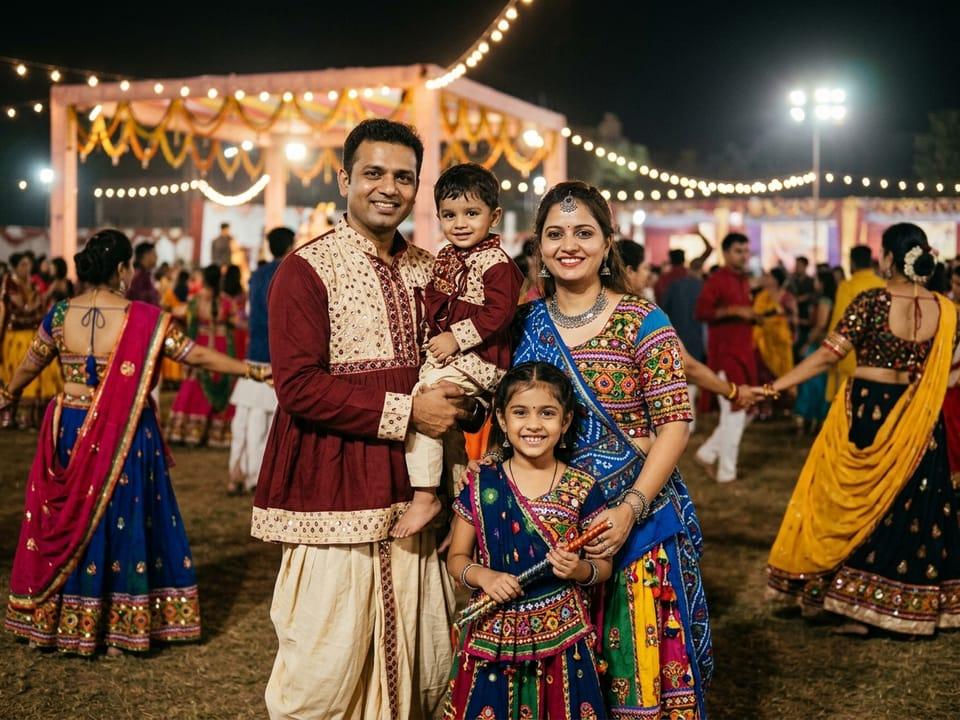
For most children, buying one sturdy chaniya choli or kediyu and changing the dupatta, jewellery and hair each night costs less than renting, and you never have to return it stain-free. Renting makes sense for one special night: a competition, a big-ground evening or a photo shoot. Navratri 2027 runs for nine nights, from 30 September to 8 October, so whatever you choose has to survive a lot of twirling and a fair amount of street food.
What children wear to garba
The chaniya choli is the classic Gujarati outfit for girls and women: a long, flared skirt (the chaniya), a fitted blouse (the choli) and usually a dupatta. Boys wear the kediyu, a long-sleeved top that is pleated across the chest and reaches the waist. It comes from the coastal parts of western Gujarat, often carries bandhani tie-dye prints, and is worn with chorno, also called kafni: wide trousers tied loosely at the ankle. For a baby, a soft frock or a one-piece in the same colours does the job, and nobody at a society garba will expect more.
Rent or buy: count the nights, not the price tag
Rental terms are set by each shop, so before you pay, ask four things: the rent and how many days it covers, the refundable deposit, the late-return charge, and exactly what counts as damage. Ask specifically about lost mirrors, food or henna stains, a torn dupatta and missing tassels, and get the answers on the receipt. Children sit on the ground, eat chaat and sweat through the night, so a rented outfit on a child is a deposit at risk.
That is why renting works best for one evening: a dance competition, a night at a big ticketed ground, or a studio shoot where the outfit stays clean. If the child will wear it three or more times, buy. Choose a size up with a drawstring waist and an adjustable choli tie, and the same set often fits next Navratri and a cousin's wedding before it is handed down.
One set can look different every night. Drik Panchang lists a colour for each day of Navratri 2027: yellow on 30 September, then green, grey, orange, white, red, royal blue, pink and purple on 8 October. The colour is set by the weekday, and the custom is followed especially by women in Maharashtra and Gujarat. Not every family follows it, and no garba requires it. If you'd like to join in, start from a multicoloured bandhani or mirror-work base and change only the dupatta to the day's colour.
Law Garden and the market near you
In Ahmedabad, the handicraft street market along the walls of Law Garden in Navrangpura sells clothing, jewellery and craft pieces through the day, and the road beside the garden turns into a food street in the evening. It is the obvious place to see many children's sets side by side. Wherever you shop, turn the choli inside out and look at the back of the embroidery, pull gently on a few mirrors, and have the child try it on and spin. Buy before the first night, so there is time to take in a waist or swap a size.
Comfort decides whether the outfit lasts the night
The back of mirror work and zari embroidery is often rough, and it sits right against the ribs and arms. A lined choli, or a thin cotton vest underneath, saves a lot of fussing. Cotton or a cotton blend is kinder in the heat of a packed garba ground than synthetic net, and a skirt that ends above the ankle won't catch little feet in a circle dance. Heavy layered skirts look wonderful but tire a four-year-old quickly. Pin the dupatta firmly or leave it off for toddlers, as a trailing end can catch on other dancers. Choose light oxidised-silver jewellery over heavy earrings.
Where the outfit photographs best
Mirror work throws flash back as white specks, so switch the flash off and use the light at the gate or under the light arches. For colours that look true, take one photo at home on the balcony before sunset, while the outfit is still crisp. The table compares the three ways to get a proper picture of the costume. For timing and ear protection on the night itself, see our guide to taking small children to garba.
|
Studio |
Photographer at the garba |
Your own phone |
| How you pay |
Session fee for set time and edited photos; outfit changes extra |
Hourly or per evening, plus passes |
Nothing extra |
| Child's mood and health |
Daytime slot, child rested |
Late and crowded |
Shoot whenever the child is ready |
| Changing the date |
Usually possible; check the policy |
Tied to one night; rain can cancel |
No booking |
| Result |
Embroidery shows clearly; no festival atmosphere |
Movement and lights; low light |
Good in daylight at home |
| Best for |
A portrait of a rented outfit, kept clean |
Competitions, big family groups |
Every night's outfit |
Prices vary by city, studio and season, so compare what is included rather than the headline figure. A studio is worth it if you rent a special outfit just for pictures, since the outfit goes back clean.
A costume portrait without one more outfit
Children outgrow a chaniya choli within a year or two, and the set you bought this season will not fit next time. pokesta can make a Navratri family portrait with AI from photos already on your phones, with everyone in chaniya choli, kediyu or bandhani, which helps when one outfit is in the wash or a cousin lives in another city. It is an AI-created image, not a photo from the night itself. It costs $1 per photo and the first one is free, so test it with a recent photo of your child before you pay for a rental that is only for pictures: create a Navratri family portrait, or see what other families wore.
References