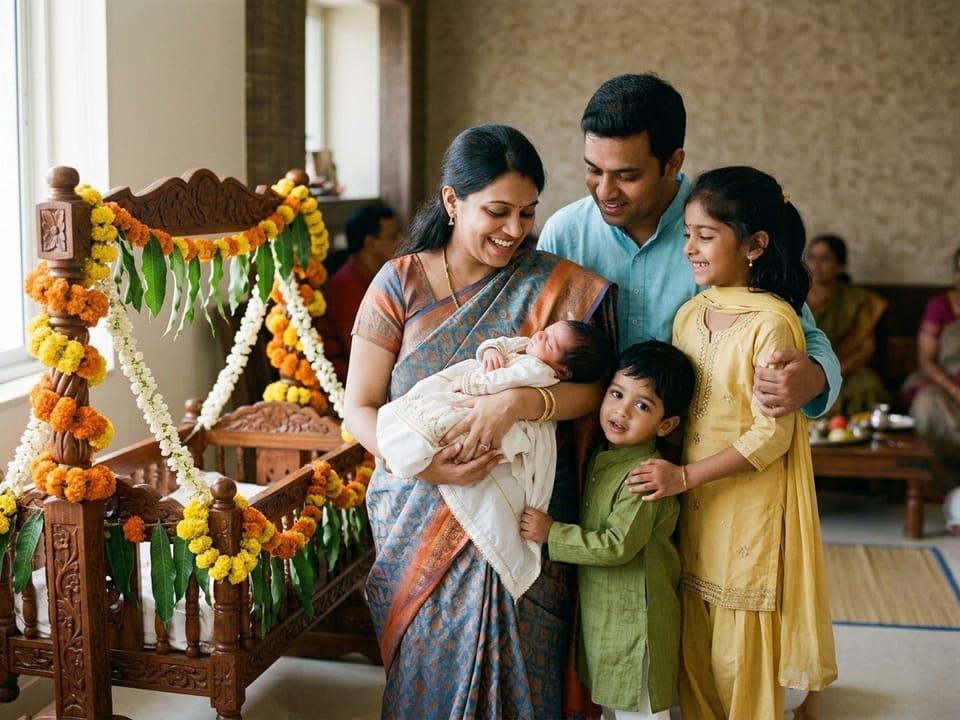
Yes, in most families the namkaran can be held after the twelfth day, provided your priest and elders agree to the new date. The Grihya Sutras, the old manuals of household rites, place the naming on the tenth or twelfth day after birth, but some texts allow the first new moon or full moon after the tenth day, and other opinions stretch as late as the first day of the baby's second year. Regional customs already spread across the calendar, from the seventh day in some Telugu families to the 28th day in Kerala. If the mother is recovering from a caesarean, or the baby is in the NICU or under phototherapy, ask the doctor what the day can reasonably ask of them, then ask your family priest for a new auspicious date.
The "right" day already varies from family to family
The twelfth day is what many families mean by namkaran. The Telugu barasala is usually held on the seventh day, but it may fall on the 11th, 16th or 21st day, in the third or fifth month, or later still; many families combine it with a cradle ceremony on the 21st day, and the Brahmin priest who sets the hour avoids rahukalam. Kerala's noolukettu, where the baby is named and a black thread and gold chain are tied around the waist, is held on the 28th day, or on the 27th for boys in some parts of the state. Some families name the baby even earlier, at the chhathi on the sixth day.
A later date is not, in itself, a break with tradition. What counts is how your own elders and priest read it. In some Hindu households mother and baby traditionally stay apart from the wider family for roughly the first ten days, so for many relatives the ceremony may be the first chance to see the baby. That is exactly the gathering a tired mother may not be ready for.
Day 12 falls in the middle of recovery
After a caesarean, the NHS says most women stay in hospital for one or two days, can't drive for a few weeks, and may need to take things easy for several weeks, holding off on carrying anything heavier than the baby until they feel ready. A day-12 ceremony with a crowd, hours on the floor and the baby lifted in and out of a cradle sits squarely inside that stretch. Even after a vaginal birth, hosting guests for hours less than two weeks after delivery is hard work.
Babies keep their own timetable too. Newborn jaundice is usually most visible around the third day and typically takes about two weeks to fade. When treatment is needed it's usually phototherapy for around 48 hours, mostly in hospital. A baby under the lights, sleepy at feeds or newly home from the NICU should be led by the paediatrician, not the calendar. Ask the doctor first, and be specific: how long can the mother sit comfortably, is it all right for the baby to be passed between many guests, and should the baby stay in a quiet room for most of the day? Then take those answers to the priest.
Ask the priest for a new muhurat, and decide what moves
When you call the priest, give the baby's birth details, which many families need to choose the first letter of the name, explain the medical reason, and ask two questions. Can the naming itself be done as a short rite on or near the original day? And if not, which later dates are auspicious?
That opens two practical routes. One is to keep a small naming at home on the original day with parents, grandparents and the priest, and hold the cradle ceremony and the big lunch weeks later. The other is to move everything to one later date. The first lets the name be spoken on the traditional day and asks the mother to manage only a short rite; the second brings everyone together at once but means waiting a few more weeks. Which one fits is for your priest and elders to say; what you bring to that conversation is a clear picture of what the mother and baby can manage.
A shorter rite: mother seated, photos first, fewer guests
Whatever the date, plan the day around the two people who are recovering. Seat the mother on a chair or a low stool with a backrest rather than on the floor, and let an elder lift the baby into the cradle. Take the family photos first, right after a feed, while everyone is fresh; the priest's rites can follow. Keep the guest list to people who would truly mind missing it, ask anyone with a cough or fever to visit another time, and set aside a quiet room for feeds. Let the priest know in advance that the mother may need to step out, so the rite can carry on without her for a few minutes.
Photographer, studio or family phone for a smaller rite
|
Photographer at home |
Studio session later |
Family phone |
| Cost |
A paid booking |
A separate paid session |
Free |
| Mother and baby |
Comes to you, works around feeds |
Means a trip out |
No extra effort |
| If the date moves |
Depends on the studio's policy |
Booked to suit recovery |
Nothing to rebook |
| Result |
A full record of the rite |
Posed portraits, not the ritual |
Casual |
| Best for |
A big postponed gathering |
Families who want styled newborn photos |
Small, quiet rites |
A professional is worth it if the postponed ceremony turns into the big gathering, with elders travelling in. For a small naming on the original day, a relative with a phone and a shot list is plenty; prices and what to ask for are in what a naming ceremony photographer costs. If you are also weighing a newborn shoot, home or studio compares the options for a mother who is still recovering.
Relatives who can't come can still be in the portrait
A moved date nearly always leaves someone out: an aunt who had booked tickets for the original day, or grandparents who can't make the journey twice. pokesta can make an AI family portrait in ceremony clothes from each person's own phone photos, with the first photo free and $1 per photo after that. It is a created image rather than a photo of the day, which is exactly why it suits relatives who weren't there. Make a free test portrait from a recent photo of your baby while the new date is being fixed.
References