Annaprashan Day Nerves: If the Baby Cries, Refuses the First Bite or Sleeps Through the Muhurat

pokesta Editorial Team · Updated October 28, 2026

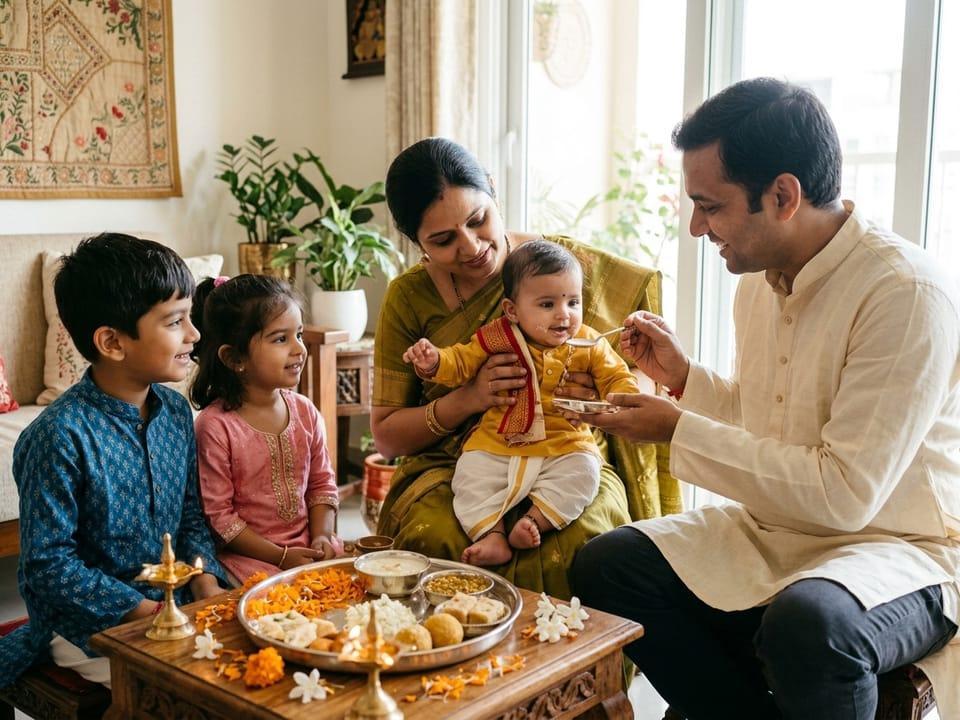
Annaprashan (First Rice) family photo (AI-generated image)

A baby who cries, turns away from the spoon or falls asleep at annaprashan hasn't spoiled anything. For many families the first bite is a token touch of rice or kheer on the lips, and a baby of five to eight months who refuses it is behaving exactly as babies that age do. The World Health Organization recommends starting complementary foods at six months, so the ceremony is often the first time anything but milk reaches the baby's mouth, and the CDC's milestone checklists list "knows familiar people" at six months and being "shy, clingy, or fearful around strangers" by nine. Plan the day around the baby's feed and nap, keep the round of cuddles short and take the formal family photos before the puja. Then even a tearful first bite leaves you with the pictures you wanted.

The tears usually have ordinary causes

Most meltdowns on annaprashan day come from three things piling up at once. The first is the food itself. Rice, kheer or payesh is a new taste and a new texture, offered from a spoon, a fingertip or a silver bowl the baby has never seen. Pushing it back out or clamping the lips shut is a normal first reaction, not a sign that something is wrong.

The second is people. Around six months babies start to tell their own family apart from everyone else, and over the following months many grow wary of unfamiliar faces. A ceremony where the baby is passed from aunt to cousin to neighbour, each wanting a photo, runs straight into that. In a Bengali mukhe bhaat the first rice is traditionally fed by the maternal uncle or maternal grandfather, who may not be someone the baby sees every day.

The third is the setting: a warm room, stiff new clothes, a crowd, noise, and a puja that runs into nap time. Any one of these is manageable. All of them together, on an empty or overfull stomach, is usually when the crying starts.

Feed a little first, and keep the cuddle queue short

Give a normal feed some time before the puja so the baby arrives neither hungry nor stuffed. A baby who is starving will cry at a spoon of rice; one who has just finished a big feed won't open their mouth. Ask the priest or the elders beforehand roughly when the first bite will come and how long the puja before it lasts, then work back from that.

Keep one familiar person, usually a parent, as the baby's base for the day. Relatives can take turns, but ask them to sit next to that parent and hand the baby back after a minute or two rather than carrying them off across the room. If the maternal uncle will give the first bite, let him hold the baby quietly for a few minutes before the ceremony, with the mother beside him, so his face isn't brand new at the key moment.

For the food, a very small amount, smooth and only lukewarm, is easiest to accept. If the baby refuses, a touch to the lips is enough for many families, and nobody needs to push a second spoonful. How much and how fast to move on to solids afterwards is a question for your pediatrician, not the guests.

If the baby falls asleep at the muhurat

Babies don't keep to auspicious times. If the baby is asleep when the moment comes, don't put food into a sleeping baby's mouth. Ask the priest in advance how your family handles this, for example whether the puja and blessings can go ahead with the baby asleep in a parent's lap, with the first taste following once they wake. If you know your baby always naps at midday, mention it when the date and time are being discussed, while there is still room to plan around it.

Formal photos before the puja, the first bite without flash

Take the posed family portraits first, while the baby is fed and rested and the outfit is still clean. Ten minutes is plenty: the baby with the parents, with each set of grandparents, and the whole family together. Once the ceremony starts there may be no calm window left.

For the first bite, keep the photographer close, at the baby's eye level and slightly to the side, so the feeder's arm doesn't hide the face. Use burst mode and no flash; a sudden flash on top of a new taste is a quick way to set off the tears. If the baby cries anyway, keep shooting. The scrunched-up face and the grandmother laughing beside it belong to the record of the day just as much as the posed shots do. Our guide to the whole ceremony covers the object-choosing game and outfits.

Photographer, studio session or family phones

Photographer at the ceremony Studio portrait session another day Family phones
Cost A package for the event A separate session fee Nothing extra
If the baby is cranky or unwell The date is fixed by the muhurat Movable if the studio's terms allow Try again later
Rescheduling Hard; the ceremony won't move Depends on the studio's policy Any time
Results Full record of the ritual and guests Calm, posed portraits Natural but uneven
Suits Large gatherings, families who want an album Formal portraits without ceremony pressure Small home ceremonies

A photographer earns the fee on the day itself. The parents are busy feeding, holding and greeting, and someone has to catch the first bite and the full family group. A studio session is the gentler option for portraits, because you can move it if the baby is ill, but it can't record the ritual. If you're weighing the cost, see what an annaprashan photography package covers.

A calm family portrait can still come later

If the day's photos turn out to be all tears and half-closed eyes, you can still have a calm family portrait. pokesta can make one with AI from the phone photos each of you already has, with the baby in ceremonial clothes and the family around them. It's a created image rather than a photo of the ceremony, so keep the real ones too. It costs $1 per photo and the first photo is free, so try it with a recent photo of your baby and see whether it's the portrait you were hoping for.

References