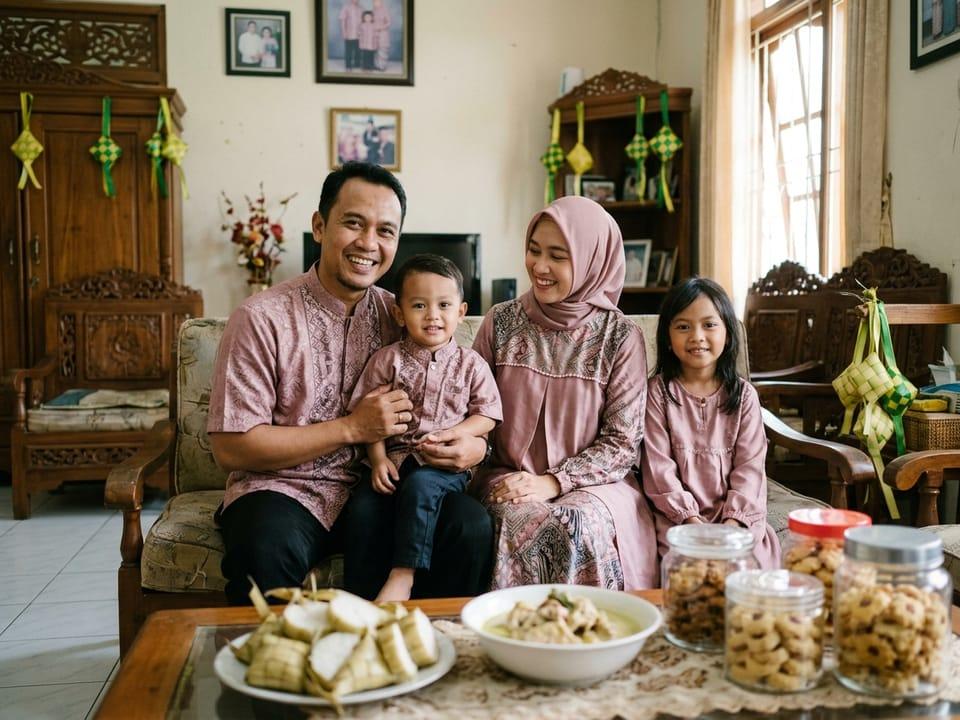
The keluarga besar photo, the one with every branch of the extended family, works when the time and the jobs are agreed in the family WhatsApp group before Lebaran, not when someone shouts "foto dulu!" and hopes everyone is in the room. On the day, seat the elders on chairs, put the children on the floor in front, fix a phone on a tripod with a remote or the self-timer, shoot in bursts, and photograph latecomers in the same spot so they can be added later. With positions decided in advance, the shooting itself takes a few minutes.
Someone is always missing, and there's a reason
Lebaran pulls families in several directions at once. Halal bihalal, the round of visits to elders in the family, the neighborhood and at work to ask forgiveness, happens on Idul Fitri or in the days after it, and younger families usually call on older relatives and neighbors. So the cousins who arrive at Grandma's at nine may leave at eleven for the other side of the family, and the ones who drove in from Jakarta turn up after lunch.
Mudik adds to the scatter. A record 193 million people traveled home in 2024, mostly from about a week to a few days before Lebaran, and the Trans-Java toll road and Java's northern coast road are where traffic is heaviest. Arrival times are hard to predict. Meanwhile the children are wound up on sweets and cousins, and the grandparents, who have been receiving guests since morning, are tired by mid-afternoon.
Sungkem comes first. This is the Javanese tradition of asking parents, grandparents and elders for blessing and forgiveness, and it shouldn't be hurried along for a photo. Plan the group shot for after it.
Fix the time and the jobs in the family WhatsApp group
Pick the slot when the most people are likely to be present, often late morning on the first or second day, after sungkem and before the big meal, while clothes are still clean. Post it in the family group a week ahead, pin the message, and remind everyone the night before. Then give a few people a job each:
- Camera: sets up the tripod, frames the shot and presses the remote. A teenage cousin who likes phones is ideal.
- Caller: fetches people from the kitchen, the terrace and the street outside.
- Kids' captain: gathers the children with a snack in one hand and a toy to hold their attention.
- Elders' helper: brings chairs, and checks glasses, peci and hijab for the grandparents.
- Counter: checks heads against the family list before the first shot.
Five jobs sounds like a lot, but each takes only a few minutes, and nobody ends up doing all of it while missing from the picture.
Seat the elders, children in front, and step back
Put the grandparents in the center on chairs. Their children stand behind and beside them, couples together. Grandchildren sit on a mat on the floor in front, smallest in the middle, and babies go on a parent's lap next to the grandparents. Tall teenagers fill the back corners. Leave a gap in the back row for the person running in from the camera.
Shoot in the shade of a terrace or indoors with window light from the side. Midday sun puts hard shadows under peci and hijab. Avoid the phone's 0.5x ultra-wide lens for a group this size: faces near the edges get stretched. Use the main lens and move the tripod back, or bring the rows closer together. Set the phone at about chest height of the standing row so nobody's face is hidden behind the person in front.
Tripod, remote and burst, then add the latecomers
A phone tripod and a Bluetooth remote let the camera person join the frame; a 10-second timer works too. With 30 faces, someone always blinks, so use burst mode or take three to five frames each round. Do a formal round first, then a relaxed one where the children can wave. Check the screen zoomed in before everyone scatters.
When an uncle walks in at four, don't move the tripod. Photograph him in his spot with the same framing and light, and he can be added to the group picture in editing. Tell the family you did this. If enough people arrive later, take a second full photo instead.
Phone and tripod, a home-visit photographer or a studio
|
Phone and tripod |
Home-visit photographer |
Photo studio |
| Group size |
Whoever fits in the frame |
Whoever fits, with lights for a dim room |
Capped by the package and the room |
| Cost |
A tripod and a remote |
Package by the hour |
Package plus extra people |
| Tired kids and elders |
Stay home and rest |
Stay home and rest |
Everyone travels to a slot |
| Result |
Depends on you |
Even light, sharp faces |
Controlled light and backdrop |
Studios are built for smaller groups. Selfie Time's Studio Pro B takes up to 10 people for Rp120,000, and its Studio Pro Jumbo up to 20 for Rp200,000, only at its Lampung branch. Jonas Photo's Minimalis C family package covers five people for Rp1,000,000 and charges Rp25,000 for each extra person (prices as of October 2026; check the official pages). Whether thirty people fit in the room is a question to ask first.
A photographer at home is worth paying for when the keluarga besar gathers only once a year and the usual camera person wants to be in the picture. Bey Creative's halal bihalal package, for example, comes with an assistant and flash. See what a home-visit photographer costs, and matching sarimbit outfits for coordinating colors across the rows.
For the relatives who couldn't come home
Even a well-planned photo can't include the sibling working abroad or the cousin who stayed in the city this year. pokesta can make a Lebaran family portrait with AI from the phone photos each person already has. It is a generated image, not a record of the gathering. Each photo costs $1 and the first one is free, so try it with a recent picture of your child and the relative who's away: create a Lebaran family photo.
References