
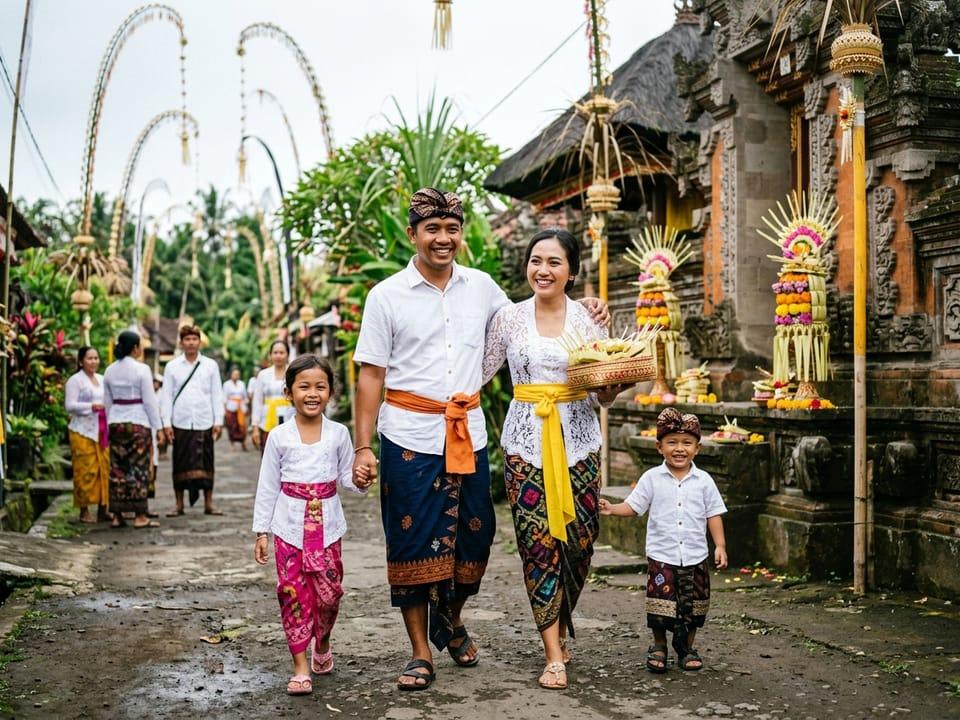
Take the Galungan family photo in your own compound, after the morning prayers at home, and let the village pura be a place for praying rather than a backdrop. In 2027 Galungan falls on Wednesday 13 January, in what is on average Bali's wettest month, and again on Wednesday 11 August, in the driest. With small children, the order of the day matters more than the camera: pray at home while they are fresh, go to the busier temples with a plan for stepping out, and take pictures in the gaps between.
Galungan falls on 13 January and 11 August 2027
Galungan follows the Pawukon, Bali's 210-day calendar, and always falls on the Wednesday (Buda) of Dungulan, the eleventh week. Kuningan comes ten days later. The Bali governor's circular for 2025 put Galungan on 19 November 2025, with Penampahan Galungan the day before and Umanis Galungan the day after listed as days for Hindu worship. Counting on in steps of 210 days gives 17 June 2026, then 13 January and 11 August 2027, with Kuningan on 23 January and 21 August. If you need to arrange leave, check the governor's circular for 2027 once it is out. For the meaning of the festival itself, see Galungan in Bali.
The days around it shape a family's plan. The penjor, the tall curving bamboo poles, are made on Penampahan, the day before. On Galungan morning, worship begins at home and continues at the temples around the neighborhood. On Umanis Galungan, families pray, gather for dharma santi and visit relatives. On Kuningan, prayers are meant to be finished before midday, so anything planned for that day has to happen early.
Pray at home first, while the children are fresh
The morning prayer at the sanggah or merajan, the family temple in the compound, is the calmest part of the day for a small child. There is no queue, the place is familiar, and a toddler can sit on a parent's lap. Keep this part unhurried and leave the phone indoors.
The village temples come next, and that is where things get hard: crowds, waiting while groups take their turn, and heat. Denpasar's average high in January is about 31°C, with heavy humidity. Decide before you leave who will take the youngest out if they get restless, and where you will wait outside the temple wall. Bring water. It is perfectly fine for one adult to take a toddler home after the first temple while the rest of the family carries on.
Temple dress needs a test run. On Penampahan, have the children put on their kamen (the wrapped cloth), kebaya or shirt, and sash, and walk around in them. Tie the kamen firmly and pin it inside the fold so it survives sitting and standing. Shorts underneath help a toddler who wants to run, and sandals that slip on and off save time at every gate. A boy's udeng can be tied once you arrive, not in the car.