
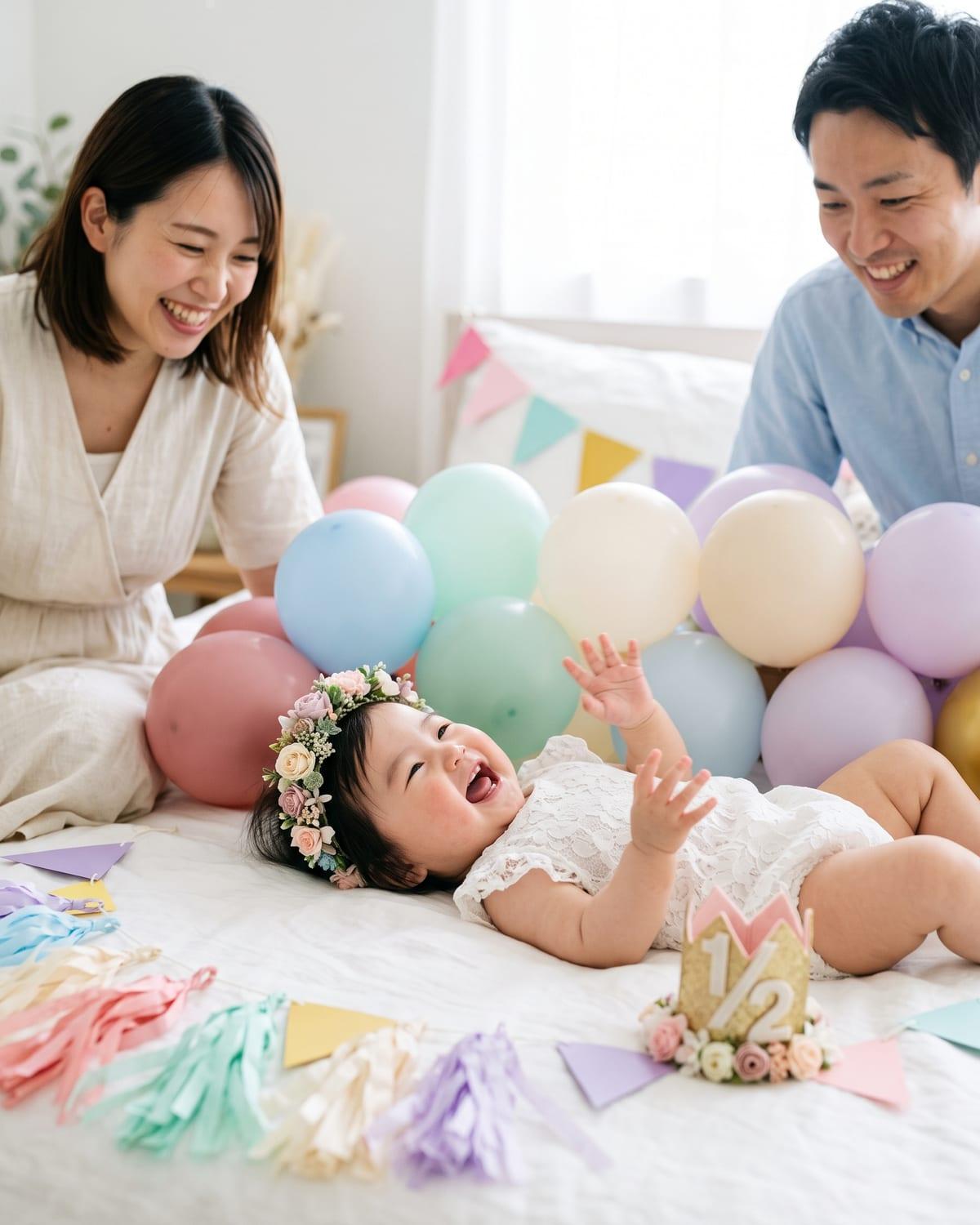
Half-birthday photos (for the six-month milestone that many families in Japan celebrate at home) usually lean Western, with balloons and banners. But a Japanese-style shoot with a hakama romper or a kimono-style romper looks clean and elegant. Once you've chosen the outfit, one or two traditional props are plenty: red cloth, a folding fan, or fabric in a traditional print. For a girl born in early September or a boy born in early November, the half birthday falls around their hatsuzekku (a baby's first seasonal festival), so you can also photograph the two together in front of the festival dolls.
Hakama rompers shine in full-length lying-down shots
A hakama romper is a one-piece romper designed so the top looks like a crested kimono and the bottom like hakama, the pleated trousers worn over a kimono on formal occasions. If it fastens with snaps at the crotch, diaper changes are the same as with any romper, so you get the look of traditional dress without the fuss. Besides black, gray or navy hakama, there are floral kimono tops paired with deep red or purple hakama. You can also find kimono-style rompers, and jinbei-style rompers without the hakama (a jinbei is a light summer outfit), so choose by season and taste.
What makes a hakama romper is the pleats of the hakama and the overlap of the kimono collar. Pull back a little for a full-length lying-down shot and the shape of the hakama comes through properly. Zoom in on the face alone and it could be any white romper, so get both a full-length shot and a close-up. Straighten the hakama so the hem runs neatly down to the baby's toes, and check that the collar overlaps evenly before you shoot.
Black or navy hakama photograph much darker than you'd think. If your phone sets the exposure for the dark hakama, the face can blow out to white, so tap the baby's face on the screen to expose for it. A backdrop in a light tint like pale gray or beige, rather than white or cream, softens the contrast with a black hakama, and both the face and the outfit come out well.
When choosing one, check for cords hanging around the neck. Japan's industrial standard for cords on children's clothing (JIS L 4129) does not allow cords that hang from the head or neck area, but the Consumer Affairs Agency explains that the standard doesn't regulate sales, so non-compliant products may be on the market. If it comes with a haori-style jacket, check that the haori cord is firmly sewn on as decoration.
Traditional props: one or two from red, gold and classic prints
You don't need to collect a lot of props to get a Japanese feel.
Red cloth on its own feels like a celebration. Spread a red cloth like the felt used under Hinamatsuri dolls and lay the baby on it, and a black or navy hakama stands out sharply. An open folding fan placed above the baby's head looks almost like a halo. Fold a sheet of gold card into a little screen and stand it up behind, and it starts to look like a photo studio.
If you're using fabric with a traditional print, asanoha (hemp leaf) is a good choice. According to Japan's Agency for Cultural Affairs' Cultural Heritage Online, asanoha is a pattern of repeated star shapes built on a regular hexagon. Because hemp is strong and grows quickly, it was favored for babies' garments and kimono as a wish for a child's healthy growth. You can bring that meaning along into a half-birthday photo.
Cutting "1/2" out of chiyogami (patterned Japanese paper) or adding a single temari (a traditional embroidered ball) also suits the style. Temari with bells inside or tassels attached should go above the baby's head, out of reach, so no frayed bits end up in the baby's mouth.