
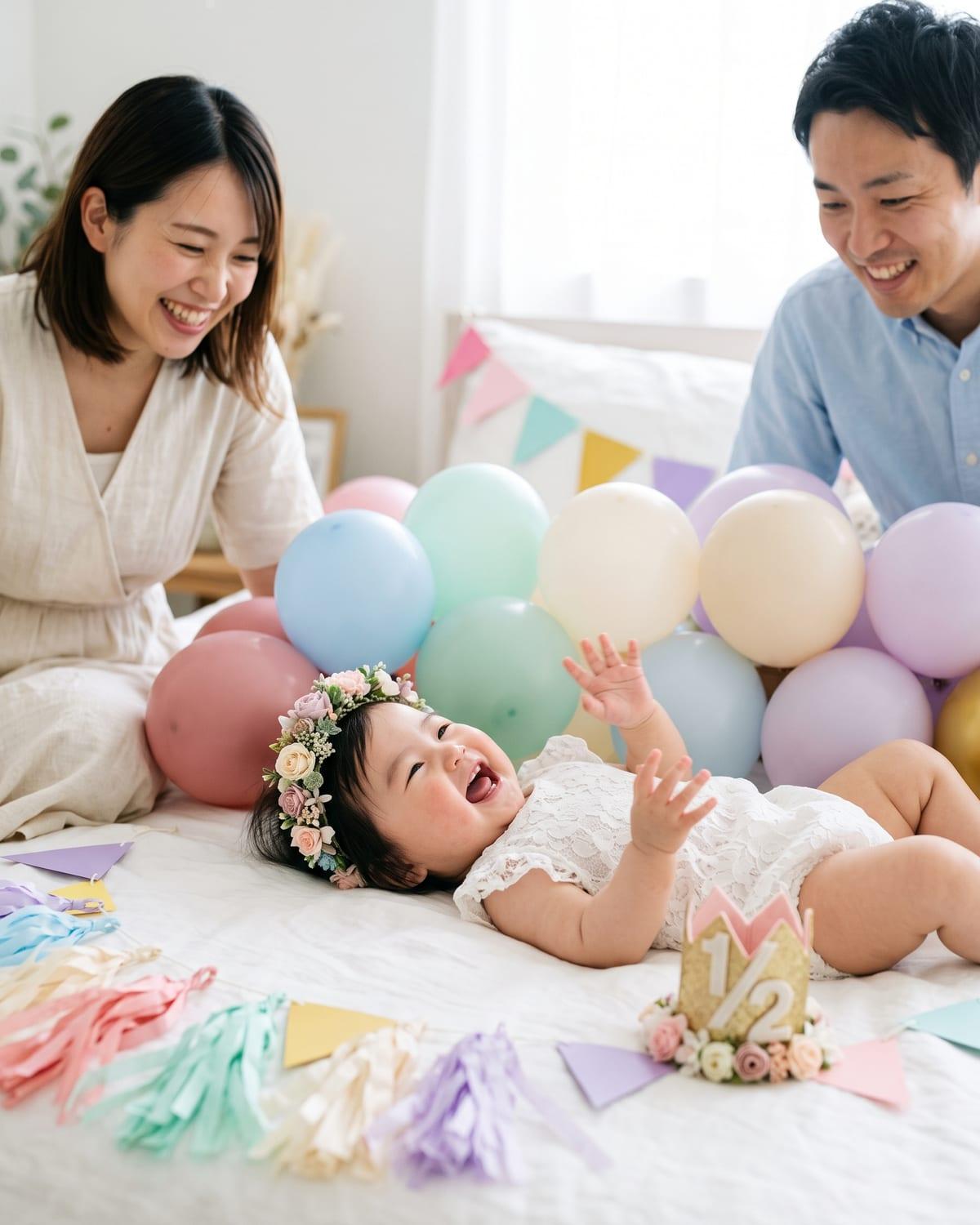
Stranger anxiety usually begins somewhere between six and nine months, and it's a sign that your baby can now tell parents apart from everyone else. That's exactly when the half birthday, a six-month milestone families in Japan often mark with photos, and the first birthday come around. To get through a studio session without tears, mention the stranger anxiety when you book, start the shoot with your baby in your arms, and give your baby a few minutes to watch you chatting with the staff before anyone comes close. If your baby still cries nonstop, it's easier on everyone to drop the studio and switch to a photographer who comes to your home, or to take the photos yourselves.
Stranger anxiety means your baby knows who you are
A leaflet from the child-rearing support committee of Tsuruoka City in Yamagata Prefecture says that from around six or seven months, babies start staring warily or crying when an unfamiliar person approaches, which is when stranger anxiety begins. The timing and intensity vary from child to child, and some babies never show it. The leaflet describes it as a cognitive ability that helps babies widen their circle from the family who care for them to people they don't know, something that appears because there's someone they can safely lean on.
The MSD Manual, written for medical professionals, says stranger anxiety starts at around eight to nine months and usually fades by age two, and calls it a normal reaction tied to a baby's developing ability to tell familiar people from strangers. If you think of the start as a range rather than a fixed date, it won't throw you when a baby who was fine at six months suddenly cries at the first-birthday shoot. If your baby hasn't shown it yet, booking the half-birthday shoot a few weeks before the six-month date is one option. A six-month photo doesn't need to be taken on the exact day to mean something.
Babies cry because a stranger comes close too fast
In a studio, the trigger is usually an unfamiliar adult approaching head-on in an unfamiliar room. A photographer's face is hidden behind the camera, which makes it even scarier. The MSD Manual suggests that before leaving a baby with a new babysitter, the family should first spend time together with that person. The same idea works at a studio. If your baby gets to watch the staff as "someone my parent is talking to," it's easier to accept them.
When you book, it helps to tell the studio:
- that stranger anxiety has started and your baby cries when strangers come close
- that you'd like to start with family photos, with your baby in your arms
- that you'd prefer to do the outfit changes yourself, with staff keeping their distance for a while
- your baby's nap and feeding times, and when they're usually in a good mood
On the day, don't go straight into the shoot after checking in. Let your baby watch you laugh and talk with the staff for a few minutes. Babies read their parents' faces closely, and if you're tense, they're more likely to cry. Start on your lap or with family photos in your arms, and move to solo shots once your baby has settled. For those, stand right behind the photographer and call your baby's name, so they look toward the lens and can still see you. Studio Alice, a children's photo studio chain, says in its FAQ to allow about two hours, and that if a child gets fussy, staff will wait a while and in some cases may ask the family to come back another day. It suggests bringing milk, diapers and toys as a change of pace, and has a nursing area. If the crying doesn't stop, step out of the room for a feed or a short walk, and leave room in your schedule for that.