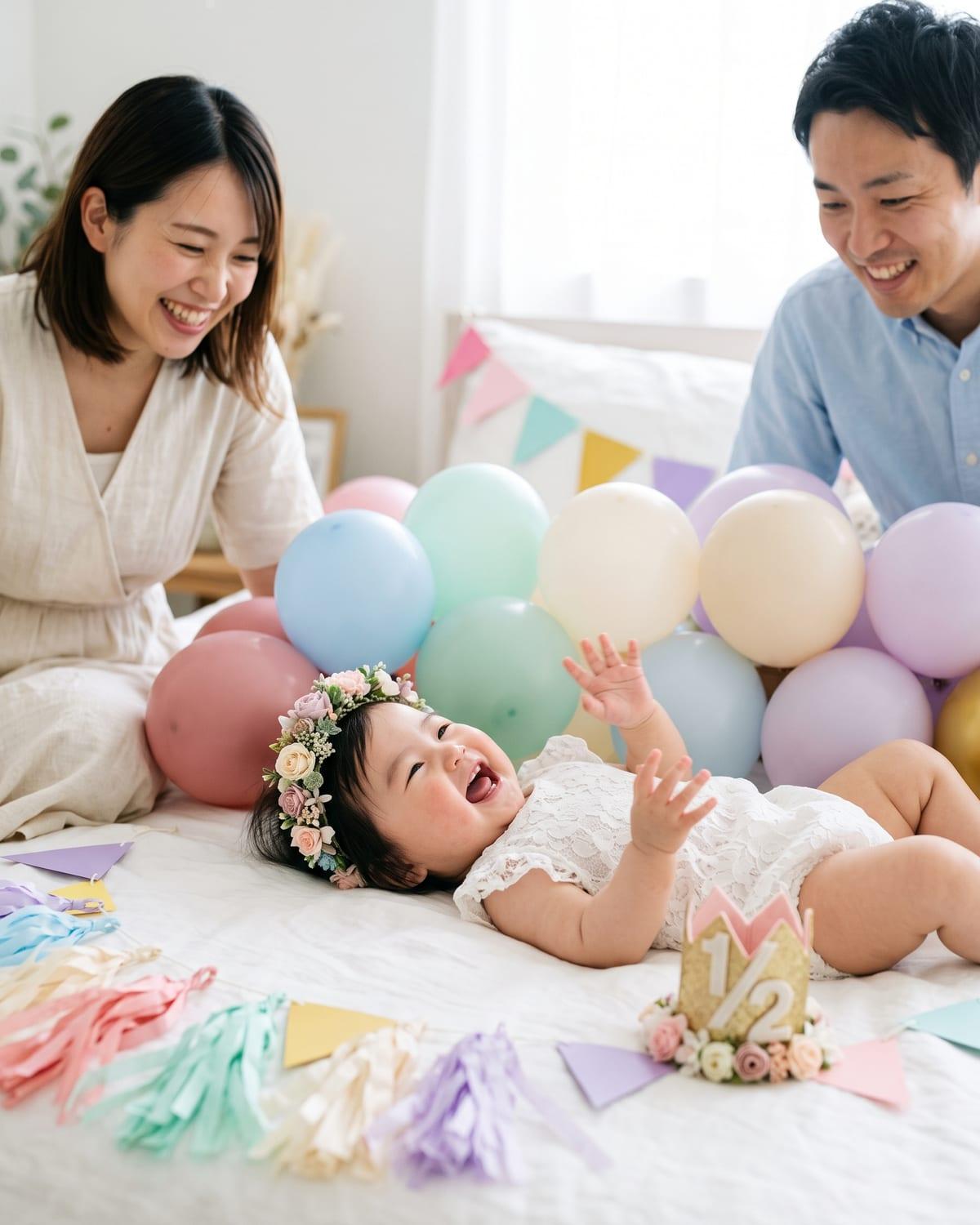
If your baby scratches their face with their own nails a few days before a half-birthday or 100-day photo shoot (two baby milestones families in Japan often mark with portraits), you can usually go ahead as planned, as long as your baby is well and in good spirits. A small scratch becomes much less visible when the unscratched side faces the camera and the light. Dab a runny nose instead of wiping it, and protect the skin under the nose with a moisturizer. Whether a studio can remove a scratch depends on the studio, and its official retouching menu may not list scratches at all, so ask when you book. If your baby has a fever, is feeding poorly or is fussy in an unusual way, put their health ahead of how the scratch looks and reschedule.
First decide whether to shoot or postpone
When you're unsure, go by how your baby is overall, not by the scratch or the runny nose. If a scratch is red and swollen or oozing, or a runny nose comes with a fever or listlessness, talk to a pediatrician rather than waiting it out for the sake of the photos. Quebec's public health institute, INSPQ, advises calling a doctor if a runny nose lasts more than 10 days and the mucus is yellow or green.
To decide, check temperature, feeding and mood twice, the night before and the morning of the shoot. If it's only the scratch or the runny nose and your baby is otherwise well, shoot. If your baby seems unwell overall, postpone. Rescheduling rules differ by provider, so check the comparison further down.
Turn the unscratched side toward the camera and the light
A thin scratch casts a shadow and stands out under strong light from the side, and blends into the skin under soft light from the front. At home, soften direct sunlight from the window with a sheer curtain and seat your baby with the unscratched cheek toward the window. Turn the face slightly so the scratched side is farther from the camera, and the scratch moves to the far side of the face and looks smaller. Skip the flash.
Adjust for where the scratch is. On a cheek, use that angled pose. On the forehead, let the edge of a hat or headband cover it. Beside the nose, step back and favor shots that include the upper body. Take plenty of sleeping shots, profiles, hands and feet too. At a studio, tell the staff where the scratch is when you arrive so they can set the lighting and pose to suit it. After the first few frames, ask to see the monitor and check how visible the scratch is together. Then you can decide on the spot whether to change the angle or ask for retouching.
Dab a runny nose and protect the skin under it
Right before each shot, dab the nose with soft gauze or a tissue. Wiping over and over turns the skin under the nose red, which shows up in the photos. INSPQ's guidance says that if the skin around the nose gets irritated, you can apply petroleum jelly or an unscented moisturizing cream. Apply a thin layer the evening before, and on the day, blot it before shooting so it doesn't look shiny.
The same guidance recommends saline drops without medication for a stuffy nose, and a nasal aspirator if needed. Bring extra gauze to the studio and ask for a moment between shots to wipe.
Trim the nails short and round the week before
The surest way to prevent new scratches is nail care. KidsHealth, the parenting resource from the US children's health organization Nemours, says babies' nails may need trimming once or twice a week, and that you can do it while your baby sleeps. Use baby nail scissors with rounded tips or baby clippers, and leave the edges rounded rather than jagged. An emery board works too. If you nick the skin, press gently with sterile gauze, and don't wrap a bandage around it, since it could come loose and become a choking hazard.
Trimming the day before risks a fresh nick showing up in the photos. Trim once earlier in the week, then smooth the corners with an emery board two or three days before the shoot.
Retouching and rescheduling differ by studio, photographer and DIY
Whether a studio will retouch depends on the studio and its menu. At Studio Alice, a children's photo studio chain, the retouching list includes tan-line correction for children (3,278 yen for all purchased images), filling in missing teeth (550 yen per shot), mask tan-line correction and a skin-smoothing print aimed at coming-of-age portraits, but nothing specifically for facial scratches (as of October 2026). The on-location service fotowa says image editing, including individual skin retouching, isn't included in its fee.
If you want a scratch toned down, mention it when you call to book and ask whether they can fix it, how much it costs, and whether it applies to both prints and files. Prices and menus change by season and location, so confirm on the official site or with the studio. If they can't help, you can adjust brightness and color yourself, as covered in editing keepsake photos on your phone. Go easy on skin smoothing, though, since it erases the texture of a baby's face at that age.
Rescheduling rules differ too. Studio Alice doesn't charge for changing or cancelling on the day if your child suddenly falls ill. fotowa lets you change the date free until the day before, and offers a 1,980-yen option that waives cancellation fees from three days before the shoot through the day itself (both as of October 2026).
|
Studio |
On-location |
DIY |
| Handling the scratch |
Lighting and pose adjusted for you |
Use window light at home |
Wait until it heals and reshoot |
| Retouching |
Ask about scope and price |
Skin retouching not included |
Brightness and color on your phone |
| Rescheduling |
No charge for sudden illness on the day (Studio Alice) |
Free until the day before |
Any time |
| Cost |
Session fee plus photos |
Base fee, files included |
Equipment only |
For a shallow scratch and a polished portrait, choose a studio. To shoot the whole family at home, choose an on-location photographer. With no rush, wait for it to heal and shoot it yourselves. For more on studio versus home, see do you need a studio for half-birthday photos?, and for photographing a baby with a rash, Omiyamairi photos when your newborn has a rash (Omiyamairi is a newborn's first shrine visit).
If you can't wait for it to heal, add an AI portrait
Maybe the date can't move, but you'd still like a photo with a clear face. pokesta uses AI to create a half-birthday portrait, with your baby in a kimono or a dress, from photos of each family member, including a phone snapshot taken after the scratch has healed. It's $1 per photo and you can do it from home. These are images generated from your photos, not a record of the day, so treat it as a separate picture from the studio's. The first photo is free, so once your baby's skin has settled, try one with a photo already on your phone.
Create a half-birthday photo
References