
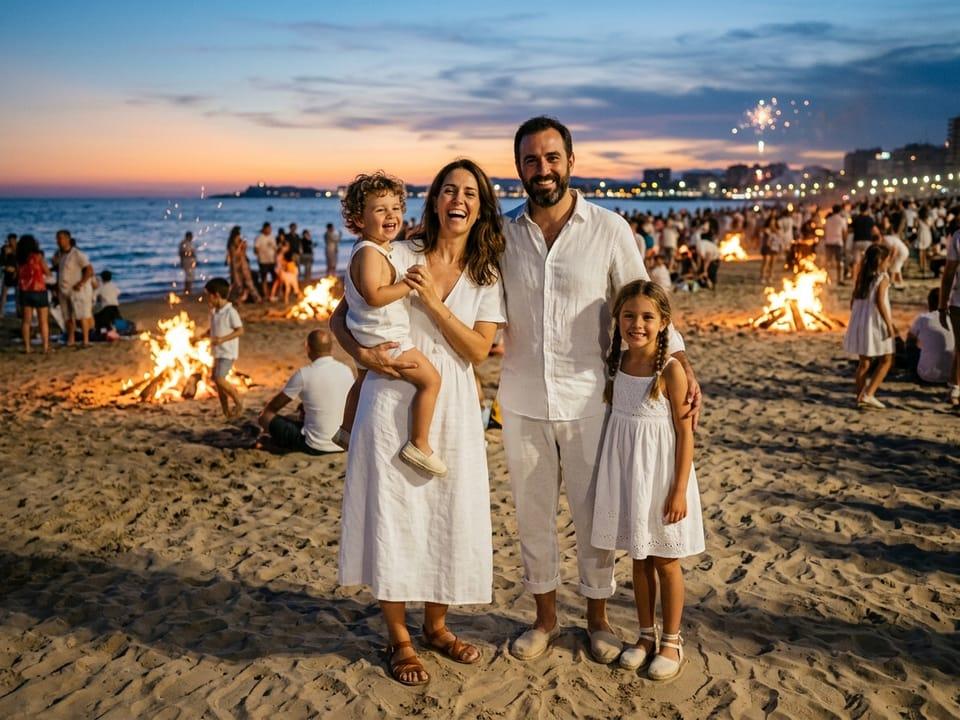
With small children, the Noche de San Juan works best as an early evening: reach the beach or square before sunset, take the family photo in the last daylight, and watch the big fires and fireworks from a distance instead of waiting for midnight. On 23 June 2027 the sun sets at about 21:29 in Barcelona and Alicante, 21:40 in Málaga, 21:49 in Madrid and 22:18 in A Coruña, so there is time for photos before the fires take hold. Spanish law sets minimum ages for fireworks, 12 for the mildest category, and the rules on bonfires vary from one town and beach to the next, so check your ayuntamiento's notice before you pack the cool box.
A late night everywhere, but not the same night everywhere
San Juan is the eve of the feast of the birth of Saint John the Baptist on 24 June, and across Spain it is celebrated with fire. In Barcelona, the Flame of Canigó reaches Plaça de Sant Jaume on the afternoon of the 23rd, and representatives of each neighbourhood carry it off to light the bonfires of the whole city, with street parties, dinners and fireworks going on until dawn. In A Coruña, where the festival is declared of International Tourist Interest, there are bonfires in every neighbourhood and huge crowds on the Riazor and Orzán beaches. Málaga lights bonfires on the beaches and burns rag figures called júas. Alicante's Hogueras, though, burn on the night of the 24th, not the 23rd.
For a child who normally sleeps by nine, any of these means a long evening. Plan the outing around the light, not the fire. Sunset on the 23rd is late, and civil twilight, the period when you can still see without artificial light, lasts roughly another half hour: until about 22:03 in Barcelona and 22:54 in A Coruña. Arrive an hour before sunset, eat early on the sand, and treat the first bonfires as the end of the night for the youngest.
Fire, firecrackers and smoke: what the rules say and what helps
Spain's regulation on pyrotechnic articles, Real Decreto 989/2015, sorts consumer fireworks into categories. F1 covers items of very low hazard and negligible noise, F2 items of low hazard and low noise for use outdoors in delimited areas, and F3 items of medium hazard for use outdoors in large open areas. They may not be sold to, or used by, anyone under 12 for F1, under 16 for F2 and under 18 for F3. Regions may lower the ages for use, to no less than 8 for F1 and 10 for F2, only for specific places and times linked to rooted local customs, and only with training, adult supervision and written permission from parents. Read the category and minimum safety distance on the label before you hand anything to a child.
Bonfires are a matter for each town. Before going, look up your ayuntamiento's notice for San Juan: whether fires are allowed on your beach at all, whether only in marked zones, and what time the beach has to be cleared, if it does. Then set a few family rules. Keep small children upwind so smoke blows away from them, a few big steps back from any fire, and in shoes, since sand that has had a fire on it can stay hot. Agree a meeting point that a child can recognise, and write a phone number on a wristband. If loud bangs upset your child, ear defenders help; our article on babies and noise at the Fallas explains more.