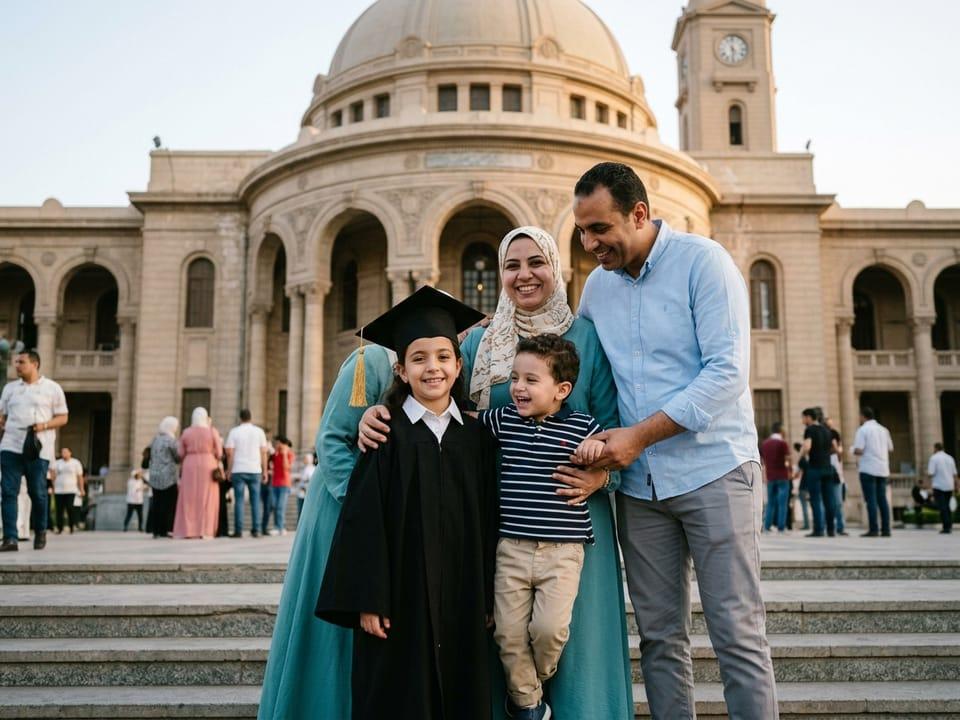
Graduation Day in Egypt's Summer Heat: Guest Limits, Crowded Gates and One Good Family Photo
pokesta Editorial Team · Updated November 4, 2026
Many graduation ceremonies in Egypt fall in June and July, when Cairo's average daily high is about 35°C. Families who come home with a good photo have usually settled two things in advance: where the family picture will be taken, in one shaded spot, and when, either before going in or straight after the ceremony. Guest tickets are often limited and not handed out on the day, so check the rules weeks ahead, especially if grandparents or young children want to come.
Guest tickets and entry rules belong to each university
Every university, and sometimes every faculty, runs its own ceremony with its own rules, so the registrar or faculty office is the place to ask. The American University in Cairo (AUC) is a useful example because it publishes the details. Its June 2026 bachelor's ceremony was held on Saturday 13 June from 7:30 to 9:30 pm at the campus stadium in New Cairo, after a compulsory rehearsal; graduates who skip the rehearsal are not called on stage.
AUC's FAQ for its 2019 ceremony shows the kind of rules to look for. Tickets were not distributed on the day of commencement, and nobody could collect tickets on someone else's behalf. Children under 7 were not admitted, and older children needed a ticket of their own. The stadium gate opened at 6 pm for a 7:30 pm start, and no food or drink except water was allowed in the seating area. Rules change from year to year, but if your family includes a four-year-old, or more relatives than tickets, you want to know in May, not at the gate.
The heat: plan around the oldest relatives
At Cairo airport, the 1991–2020 average high is 34.6°C in June and 35.0°C in July, and nights only fall to around 22–24°C. June's record high is above 46°C. An evening ceremony is cooler than a midday one, but queueing at a gate and then sitting in an open stadium is still hard on grandparents.
Give the oldest relatives the shortest walk. Drop them at the gate nearest the venue, look for seats in the shade or close to an exit, and make sure everyone carries water. Loose, light-colored clothes help, and so do a folding fan and a small towel. The graduate's black gown soaks up heat, so carry it until it is needed and put it on in the shade. If a grandparent finds the day too much, a family photo at home the next evening is a perfectly good substitute. If anyone feels dizzy or unwell, get them into the shade, sit them down with water and ask the venue staff for help.
One shaded spot and one time, decided in advance
The usual mistake is trying to photograph the family everywhere: at the gate, in the crowd, by the stage. Pick one place, such as a covered walkway, a row of trees, or the east side of a building, which is in shade through the late afternoon. Then pick one time.
For an evening ceremony in June, the best moment is usually before you go in. Egypt uses daylight saving time from the last Friday of April to the last Thursday of October, so in mid-June the sun sets in Cairo at about 8 pm. Between 6 and 7 pm the light is low and warm, and everyone still looks fresh. After the ceremony it is dark, and you will need a lit wall or the building's entrance lights. For a daytime ceremony, avoid noon and take the photo afterwards in full shade, where nobody has to squint.
Three or four frames are enough: the graduate alone with the diploma or bouquet, the graduate with the parents, and the whole family together. Hold the phone at chest height, and ask a classmate's family to take one with you in it, then return the favor. Charge every phone the night before and bring a power bank, because the batteries run lowest just when the light is best.
When the phones stop connecting
A stadium full of families can slow calls and messages to a crawl. Agree on a meeting point before you split up, something fixed like a numbered gate or a named building, and a time, such as fifteen minutes after the ceremony ends. Send everyone a photo of the meeting point beforehand, and tell children what to do if they can't find you. For older relatives who rarely use their phones, write the meeting point and time on a slip of paper for their pocket.
Your phone, the official photographer or a studio
On the day, the family's own phones capture what matters most: who came, and their faces. Some universities have an official photographer, and AUC tells graduating seniors to contact the university photographer to buy commencement photos. A photographer you hire yourself may not be allowed into the seating area, so ask the venue before paying a deposit. A studio portrait in air conditioning on another day gives you the formal picture for the wall; our comparison of studio, outdoor and phone graduation photos weighs those choices.
Settle the place and time for the family photo first
Everything else on the day can be improvised. If a grandparent stayed home because of the heat, or the ticket limit kept an aunt outside, pokesta can turn phone photos you already have into a graduation family portrait with AI, gown and diploma included, in front of a university hall or on the Nile corniche. It is a generated image, not a picture taken at the ceremony, so keep your own photos as the record of the day. It is $1 per photo and the first one is free: make one with a recent photo of the graduate and see how it looks. Other families share theirs in graduation posts.