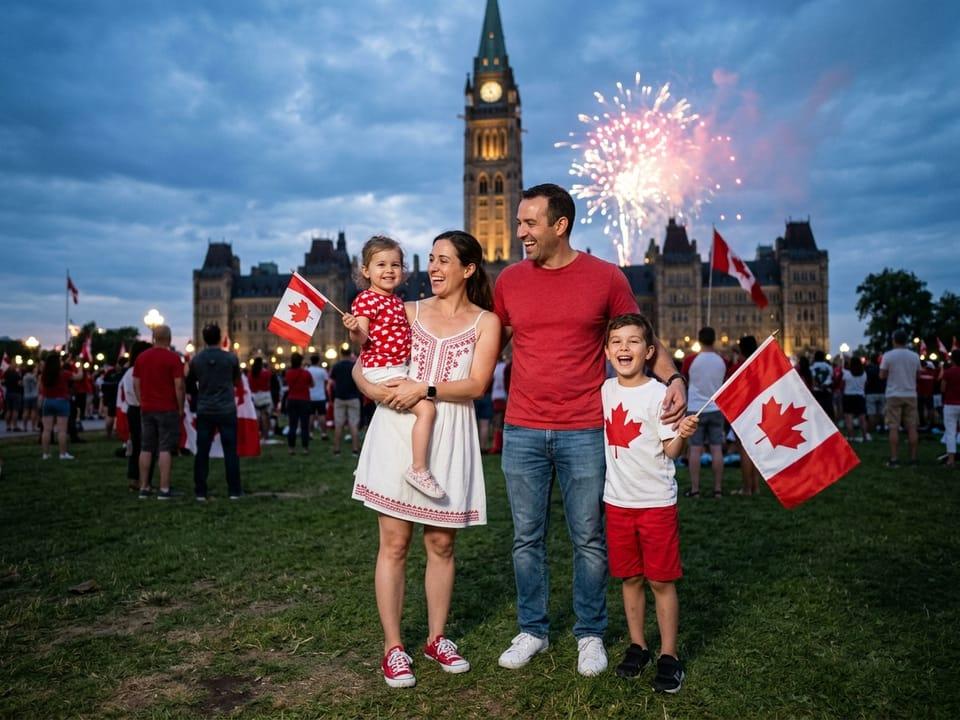
Canada Day fireworks start after dark, and in early July that means late: in Calgary in 2026, the show launched at about 11 p.m. With a baby or toddler, take the family photo in the early evening, then decide before you leave home whether you'll stay for the fireworks, watch from a distance, or watch from home. If you stay, move the nap later, bring ear protection that fits your child, and know your way out of the crowd before it gets dark.
Decide on the fireworks plan before you leave home
Fireworks have been part of Canada Day since 1981, when they were set off in 15 major cities, and the tradition continues today. The start time and launch site change by city and by year, so check your municipality's Canada Day page the week before.
Calgary's 2026 page is a good example of why the details matter. The fireworks launched from Stampede Park, but on-site viewing there wasn't available because of Stampede setup, and the city pointed people to the Max Bell Centre parking lot as the best viewing spot. So check where you're allowed to watch, not just where the fireworks go up.
There are three realistic plans. Staying at the main site gives the full show but the most noise, the biggest crowd and the latest night. Watching from a quieter spot farther away, such as a hill, a parking lot or a friend's balcony, cuts the noise and makes leaving easy. Watching from home, or skipping the show this year, protects bedtime completely. None of them is the wrong choice; the mistake is deciding at 10:45 p.m. with a tired child.
Noise: more distance and ear protection that fits
Health Canada says children are more vulnerable to hearing damage from loud sounds. Its general advice is to use earplugs or earmuffs according to the manufacturer's instructions, and to take breaks or move away from the source of a loud sound. It also gives a simple test: if you, or someone standing a metre away, has to shout to be heard, the environment is too loud.
For a baby or toddler, that points to two things. First, distance: watching from farther back is the easiest way to lower the volume. Second, earmuffs made for your child's age and head size, worn the way the maker describes. Put them on a few times at home in the week before, so the first time isn't in the dark with a crowd around. If your child pulls them off and cries, take that as the answer and move back or head home.
Some cities set aside calmer spaces. In 2026, Calgary listed a quiet, low-sensory rest stop at Prince's Island Park. Look for something similar on your city's map.
Bedtime and crowds: a late nap and a set leaving time
A late afternoon nap is the main thing that makes a 10 or 11 p.m. show possible. Bring pyjamas, a sleep sack or blanket, and whatever your child sleeps with, so they can fall asleep in the stroller or carrier and transfer home. Agree with your partner on a rule before you go, for example "if she's crying for ten minutes, we leave," so nobody has to negotiate in the dark.
Crowds after the show are often harder than the fireworks. Leave a few minutes before the finale if you're near a transit line, or wait twenty minutes until the rush thins out. A carrier is easier than a stroller in a packed crowd. Pick a meeting spot with older children, and put your phone number in a toddler's pocket. Calgary's 2026 page, for one, suggested walking or transit because parking was limited.
The daytime has its own risk. Health Canada says UVB rays are strongest between 11 a.m. and 3 p.m., and advises keeping babies under one year out of direct sunlight. A shaded morning and an indoor rest in the afternoon also help with the late night.
Take the family photo before dark
The fireworks are a poor time for the family photo. It's dark, the children are tired and the flash only lights the back of someone's head. Take the picture in the early evening, when the light is low and warm and everyone is still in good spirits. Our guide to red-and-white Canada Day outfits from your own closet covers what to wear.
Studio, photographer or phone: on July 1, the phone usually wins
A studio portrait in red and white can be booked any day in June, indoors, with no heat, no crowds and no late night. That's a real advantage with a baby, but the picture won't have the day in it. A photographer who meets you in a park on the afternoon of July 1 gets the real setting and puts you in the frame, though you're booking a fixed time on a busy holiday and the weather decides the rest. Ask what happens if it pours or is dangerously hot, and whether the session can move to the evening or another day.
Your own phone is the most flexible. You can shoot at 6 p.m. if the baby slept late, stop when someone cries, and go home without losing a fee. Hiring someone makes the most sense when extended family are gathering that day and you want everyone, including yourself, in a properly lit group photo.
For the fireworks themselves, turn the flash off, rest the phone on something solid and shoot a short video; you can pull a still from it later.
If the fireworks are past bedtime
If your family decides the fireworks can wait a few years, you can still have the picture. pokesta can make a Canada Day family portrait with AI, set under the fireworks or on Parliament Hill, from phone photos each of you already has. It's an image the AI creates, not a photo of the night itself, so it sits alongside your real evening pictures. It's $1 per photo and the first photo is free, so try it with a photo from earlier in the day, and see what other families shared on the Canada Day page.
References