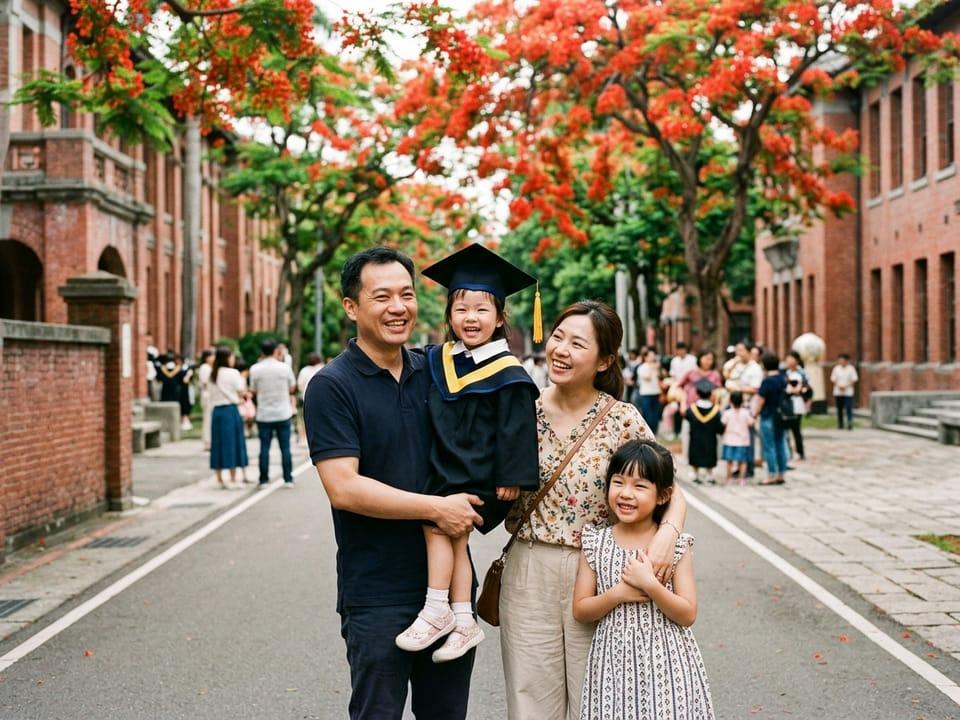
At a kindergarten graduation in Taiwan (幼兒園畢業典禮), the stage photos can usually be left to the photographer the school arranges. What parents are best placed to capture is their child's face while waiting to go up, and a family photo afterwards. If your child cries on stage or won't go up, leave it to the teachers rather than steering them back. Take one family photo in the graduation gown before the ceremony starts. Check the photo rules in advance, and don't post pictures showing other people's children to public social media as they are.
Read the school's notice first: where you can stand, whether you can film
Under Taiwan's regulations on early childhood education and care services, a kindergarten's second semester of classes normally runs from 11 February to 30 June, and graduation is usually held before term ends; your school's notice will confirm the date and format. In the notice or the contact book, look for where parents sit, whether you can stand in the aisles, whether flash is allowed, whether you may film or livestream, and whether the school has hired a photographer. If it doesn't say, ask the teacher. Flashes and adults walking the aisles distract children on stage and block the view from the back, so these rules exist for everyone in the room. Before leaving home, free up storage, charge the phone and bring a power bank; running out of space mid-recording is the most avoidable disappointment of the day.
If your seat is far back, shoot what happens off stage
Zooming in on the stage from the back usually gives you dark, blurry frames. Phone optical zoom has a limit, and beyond it the phone is cropping and enlarging, which looks worse the darker the hall. Rather than fight the distance, shoot what happens off stage: the children looking around as they file in, a profile on a little chair while waiting, the moment your child comes down and searches for you. Those moments are close to your seat, and the light is steadier than on stage.
With two adults, split the jobs: one films, one takes photos. The person filming braces their elbows against their body or a chair back and records from start to finish without zooming in and out. The photographer turns off the flash and shoots when the child pauses. Stage lights brighten and dim faster than auto-exposure can follow; on most phones, a long press on your child's face locks focus and exposure, then a burst gives you frames to choose from later. If grandparents come, seat them by the aisle or near the front and let them simply watch. A familiar face in the audience helps a child on stage more than one more phone.
Tears or a refusal to go up: leave it to the teachers, hug them afterwards
Kindergarteners crying on stage, wanting to run down to their parents, or stopping at the edge and refusing to go up is not unusual. Don't step forward to push your child back up, and don't keep waving from your seat to make them look at the camera. The teachers know the running order and will decide whether to let the child sit to one side, walk them up by the hand, or hand over the certificate later. Your part is to nod and smile when your child looks your way.
The night before, tell your child what will happen: lots of people, bright lights, going up for a certificate, then coming back to Mum and Dad. Afterwards, whatever happened on stage, hug them first and tell them they were brave; mention photos later. A child who has been crying needs time, water and a snack before you ask for a smile.
One family photo before the ceremony, more afterwards
The easiest time to get good expressions is before the ceremony, when the gown has just gone on and nerves and waiting haven't worn your child down. Take one family photo by the classroom door or in front of the decorations. If spirits are still good afterwards, do a second round with the grandparents. If the gown is on loan from the school, check when it goes back and finish before then. A child who doesn't want to face the camera can be photographed from the side or behind, holding the certificate and walking hand in hand with a parent; that is how the day looked too.
|
School's photographer |
Your own photographer |
Family on phones |
| Captures |
Stage, whole class, classroom |
Close family shots |
Family and child |
| Cost |
Per the school's order form |
Photographer's quote |
Almost free |
| If your child cries |
Shoot goes ahead |
Can wait for calm |
Can wait or redo another day |
| Check |
Whether ordering is optional |
Whether outside photographers are allowed |
Light and positions in advance |
Hiring your own photographer suits a large family that wants someone focused on the group, but always confirm first that the school lets outside photographers in. For whether to buy the school's photos, see is the kindergarten photo package worth buying.
Don't post other children's faces as they are
Ceremony photos inevitably include other children. Article 51 of Taiwan's Personal Data Protection Act says the act does not apply when an individual collects, processes or uses personal data purely for personal or household activities, but a public social media post goes beyond the family. In practice, the school's rules and other parents' wishes matter more. Crop or blur other children's faces before sharing, or share only in a small family group. Our guide to sharing children's photos with family on LINE covers how.
If the ceremony didn't give you the photo you wanted
If your child cried through the ceremony, or the grandparents couldn't come, and you still want one picture of the whole family around your child in a gown, pokesta can make a graduation family portrait with AI from the phone photos each of you has, at $1 per photo with the first photo free. It is a created keepsake, not a record of the ceremony. Start with a recent photo where your child is smiling and make the first one free, then decide whether you want more.
References