
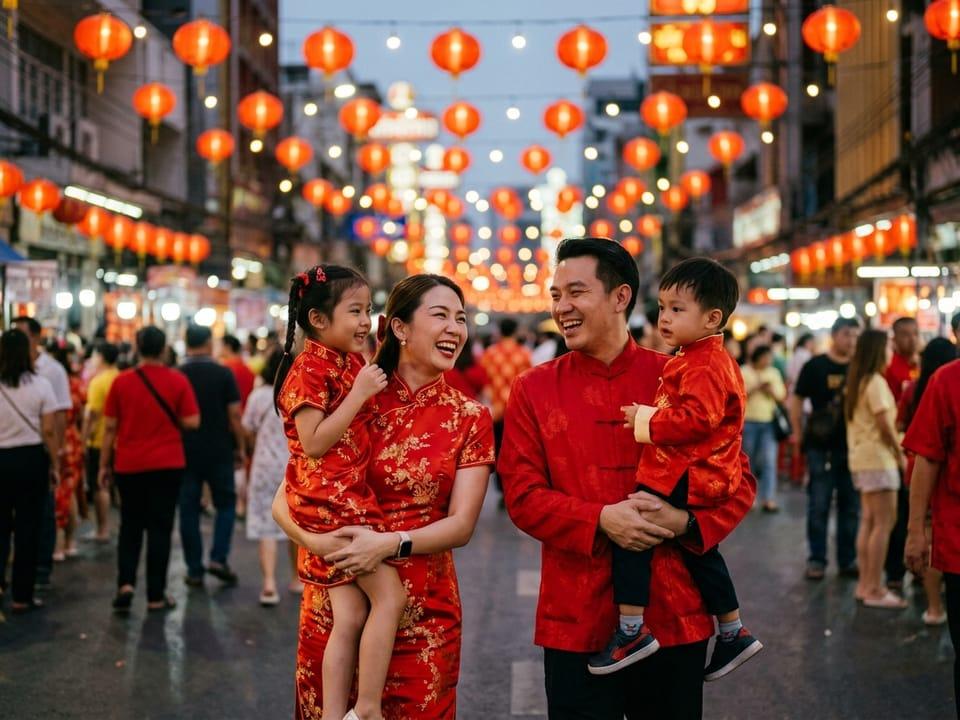
In 2027, Chinese New Year falls on Saturday 6 February. For Thai-Chinese families that makes Thursday 4 February wan chai (วันจ่าย, the shopping day), Friday 5 February wan wai (วันไหว้, the worship day) and Saturday 6 February wan tiao (วันเที่ยว, the visiting day). With a baby, plan a single family photo on wan wai, after the ancestor offering and before the meal, and protect the baby's nap before it. A baby who is wary of relatives can stay in a parent's arms for the picture.
Wan chai, wan wai, wan tiao: three days with different jobs
Wan chai is for buying what the offerings need: dishes the ancestors liked, auspicious savoury food, sweets and fruit. Wan wai is the busiest day at home. In many households it starts early in the morning with offerings to the deities, including the guardian spirits of the house. The ancestors are honoured in the late morning, finished before noon, and in the afternoon there is an offering for wandering spirits who have no family of their own. Late that night some families also make an offering to Choi Sing Ye (ไฉ่ซิงเอี๊ย), the god of wealth.
Wan tiao is New Year's Day itself. People put on new, brightly coloured clothes, red above all, and go to pay respects to their elders. Visitors bring oranges, elders hand out red envelopes (อั่งเปา, ang pao), and there is a list of things to avoid on the day, including arguing, cleaning the house and crying.
The details vary. Families of Teochew, Hokkien, Hakka, Hainanese or Cantonese origin keep their own versions, and so does each household, so ask the eldest person in the house how they do it rather than relying on a general guide. The dates move every year with the Chinese lunar calendar; in 2026, wan tiao fell on 17 February.
Take the group photo after the ancestors, before anyone eats
The late morning of wan wai is often the one time nearly everyone is at home, dressed, and not yet full. Once the ancestor offering is finished, the table is still laid and the elders are in good spirits. Ask them first whether they're comfortable having the altar or the offerings in the picture. Some families are glad to include them; others would rather keep the camera away from the altar. Either way, don't move offerings to tidy up the frame.
For the four-generation photo, seat the great-grandparents on chairs in the middle, put the grandparents behind or beside them, and have the parent holding the baby sit right next to the eldest. Use burst mode and keep it to a few minutes. Older relatives tire, and a baby's patience runs out faster.
Then work backwards from that moment. If the photo is planned for around 11:30, a nap that ends at 11:00 and a feed straight afterwards will give you the calmest twenty minutes of the day. A quiet bedroom away from the incense and the kitchen helps. On wan tiao, keep visits short and fit the car journeys around naps; that day is for greetings, not another group shot.