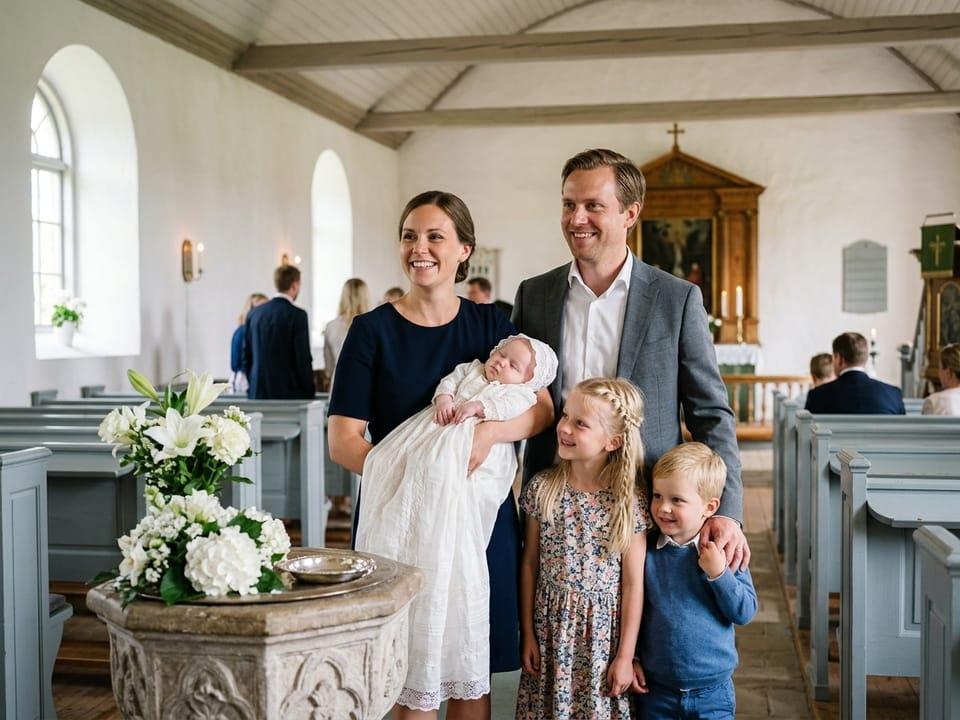
A crying baby at a Swedish christening (dop) is so ordinary that parishes answer the question on their own pages. Svenska kyrkan in Falun tells parents not to worry, says priests are used to children reacting in different ways, and adds that a short pause is completely fine. A baptism service takes about 30 minutes, and the moment with the water lasts only seconds. Plan for a few record shots during the service and take the calm family photos at the font straight afterwards.
The water takes seconds, the service about half an hour
It helps to know exactly when the baby needs to cooperate. Svenska kyrkan's order for a baptism service opens with bells, music and a hymn, then a prayer of thanksgiving in which the priest asks the child's name. Bible readings, a short sermon and music follow. Water is poured into the font, and that can be done by the priest, a parent, a godparent or an older sibling. The congregation says the creed together.
Then comes the baptism itself: the priest pours water over the child's head three times while saying the name and the words "in the name of the Father and of the Son and of the Holy Spirit". The child is welcomed into the church, the baptismal candle (dopljus) is lit and the certificate handed over. Prayers, the Lord's Prayer, a blessing and a final hymn close the service. The Härnösand parishes put the whole thing at about 30 minutes, longer if the baptism is part of an ordinary Sunday service.
So the moments people want on camera are three: water going into the font, the baptism and the lit candle. For the rest, the baby can be asleep on a shoulder, walked at the back or feeding in a pew.
Why babies cry in church, and what helps on the spot
1177, the Swedish public healthcare guide, lists the usual reasons small babies cry: they are hungry or thirsty, tired and wound up at the same time, or overstimulated by too many impressions. A church full of relatives offers all three: a new place, people taking turns to hold the baby, an organ, and a timetable that rarely matches the feeding rhythm.
The same 1177 page suggests holding the baby close, dimming light and sound, rocking or walking, and moving to a quieter room if the baby seems overloaded. In practice that means deciding in advance who holds the baby during the service (Falun parish notes that parents and godparents often do), sitting near an aisle so you can slip out, and packing whatever usually works: a dummy, a bottle, the sling. If you need to step away for a minute, that is the pause the parishes say is fine.
A baby who sleeps through the whole thing is not a problem either. A white gown and closed eyes in a parent's arms make a gentle picture, and the water may wake them anyway.
Pick the time around the last feed, then ask about photos at the dopsamtal
Parishes offer set baptism times, and the Härnösand parishes, for example, hold several on Saturdays that are not public holidays. When you book, choose a slot that lets you feed the baby just before leaving home, or in a side room at church, and that falls in a stretch when your baby is usually awake and content. Härnösand says most children baptised there are three to five months old, an age when routines are only just forming, so leave margin rather than planning to the minute.
After you book, the priest contacts you for the baptism conversation (dopsamtal). Bring your photo questions to that meeting, because the answers differ between parishes. Genarp parish does not recommend photographing during the service itself, says photos are usually taken on the way in, on the way out and after the service, and asks guests to use as little flash as possible and to turn off the shutter sound. Falun parish asks families to talk it through with the priest and suggests gathering for photos once the service is over. Ask where a photographer may stand, whether flash is allowed and whether you can stay at the font for ten minutes afterwards.
Photographer, relative or studio: which copes best with a fussy baby
|
Photographer at church |
Relative with a phone |
Studio session another day |
| If the baby cries |
Waits for the calm moment |
Waits too, but is also a guest |
Can stop for a feed and restart |
| If the baby is ill that week |
The baptism date rarely moves |
Nothing to rebook |
Depends on the studio's terms |
| Dim church, little flash |
What they are hired for |
Hit and miss |
Not applicable |
| Group photo afterwards |
Organised quickly |
Needs a plan |
Not practical |
A photographer earns the fee in a dark church where flash is discouraged and when you want the font moments sharp. A relative can cover a service where photos during the ceremony are not allowed anyway, as long as they have a short list. A studio session a few weeks later is the gentlest way to get an unhurried portrait in the gown, and the easiest to move if the baby has a cold. For the full comparison, see christening photographer or a relative with a phone.
Keep the service for the memory, and the font for the photos
The most reliable plan is to accept that the service will give you a handful of record frames, and to keep ten minutes at the font once the congregation has left. Feed or settle the baby first, then photograph the parents with the baby, siblings, godparents, grandparents and finally everyone together. If the baby falls asleep halfway, photograph that too.
If the pictures still don't turn out, or half the family could not travel, pokesta can turn phone photos you already have into a christening family portrait with AI. It costs $1 per photo and the first photo is free. The result is a generated image, not a record of the day, so it sits alongside the real photos rather than replacing them. Try one free with a recent photo of your baby, and see how other families celebrated their dop.
References